

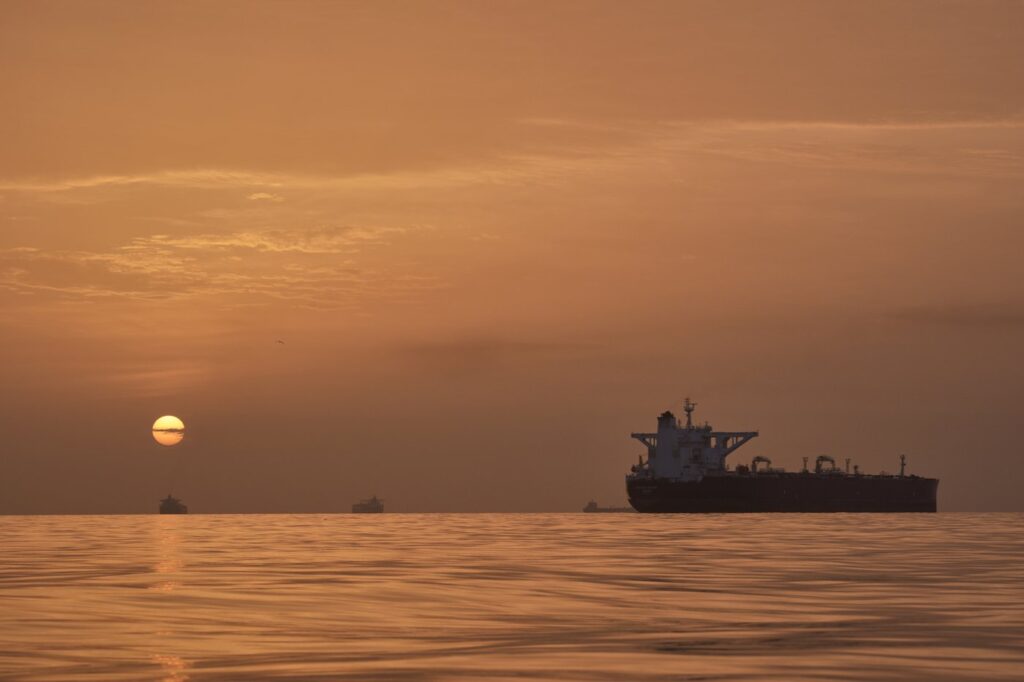
CAIRO - Iran has reaffirmed its commitment to impose restrictions on ships passing through the Strait of Hormuz, as tensions escalate over the U.S. blockade of Iranian ports. Iranian parliamentary Speaker Mohammed Bagher Qalibaf stated in a televised interview that Tehran would continue to threaten commercial vessels traversing this vital waterway. This announcement follows a recent incident where Iran fired on ships attempting to pass, signaling a robust stance in the ongoing conflict.
Qalibaf emphasized that "it is impossible for others to pass through the Strait of Hormuz while we cannot," highlighting Iran's resolve as it engages in negotiations with the United States. The Iranian navy has issued warnings to vessels, noting that approximately one-fifth of the world's oil passes through this strategic chokepoint. Following a brief increase in transit attempts, vessels in the Persian Gulf have remained stationary, demonstrating caution after incidents in which two India-flagged ships were fired upon mid-transit.
This situation has reverted the strait to its pre-ceasefire status, intensifying the global energy crisis while posing risks of renewed conflict as the war approaches its eighth week. The fragile ceasefire between the U.S. and Iran is set to expire by Wednesday. On Saturday, Iran indicated it had received new proposals from the U.S., and Pakistani mediators are working to facilitate another round of direct negotiations.
The closure of the Strait of Hormuz by Iran has emerged as a potent weapon, undermining the global economy and exerting political pressure on U.S. President Donald Trump. The blockade is intended to cripple Iran's weakened economy by hindering its access to long-term cash flow, and tensions have heightened with reports of at least 3,000 casualties in Iran, over 2,290 in Lebanon, 23 in Israel, and several more in Gulf Arab states. Additionally, 13 U.S. service members have lost their lives as a result of the ongoing hostilities.
Iran has previously announced the reopening of the strait to commercial vessels following a 10-day truce between Israel and Hezbollah, an Iranian-backed militant group in Lebanon. However, after Trump's assurances that the U.S. blockade would remain in effect until a deal is reached, Iran decided to continue its restrictions on maritime traffic through the strait.
Recent reports have indicated that Revolutionary Guard gunboats targeted a tanker and a projectile struck a container vessel, causing damage to some of the containers. In light of these developments, India's Foreign Ministry has summoned Iran's ambassador, expressing concern over the "serious incident" involving its flagged ships, especially after Iran had previously allowed several vessels headed to India to pass through.
Iranian Deputy Foreign Minister Saeed Khatibzadeh criticized the U.S., arguing that they "are risking the international community, risking the global economy through these, I can say, miscalculations." He warned that the U.S. is jeopardizing the entire ceasefire arrangement and reiterated Iran's commitment to refuse any conditional and limited reopening of the strait.
The Iranian Supreme National Security Council reaffirmed its stance, asserting that Iran would maintain oversight and control over maritime traffic through the strait until the conclusion of hostilities. This includes establishing Iran-designated routes, the collection of fees, and issuing transit certificates.
The renewed standoff coincided with statements from Pakistani Foreign Minister Ishaq Dar, who noted that Pakistan is striving to bridge differences between the U.S. and Iran. Pakistan is reportedly preparing to host a second round of negotiations in the coming week. In a related development, the Iranian Supreme National Security Council acknowledged receiving "new proposals" from the U.S. but indicated that Iran was not yet prepared for direct negotiations due to the perceived "maximalist position" of the Americans.
Khatibzadeh emphasized the unacceptability of handing over Iran's stock of 970 pounds (440 kilograms) of enriched uranium to the U.S., labeling the notion as "a nonstarter," yet mentioned Iran's readiness to address any concerns regarding its nuclear capabilities. Trump commented that Iran "got a little cute," but maintained that "very good" conversations were underway, suggesting that more updates could follow.








