

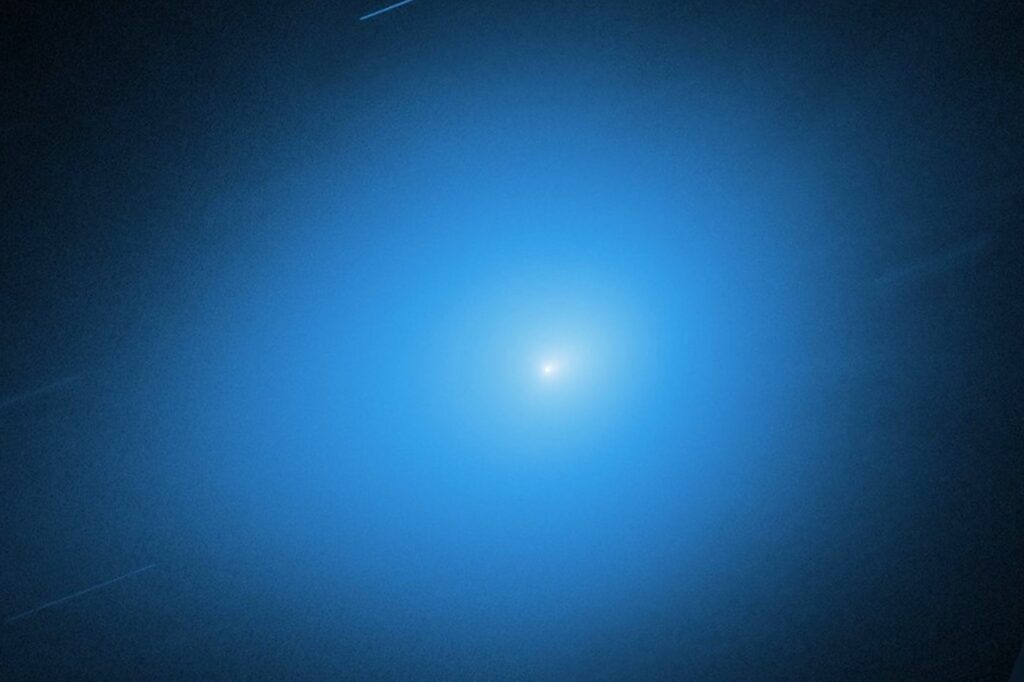
CAPE CANAVERAL, Fla. (AP) The comet known as Comet 3I/Atlas, which made a notable pass by Earth last year, has sparked considerable interest among astronomers regarding its origins and characteristics. Recent reports indicate that this comet likely hails from a cold, secluded region of the galaxy that has not yet developed into a solar system of its own. This finding was announced by a team of researchers on Thursday.
Comet 3I/Atlas is distinguished as only the third confirmed interstellar visitor to our solar system, and it may be the oldest among them. Scientists speculate that it could be as much as 11 billion years old, which is more than twice the age of our sun. This revelation attempts to shed light on the evolving understanding of interstellar objects and their implications for cosmic history.
A team from the University of Michigan utilized the Atacama Large Millimeter/submillimeter Array (ALMA) observatory in Chile to conduct analyses of the comet last fall. Discovered in the summer of 2022, the comet provided ample opportunities for NASA and the European Space Agency to direct multiple space telescopes toward it as it approached Mars in October 2022 and reached its closest point to Earth in December 2022. Having now exited our solar system post its approach, the comet is currently beyond Jupiter and remains observable only to professional astronomers.
In their study, the researchers reported an unexpected abundance of deuterium, or heavy hydrogen, found in the water of Comet 3I/Atlas. This significant finding suggests that the comet originated from a much colder environment, presumably before the formation of our solar system. Teresa Paneque-Carreno, one of the researchers at the University of Michigan, noted that while our sun formed in conjunction with other emerging stars, the comet's original star might have been more isolated. Such an environment could lead to cooler temperatures and less thermal alteration of materials.
Despite the intriguing findings, the exact origin of the comet remains a mystery. Observations made by the Hubble Space Telescope estimate that the comet's nucleus measures between a quarter-mile and 3.5 miles (approximately 440 meters to 5.6 kilometers) in diameter. The comet is currently racing away from the sun at a staggering speed of 137,000 miles per hour (220,000 kilometers per hour).
As scientists strive to piece together these observations, they aim to gain insights into the planet-forming conditions and cosmic environments that prevailed during the early epochs of the universe. This context is crucial for understanding not only the formation of our solar system but also the broader dynamics of other potential solar systems across the galaxy.
Noteworthy is that Comet 3I/Atlas follows the first known interstellar object, 'Oumuamua, which was spotted by a telescope in Hawaii in 2017. Another interstellar visitor, Comet 2I/Borisov, was discovered in 2019, named after the amateur astronomer who identified it.
As research continues regarding interstellar bodies like Comet 3I/Atlas, scientists hope to deepen our understanding of the cosmos and the processes that shaped it. The ongoing study of such objects provides a unique opportunity to explore theories of galactic evolution and the potential for life elsewhere in the universe.








