

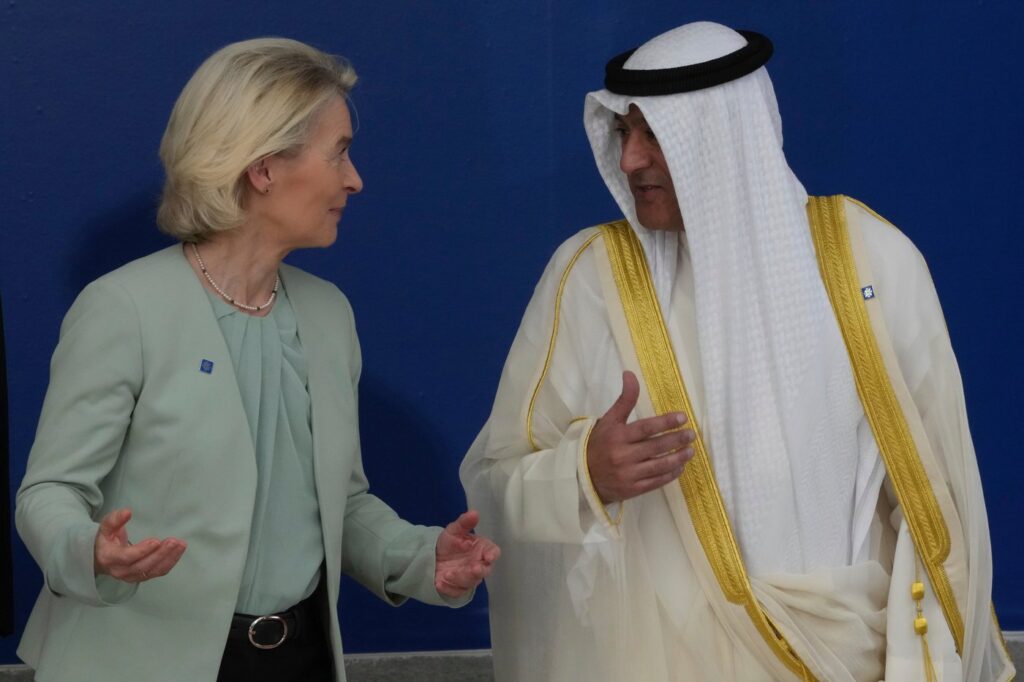
NICOSIA, Cyprus (AP) — A critical fuel shortage and surging oil and gas prices, exacerbated by the ongoing war in Iran, have prompted the European Union to intensively consider funding alternative energy routes in the Middle East. This initiative aims to bypass geopolitical hotspots, particularly the strategic Strait of Hormuz, which is vital for global oil transport.
On Friday, European Commission President Ursula von der Leyen expressed the EU's readiness to collaborate with Persian Gulf countries on new energy projects that would not be adversely affected by war or political instability. "The events of the past month have taught us a hard lesson," von der Leyen remarked at a press conference following an informal meeting of EU leaders in Cyprus's capital. She emphasized that the security of the EU is interconnected, asserting that threats to maritime routes, such as that in the Strait of Hormuz, also pose risks to industries in European countries, such as Belgium.
The EU's executive body has called for strengthening defense collaborations and has endorsed the bloc's maritime security mission in the Red Sea as a potential naval security option in the Persian Gulf. However, von der Leyen's public statements largely revolved around the EU's support for the repair and construction of energy infrastructure in the Middle East.
Von der Leyen stated, "We are also ready to team up with the Gulf countries to diversify export infrastructure away from solely the bottleneck of the Hormuz Strait," additionally offering assistance for repairing Gulf energy infrastructures that have suffered damage due to the war. It is noteworthy that approximately one-fifth of the world’s oil and gas typically transits through the Strait of Hormuz, although the ongoing conflict has severely restricted access to this critical waterway, leading to a spike in fuel prices.
As of early Friday, Brent crude prices had risen by 98 cents to reach $100.33 a barrel, while the U.S. benchmark crude had increased by 81 cents to $96.66 per barrel. Von der Leyen noted that the EU's energy bill had surged by €25 billion ($29.3 billion) over the past 43 days due to the rise in oil and gas prices.
Neither von der Leyen nor European Council President Antonio Costa provided specific details regarding which alternative energy projects are under consideration or when they might commence. However, von der Leyen did reference the India-Middle-East-Europe Economic Corridor as a significant initiative linking the EU with India, the world's largest democracy.
A summit between the EU and the Gulf Cooperation Council (GCC) is scheduled for later this year, providing both parties an opportunity to further explore these energy projects. Cyprus currently holds the rotating presidency of the EU and is strategically located near conflict zones, including Lebanon, Syria, Israel, and Turkey. Cypriot President Nikos Christodoulides has been advocating for stronger economic ties and security support between the EU and Middle Eastern nations.
This initiative was underscored during the EU leaders' informal summit by the presence of notable figures such as Syrian President Ahmad al-Sharaa, Egyptian President Abdel-Fattah El Sissi, Lebanese President Joseph Aoun, Jordan’s Crown Prince Hussein, and GCC Secretary-General Jasem Mohamed AlBudaiwi. Al-Sharaa emphasized the mutual dependency between Europe and Syria, while President Aoun called for European support to help rebuild Lebanon, which has been devastated by conflict.
President Costa acknowledged Aoun's efforts to restrict Hezbollah's military operations, stating that the group represents "an existential threat" to Lebanon. He reinforced the EU's commitment to being part of a solution rather than being part of the ongoing conflict, remarking, "The European Union is not part of the conflict, but we will be part of this solution."
In contrast, human rights organizations criticized EU leaders for not taking a stronger stance against Israel’s military activities in the region. Additionally, EU leaders, including German Chancellor Friedrich Merz, indicated that sanctions on Iran would remain until a comprehensive resolution is reached concerning various issues, including Iran's missile program and its support for various regional proxies.
Cyprus has experienced direct repercussions from the war, marked by an attack on March 2, when a Shahed drone launched from Lebanon damaged a British military base on the island. This attack resulted in the deployment of warships from Greece, France, Italy, Spain, and the Netherlands to bolster the island's defenses against drone threats.
This situation has reignited discussions concerning a clause in the EU's foundational treaties which could facilitate mutual defense assistance among member states under attack. President Christodoulides noted that EU leaders have agreed to parameterize mutual defense arrangements to ensure reliability, moving away from "ad hoc arrangements."








