

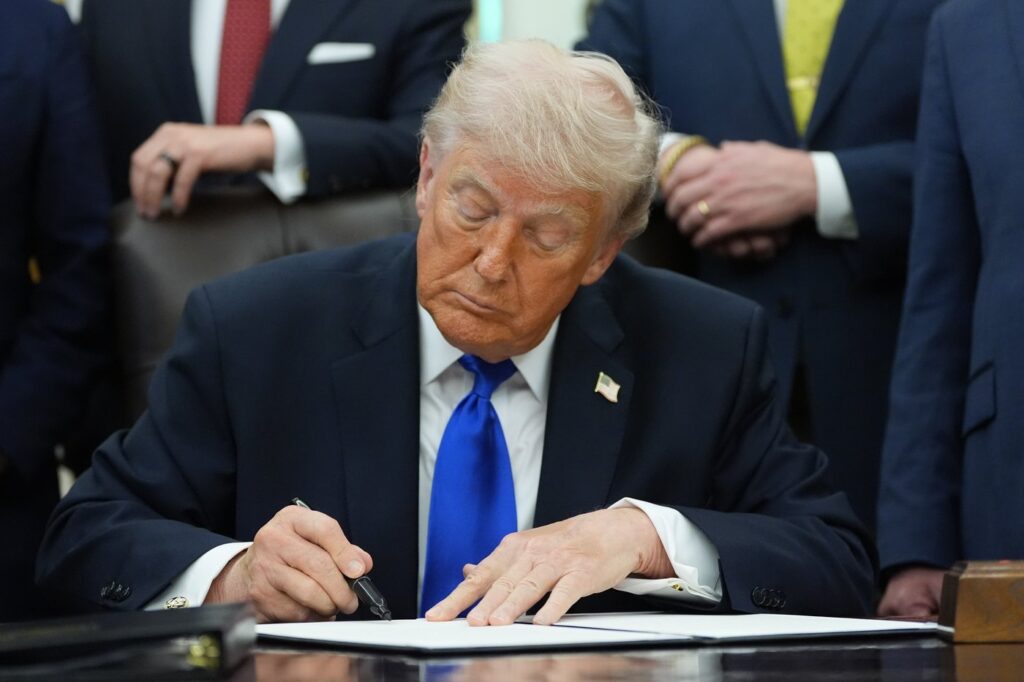
On Friday, President Donald Trump announced plans to increase tariffs on cars and trucks imported from the European Union (EU) to 25%, a decision anticipated to significantly impact the global economy during a precarious phase. Trump's declaration came via social media, in which he accused the EU of "not complying with our fully agreed to Trade Deal," although he did not provide specific details regarding his objections.
This development follows the trade deal agreement between Trump and European Commission President Ursula von der Leyen in July 2023, which had established a tariff ceiling of 15% on most goods. However, a recent Supreme Court ruling invalidated the Trump administration's legal authority to implement these tariffs, leaving Trump searching for alternative legal grounds. Consequently, his administration has resorted to imposing a 10% tax while investigating trade imbalances and national security issues to establish new tariffs, aiming to compensate for lost revenue.
The timing of these tariffs is particularly challenging, as the ongoing Iran war has exacerbated global economic turmoil, causing expectations of slower growth and elevated inflation rates. The conflict has led to increased oil and natural gas prices due to the effective blockade of the critical Strait of Hormuz, following U.S. and Israeli military actions that commenced at the end of February 2026.
Domestically, Trump is under mounting political pressure as the midterm elections approach in November, largely due to rising inflation levels. He returned to the presidency last year on the pledge to quickly address price surges resulting from the government's pandemic response; however, higher energy costs have propelled annual inflation to 3.3% as of March, surpassing the levels he initially inherited.
A recent poll conducted by The Associated Press-NORC Center for Public Affairs revealed that only 30% of U.S. adults approve of Trump's economic management. Despite these challenges, both the United States and the EU have reiterated their commitment to the trade framework known as the Turnberry Agreement, named after Trump’s golf course in Scotland.
The integrity of the 2025 trade deal now faces uncertainty after the Supreme Court's ruling on tariffs, casting doubt on Trump's ability to declare an economic emergency. The new tariffs the administration is exploring might jeopardize compliance with the EU agreement. However, European Commissioner for Trade and Economic Security, Maroš Šefčovič, assured reporters last week that the U.S.-EU relationship has improved significantly over the past year.
The EU had previously expected that this bilateral deal would protect European automakers, potentially saving them between 500 million to 600 million euros (approximately $585 million to $700 million) monthly. According to Eurostat, the value of goods and services traded between the EU and the U.S. reached 1.7 trillion euros (around $2 trillion) in 2024, translating to an average of 4.6 billion euros daily.
The European Commission emphasized in February that a deal is a deal, urging the U.S., as the EU's largest trading partner, to uphold its commitments laid out in the Joint Statement. They reaffirmed that EU products should continue to benefit from the most competitive treatment and insisted that no further tariff increases should exceed the previously established comprehensive ceiling.
As developments continue to unfold regarding international trade and domestic economic pressures, the ramifications of Trump's tariff hike on vehicles from the EU could lead to heightened tensions in trade relations and further economic instability.








