

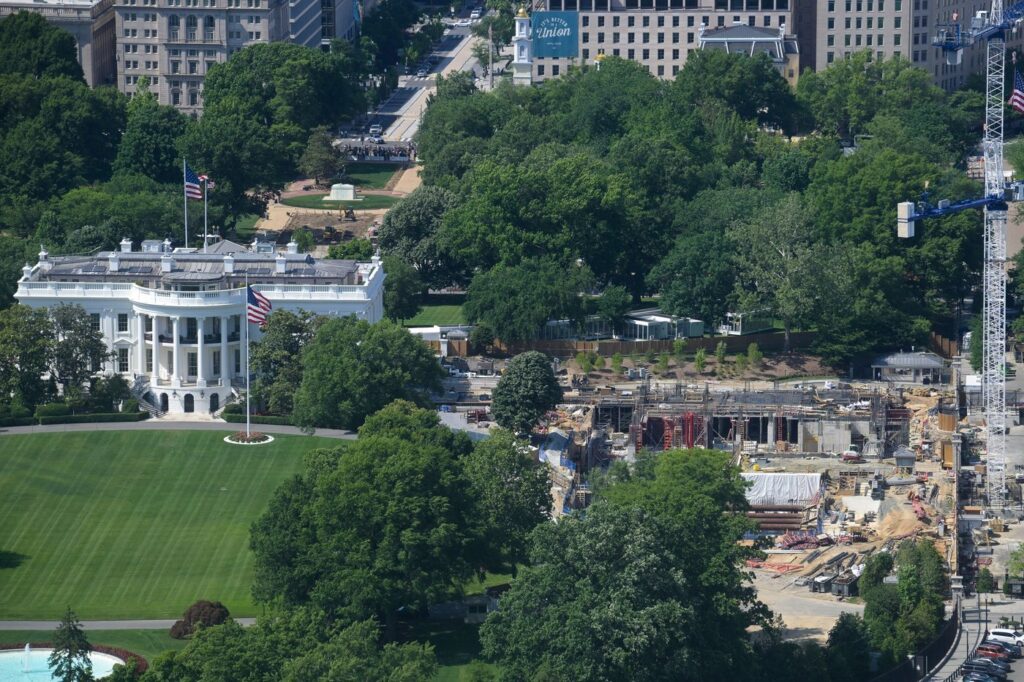
WASHINGTON (AP) — A proposal aimed at securing $1 billion for security enhancements on the White House campus, including funding for President Donald Trump’s new ballroom, has been deemed inconsistent with procedural rules by the Senate parliamentarian. This ruling presents a setback for Republican efforts to incorporate the funding into a bill designed to finance immigration enforcement agencies for the next three years.
The parliamentarian's decision, communicated late Saturday by Senate Democrats, indicated that the expansive nature of President Trump’s vast East Wing renovation made it too broad a topic to be appended to the narrower GOP budget bill. This budget bill can be passed with a simple majority without the possibility of a filibuster.
It remains uncertain whether Republicans can salvage any portion of the proposed billion-dollar Secret Service funding, which is earmarked not only for the ballroom but also for various security measures across the White House. This includes the construction of a new visitor screening center, enhanced agent training, and additional security reinforcements for large events. In response to the ruling, Republicans announced late Saturday that they are restructuring the legislation based on the parliamentarian’s guidance.
Ryan Wrasse, spokesman for Senate Majority Leader John Thune, clarified on the social media platform X that this procedural complexity is typical during the intricate budget process that Republicans are using to push through funding for immigration enforcement alongside the White House security enhancements. Wrasse emphasized the process, stating, “Redraft. Refine. Resubmit.”
Democrats have seized the opportunity to criticize the security request, arguing that it misappropriates federal funds that could be better spent on addressing issues affecting ordinary Americans, such as rising costs. Republicans have countered that private donations will primarily fund the ballroom, and that federal resources are solely directed toward essential security upgrades.
Senate Minority Leader Chuck Schumer, D-N.Y., claimed credit for the parliamentarian's ruling, spotlighting Democrats' successful argument that the requested funding belongs outside the bill in question. Schumer stated, “Republicans tried to make taxpayers foot the bill for Trump’s billion-dollar ballroom," highlighting that Senate Democrats were prepared to continue their opposition as Republicans sought to revise the proposal.
The parliamentarian’s ruling serves as an advisory, but similar rulings are typically respected when lawmakers aim to package legislation for simple majority approval. Most legislative proposals face a filibuster and therefore require 60 votes to pass, compelling Republicans to seek some Democratic support in the current 53-47 Senate configuration.
The $1 billion for White House security enhancements is part of a larger immigration bill that Republicans are striving to pass. This package intends to allocate approximately $72 billion for Immigration and Customs Enforcement (ICE) and Customs and Border Protection (CBP) until the conclusion of Trump’s term, amidst months of resistance from Democrats to provide this funding.
Included in the package is the requested funding for White House security upgrades, as a response to a recent assassination attempt on Trump during the White House Correspondents' Association dinner last month. This budget plan further supports Trump's measures on immigration and deportation, facilitating operations through September 2029, following last year’s substantial funding allocated in a major tax break bill signed into law.
Although the parliamentarian upheld most of the immigration-related provisions within the legislation, a few minor components, like CBP funding for hiring and training new Border Patrol agents, were disallowed. Republicans maintained that these exclusions were merely technical corrections.
Oregon’s Senator Jeff Merkley, who leads the Democrats on the Senate Budget Committee, affirmed that they are ready to contest any amendments to the bill, asserting that Americans should not foot the financial burden for "Trump’s Louis XIV-style ballroom" while allocating vast sums to what he termed “two lawless agencies.”








