

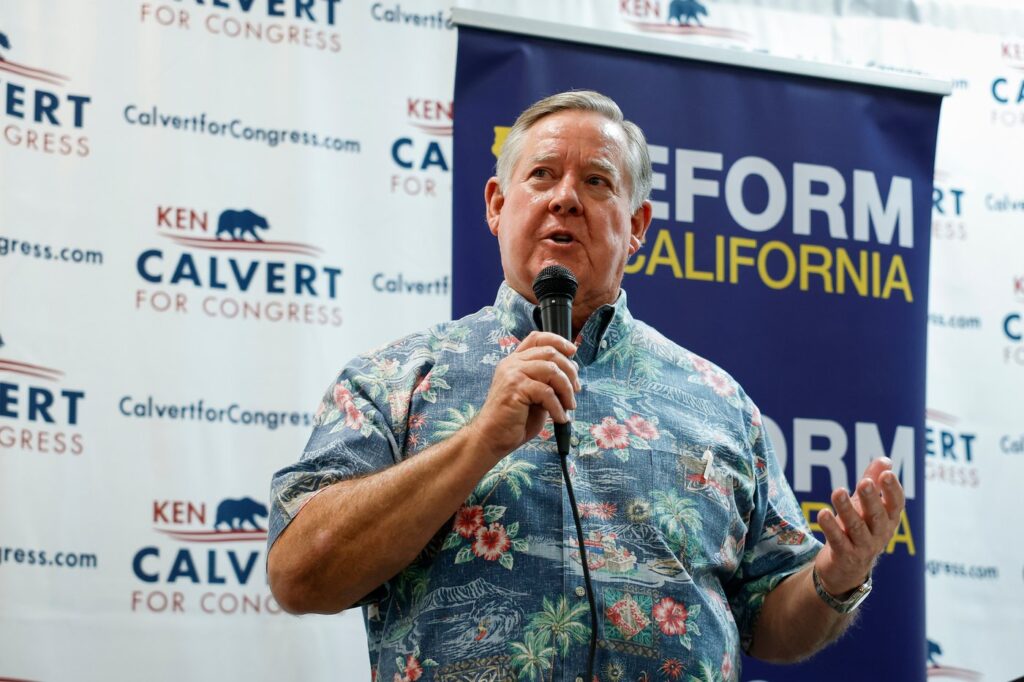
The political landscape in Corona, California, is currently witnessing a fierce U.S. House primary, highlighting a unique scenario for Republicans in a predominantly Democratic state. In a heated contest that began on June 2, 2026, two incumbents, Rep. Ken Calvert and Rep. Young Kim, find themselves competing against each other after being redistricted into the same constituency.
Rep. Ken Calvert, who holds the distinction of being the longest-serving Republican in California's congressional delegation, has launched aggressive advertising campaigns that label Young Kim as a “traitor” to former President Donald Trump, as well as accusing her of being “a liberal and a liar.” These advertisements prominently feature past footage of Kim criticizing Trump, aimed at undermining her credibility among conservative voters.
In response, Kim has pivoted her campaign strategy. After previously promoting her independence from the Trump administration, she now identifies herself as a “Trump Republican.” Her advertisements accuse Calvert of undermining Trump’s agenda and suggest that he has aligned himself with Nancy Pelosi, a formidable figure in Democratic circles and widely opposed by Republicans. This antagonistic tone reflects the escalating stakes in an election neither candidate anticipated.
The primary race emerges from a recent congressional redistricting effort spearheaded by California Governor Gavin Newsom, which aims to secure additional seats for Democrats by reshaping the electoral map. This Republican-versus-Republican contest is notable, as it is one of the few remaining conservative districts amidst California's liberal tendencies.
Nationally, the significance of the race increases, as Calvert and Kim are the only Republican incumbents facing off against each other in 2026. This contest encapsulates broader Republican sentiments, despite Trump’s popularity waning due to various national challenges such as the ongoing war in Iran and rising consumer prices. Democrats nationwide are buoyed by recent election outcomes leading into midterms traditionally favoring the opposition party, whilst Trump continues to exert influence by supporting candidates who align closely with his agenda.
At a recent barbecue event in Corona, local Trump supporters expressed their indecision amidst a barrage of negative ads. Many voters are vocal about their disdain for “RINOs,” or “Republicans in name only,” showcasing the strong desire for candidates who closely align with Trump’s ideologies.
The primary is not just significant for Calvert and Kim; it reflects a wider national trend of redistricting whereby states are reconfiguring partisan advantages following a U.S. Supreme Court ruling that lessens the protections of the Voting Rights Act. In California, fresh maps have led to instability within Republican ranks, prompting long-serving GOP members to retire or shift to independent status to navigate new electoral challenges.
Potential outcomes from the primary are intriguing, as California allows the top two vote-getters to advance to the general election regardless of party affiliation. With a Republican voter registration lead in their district, it is possible for Calvert and Kim to face each other again in the November elections, raising critical questions about how Democrats and moderate voters will influence the outcome.
The contest is shaped by a historical context where Orange County, once a Republican stronghold, has shifted significantly toward Democratic leadership. Both candidates are heavily leaning on Trump for support, with strategists noting that if they progress past the primary, they must navigate a diverse electorate comprised of Democratic and non-conservative voters.
This primary is just a taste of the potential tumult awaiting in November, as both candidates trade sharp criticisms. Voters have received mailers from Kim’s campaign that allege Calvert supports controversial policies, while Calvert counters with claims of Kim's previous disloyalty to Trump. Each attack emphasizes their contrasting electoral records, setting the stage for an aggressive and possibly contentious battle for control of the district.
Initially elected in 1992, Calvert's political legacy is at stake in this redrawn district where his experience is pitted against Kim’s outsider appeal. Both candidates are attempting to solidify their positions within an evolving Republican Party guided by Trump’s doctrines as they gear up for an unpredictable election season.








