

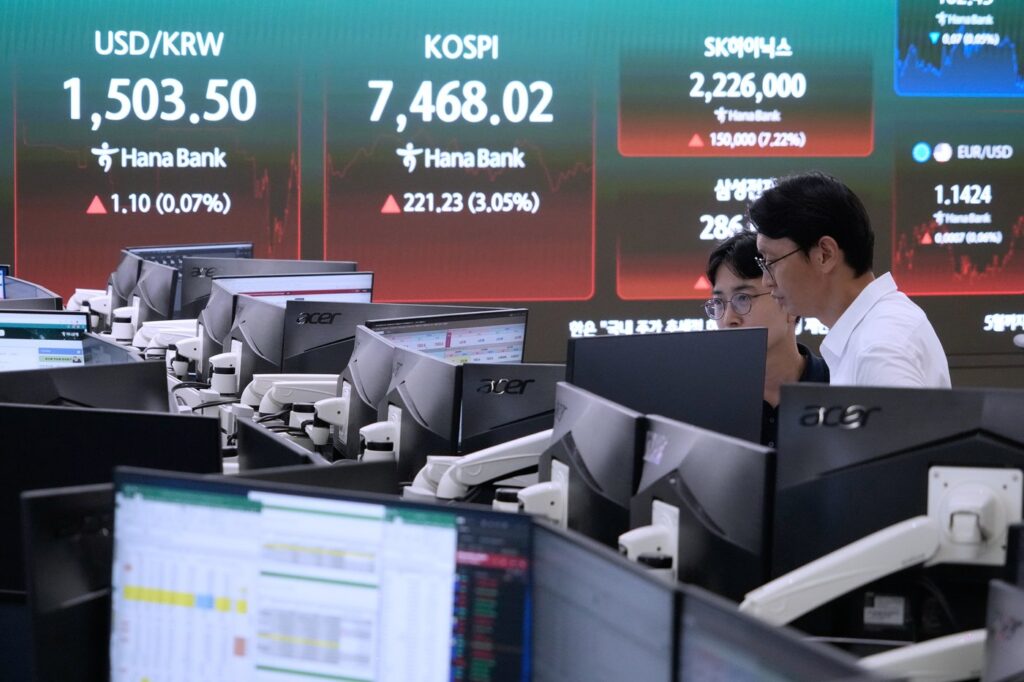
HONG KONG (AP) – Global stock markets were mixed on Thursday, with oil prices declining as tensions escalated in the Middle East. Recent confrontations have occurred between Iran and the United States, leading to a series of attacks that heightened the sense of uncertainty in the region.
The U.S. conducted further airstrikes on Iran, to which Iran retaliated by launching attacks against Bahrain, Kuwait, and Qatar. This escalation comes just a day after U.S. President Donald Trump declared that a temporary ceasefire had ended. The situation has made the prospects for lasting peace tenuous, with high-level discussions aimed at mediating an interim agreement to end the conflict reportedly still ongoing, as shared by an anonymous regional intelligence official.
In early European trading, the market showed varied performance. The FTSE 100 index in Britain decreased by 0.6% to 10,422.75, while France’s CAC 40 managed a small rise of 0.3% to 8,280.05. Germany’s DAX saw a similar uplift, trading 0.3% higher at 24,963.05.
Meanwhile, Japan's Nikkei 225 index rebounded from its earlier losses, climbing by 1.4% to 67,743.85. Notable mention includes chip equipment firm Tokyo Electron, which surged by 5.5%, contrasted by a slight decline of 0.1% in the stock of SoftBank Group, an investment holding company focused on artificial intelligence.
South Korea's Kospi index displayed fluctuations but ultimately closed 0.6% higher at 7,291.91. Samsung Electronics enjoyed a slight gain of 0.2%, while memory chipmaker SK Hynix recorded a significant rise of 5.3%.
In China, the Shanghai Composite index rose by 1.7% to 4,036.59, coinciding with a rise in the country's producer price index, which saw a 4.1% increase in June compared to the previous year. This inflation is partially attributed to the ongoing Iran conflict, according to some economists.
Conversely, the Hang Seng index in Hong Kong fell by 0.7% to 24,030.18. In its trading debut in Hong Kong, shares of Apple supplier Luxshare dropped by 1.6%. However, the Chinese AI company Zhipu, also known as Z.ai, saw a remarkable increase of 11.3% after announcing its intention to raise approximately $4 billion through a share sale.
Australia's S&P/ASX 200 shifted down 0.3% to close at 8,762.50. Similarly, Taiwan's Taiex experienced a 0.8% decrease, whereas India's Sensex enjoyed a modest increase of 0.6%.
On the commodity front, oil prices experienced a decline on Thursday morning, with Brent crude oil, the international benchmark, decreasing by 0.4% to $77.69 per barrel. This follows a brief spike above $80 on Wednesday, a level not seen since prior to the commencement of the Iran conflict, when Brent was trading around $72 per barrel. Optimism surrounding a potential interim peace deal had briefly boosted prices back to prewar levels.
Similarly, benchmark U.S. crude oil saw a decrease of 0.4%, landing at $73.21 per barrel. On Wall Street, notable shifts occurred as the benchmark S&P 500 closed down by 0.3%, while the Dow Jones Industrial Average decreased by 1.1%. The technology-dominated Nasdaq composite saw a slight uptick of 0.2% buoyed by U.S. chipmaker Broadcom, which surged by 4.8% following Apple’s commitment to a multiyear partnership with the firm.
Regarding currency performance, the U.S. dollar traded lower against the Japanese yen, slipping to 162.43 from 162.59 yen. The euro also appreciated against the dollar, trading at $1.1427, up from $1.1417.








