

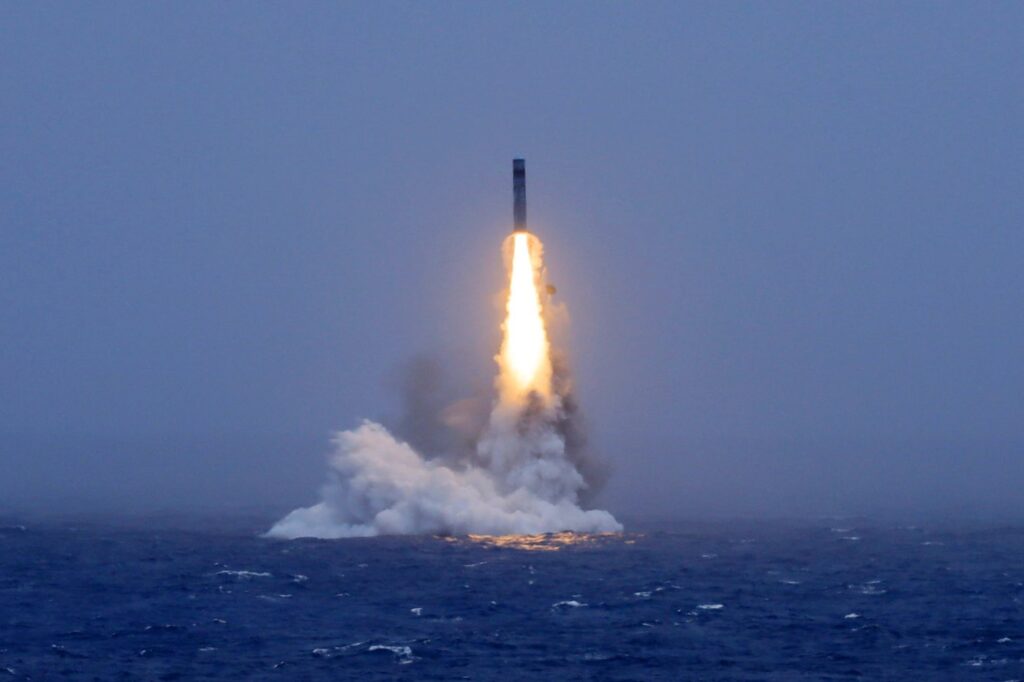
BANGKOK (AP) — On Monday, China conducted a rare test of a nuclear-capable ballistic missile in the South Pacific Ocean, a move that has drawn international criticism. This missile launch marks an important event in the realm of military capabilities and geopolitical tensions, especially aimed at the United States, as suggested by analysts.
The test, executed by the People’s Liberation Army (PLA) from a nuclear-powered submarine, serves as a demonstration of China's growing strategic nuclear capabilities, particularly the sea-based component of its nuclear triad, which includes land, air, and naval nuclear systems. Experts such as Tong Zhao from the Carnegie Endowment for International Peace emphasized that this test illustrates China's progress in developing a powerful military and a significant second-strike capability, allowing it to respond effectively even if it were to be attacked first.
China has characterized the missile launch as part of its annual military exercises, indicating that further tests could occur in the future. K. Tristan Tang, a Nonresident Fellow at the National Bureau of Asian Research, suggested that this launch is part of a systematic military strategy rather than an isolated incident.
The recent missile testing has drawn acute concern from several small Pacific island nations, which have urged larger countries to refrain from using the strategic and resource-rich South Pacific Ocean for military power plays. Historical grievances regarding nuclear testing in this area, particularly involving the U.S., U.K., and France, have left deep scars, as these tests resulted in environmental contamination and health issues that still affect local populations today.
In light of these historical contexts, the recent missile landed in the South Pacific Nuclear Free Zone, established by the 1986 Rarotonga accord that prohibits nuclear weapons testing in the region. Notably, China ratified these protocols in 1987, agreeing not to test nuclear weapons or threaten their use against member states in the region. Solomon Islands Prime Minister Matthew Wale expressed that while China is viewed as a friend, such actions do not align with the spirit of friendship.
Australia and New Zealand have both voiced discontent regarding the lack of prior notice provided by China regarding the test. Countries like Japan also criticized the launch for being conducted without transparency. Australian Prime Minister Anthony Albanese condemned the missile test as a "provocative act" that destabilizes the region, emphasizing the concern over the short notice given for this military activity. Australia is reportedly negotiating a comprehensive treaty with the Solomon Islands, amidst rising apprehensions about China’s expanding influence in the Pacific.
In its defense, China claimed to have given the relevant countries appropriate notice of the missile launch, asserting that this reflects the openness and transparency of its military actions. However, experts pointed out that despite these claims, China's membership status in international agreements like the Hague Code of Conduct, which recommends a minimum 24-hour notice before missile launches, remains uncertain.
As the situation unfolds, many are speculating about the specific missile fired during this test. Officials from Taiwan’s National Security Council indicated that the missile was likely launched from Guangdong and could possibly be a JL-2 or a newer JL-3 model with longer range capabilities. Analysts note that as China rapidly advances its military capabilities, the international community will likely place greater scrutiny on its actions going forward. Zhao highlighted that if China seeks to be recognized as a major military power, it should adhere to the same standards as other countries like the U.S., U.K., and France.








