

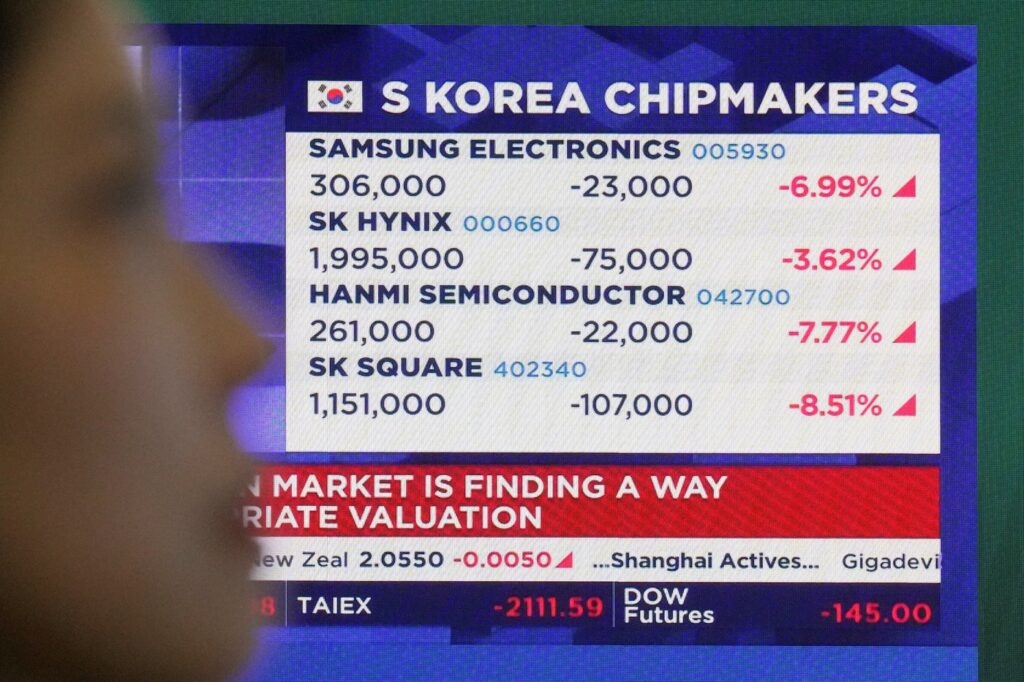
Asian shares faced significant declines on Monday due to concerns surrounding investments in Big Tech and escalating expectations for an interest rate hike, which collectively contributed to the worst performance of U.S. stocks since October. Japan's benchmark Nikkei 225 saw a drop of 4.2%, closing at 63,804.77. This decline was further compounded by a revision from the Japanese government, which adjusted the annualized economic growth rate for the first quarter of this year down to 1.8%, a decrease from the previous estimate of 2.1%.
In the global market, oil prices surged sharply as Israel conducted airstrikes on central and western Iran in response to missile attacks. Reports from Iranian state television indicated that explosions were audible in cities such as Isfahan, Tabriz, and Tehran, although further details were not immediately available. The situation remains tenuous, as American and Iranian negotiators had reached a tentative deal to extend a ceasefire, but the recent military actions complicate efforts to finalize the agreement.
As a result of these developments, Brent crude, an international benchmark for oil prices, increased by $3.50 to $96.59 a barrel, while benchmark U.S. crude surged by $3.48 to $94.02 a barrel. The instability in the region clearly has direct implications for the global oil market.
Across Asia, South Korea's Kospi experienced a substantial decline of 6.8%, closing at 7,605.42, largely influenced by a 7% plunge in shares of Samsung Electronics, the country's largest company. Other tech stocks, such as SK Hynix, also faced losses, decreasing by 3.3%. Taiwan's Taiex index followed suit with a drop of 3.8%, while Hong Kong's Hang Seng index fell by 1.3% to 24,631.64, and the Shanghai Composite index decreased by 1.1% to 3,984.75.
Amid this turmoil, trading in Australia was halted for the observance of King’s Birthday, creating a pause in market movements for that region. Meanwhile, Wall Street ended the previous week on a bleak note, with the S&P 500 index dropping 2.6% to 7,383.74. This marked the largest daily decline since October 10 when the Trump administration threatened to impose a 100% tariff on goods imported from China. Concurrently, the Dow Jones Industrial Average fell by 1.4% to 50,866.78, and the Nasdaq composite plummeted by 4.2% to 25,709.43.
In the bond market, yields experienced a notable increase following a report indicating that the U.S. added a surprising 172,000 jobs in May, as announced by the Labor Department. This employment data suggests sustained strength in the labor market, despite economic pressures from rising inflation. Following this report, the yield on the 10-year Treasury bond rose to 4.54%, up from 4.50%, while the yield on the 2-year Treasury bond, which is more closely aligned with Federal Reserve actions, increased to 4.16% from 4.04%.
The Federal Reserve has maintained its position on interest rates, seeking to assess the ongoing ramifications of rising inflation. Economic pressures have been exacerbated by tariffs and the impact of the ongoing conflict with Iran, which has largely limited the movement of crude oil shipments through vital routes such as the Strait of Hormuz.
In early currency trading, the U.S. dollar saw a slight increase against the Japanese yen, rising to 160.35 yen from 160.25 yen. The euro also experienced a modest gain, costing $1.1530, up from $1.1515. The situation in global markets remains fluid as geopolitical tensions and economic indicators continue to influence investor sentiment.








