

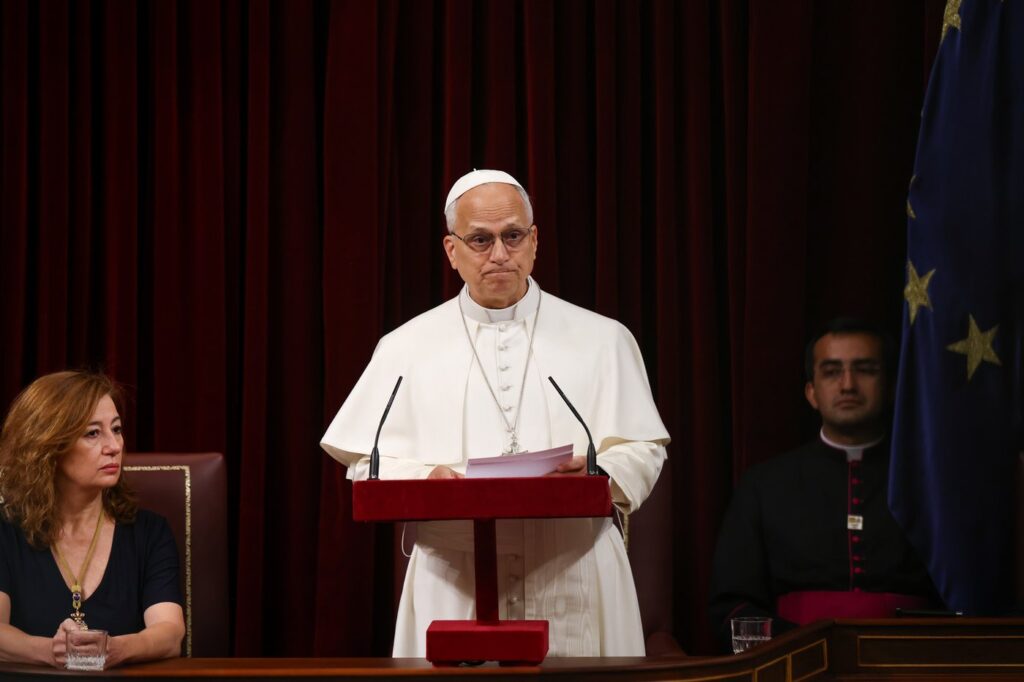
MADRID (AP) — In a historic address to the Spanish parliament on June 8, 2026, Pope Leo XIV advocated for increased respect for migrants' rights and the upholding of international law. His speech marked the first time a pope addressed the Spanish legislature, indicating a significant shift in the Catholic Church's acceptance within a predominantly secular society.
Pope Leo called for a "moral renewal" across legislatures, emphasizing the need to respect the inherent dignity of all individuals, including migrants, the unborn, and other vulnerable groups. He stated, "The moral greatness of a nation is manifested, above all, in its capacity to accompany, protect and love those lives that are most fragile."
Speeches from popes to foreign legislative bodies are uncommon, as they suggest a form of acknowledgment by lawmakers of a religious authority. Notably, Pope Francis spoke to a joint session of the U.S. Congress in 2015, while Pope Benedict XVI addressed Germany's Bundestag in 2011. The invitation extended to Pope Leo to speak at Las Cortes Generales symbolizes a newfound acceptance of the Catholic Church in the political arena, a stance that seemed unlikely only a few years prior, especially given the church's historic ties to Franco's dictatorship.
Despite a decline in religious observance amid broader secular trends, Leo's message resonated with Spanish lawmakers, who responded with enthusiastic applause and chants of "Viva el Papa!" reflecting a surprising degree of acceptance across the political spectrum.
Meanwhile, Leo's address coincided with escalating tensions in the Middle East, particularly as Israel and Iran engaged in retaliatory strikes. He reiterated the necessity for dialogue and diplomacy to address conflicts. "Peace demands diplomatic courage, ethical responsibility, and a vision for the future grounded in respect for the identity of every people," he declared.
The pope expressed concern over rising military expenditures in Europe, particularly in response to Russia's aggression in Ukraine. He called for "rigorous ethical oversight" of automated weapons systems, emphasizing the need for human moral responsibility over life-and-death decisions.
In a historical context, Leo referenced the 16th-century intellectual movements in Spain, particularly the School of Salamanca, which contributed to the development of international law and human rights. He acknowledged that, historically, both society and the church did not always uphold these principles, indirectly addressing the Catholic Church's role in the trans-Atlantic slave trade and colonial conquests.
Additionally, his speech highlighted the urgent issue of human trafficking and the need for international cooperation to curb migrant smuggling. Leo emphasized the dual demand for social justice: offering safe, legal pathways for migrants seeking refuge while also working towards enabling conditions that allow individuals to remain in their home countries.
The address comes at a politically delicate time for Spanish Prime Minister Pedro Sánchez and his Socialist-led government, which has faced various corruption scandals. Despite these challenges, Sánchez has defended immigration on both humanitarian and economic grounds, seeking legal status for undocumented migrants while acknowledging their contributions to Spain's aging workforce and economy.
Highlighting Spain's political polarization, Leo warned against the degradation of political pluralism into constant attacks on adversaries. He and Sánchez share overlapping views on critical global issues, notably advocating for dialogue over military intervention in conflicts such as those in Iran and Gaza.
In summary, Pope Leo XIV's address at the Spanish parliament represents a significant moment in the reintegration of the Catholic Church into the public sphere of a secular nation, underscoring the urgency of compassion and ethical responsibility in international relations and social justice.








