

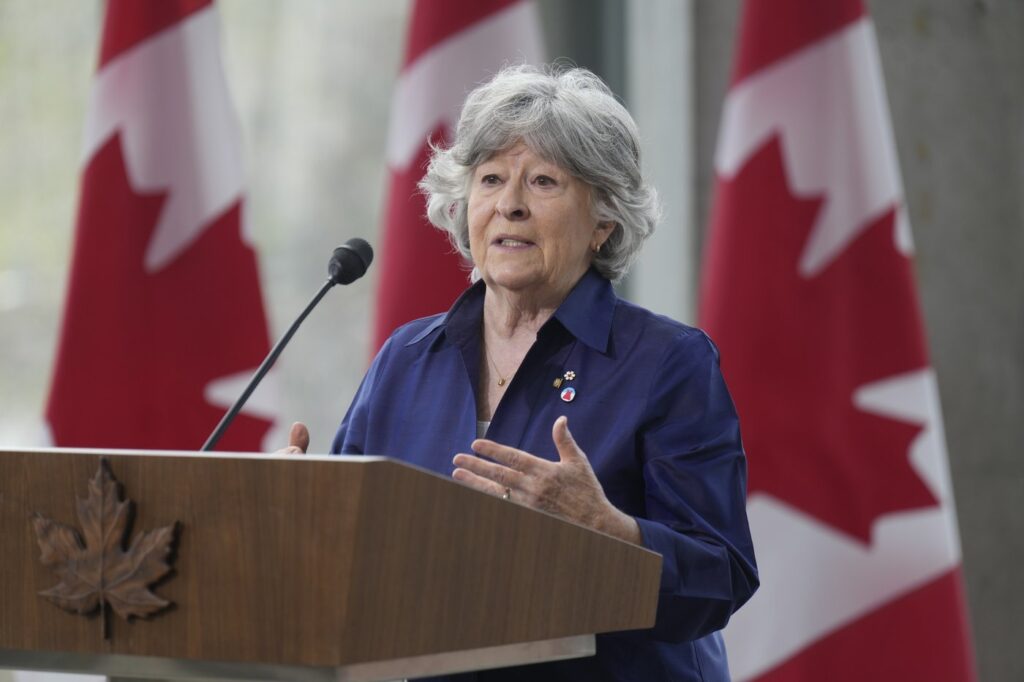
In a series of significant developments across Canada, former Supreme Court Justice Louise Arbour is stepping into her new role as Canada’s 31st governor general today, a position she will be inaugurated into during a ceremonious event in Ottawa. This event will feature military salutes, a poetry reading by the Parliamentary poet laureate, and various musical performances. Among the attendees will be outgoing governor general Mary Simon, Prime Minister Mark Carney, and National Chief of the Assembly of First Nations Cindy Woodhouse Nepinak. During her first address to the nation, Arbour is expected to outline the priorities she envisions for her role. Following the ceremony, she intends to lay a wreath at the Tomb of the Unknown Soldier at the National War Memorial.
On another front, Conservative Leader Pierre Poilievre is addressing the rising separatist sentiment in Alberta. Set to deliver a speech in Calgary, Poilievre plans to advocate for a transformation in federal policies to alleviate the frustrations of Albertans towards the federal government. The excerpt from his speech suggests that he aims to promote policies focused on unblocking resources, advancing pipeline projects, respecting provincial autonomy, and easing the tax burden on citizens. Poilievre points out that separatist sentiments are not targeted at Albertans’ fellow Canadians but are instead directed at perceived shortcomings of the federal government.
In the realm of economics, the Bank of Canada is anticipated to maintain its benchmark interest rate for the fifth consecutive time in an upcoming meeting. Economists suggest that the central bank will keep the rate steady at 2.25%, mirroring its approach from the last meeting in April. There is speculation that while the economic data has not been particularly promising, a recent jobs report indicating a decline in the unemployment rate may balance some concerns. RBC senior economist Claire Fan comments that the central bank is likely to continue promoting a message of flexibility and caution regarding future interest rate adjustments, especially amidst ongoing geopolitical uncertainties.
In a grassroots movement, residents of Nova Scotia's Annapolis Valley are rallying to save five rural library branches scheduled for closure due to stagnant provincial funding since 2020. Community members are expressing their concerns, with seven-year-old Alice Arsenault highlighting her sadness about the impending closure of the Kentville branch, a place she frequents for reading and participating in a chess club. Substitute librarian Sue Littleton emphasizes that libraries serve as essential hubs within communities, extending beyond just being venues for books. Nova Scotia's communities minister, Dave Ritcey, has acknowledged the devastating impact the closures could have and has indicated plans to meet with the library board this week.
As the FIFA World Cup approaches, security considerations are at the forefront, shaping the budget for the event. Bud Mercer, a former RCMP officer responsible for security during the 2010 Vancouver Olympics, expresses concerns about the new and complex security landscape influenced by various global conflicts, including the war in the Middle East and the ongoing situation in Ukraine. He notes that the budgeted security costs exceed $242 million in Vancouver and $94 million in Toronto, partly attributable to differences in stadium locations. Moshe Lander, an economics professor at Concordia University, reinforces the idea that geographical factors significantly impact the financial logistics of hosting such a monumental event.
Overall, these stories reflect a multiplicity of issues shaping Canada today—from changes in leadership and economic policies to grassroots advocacy for community resources and heightened security measures for significant international events.








