

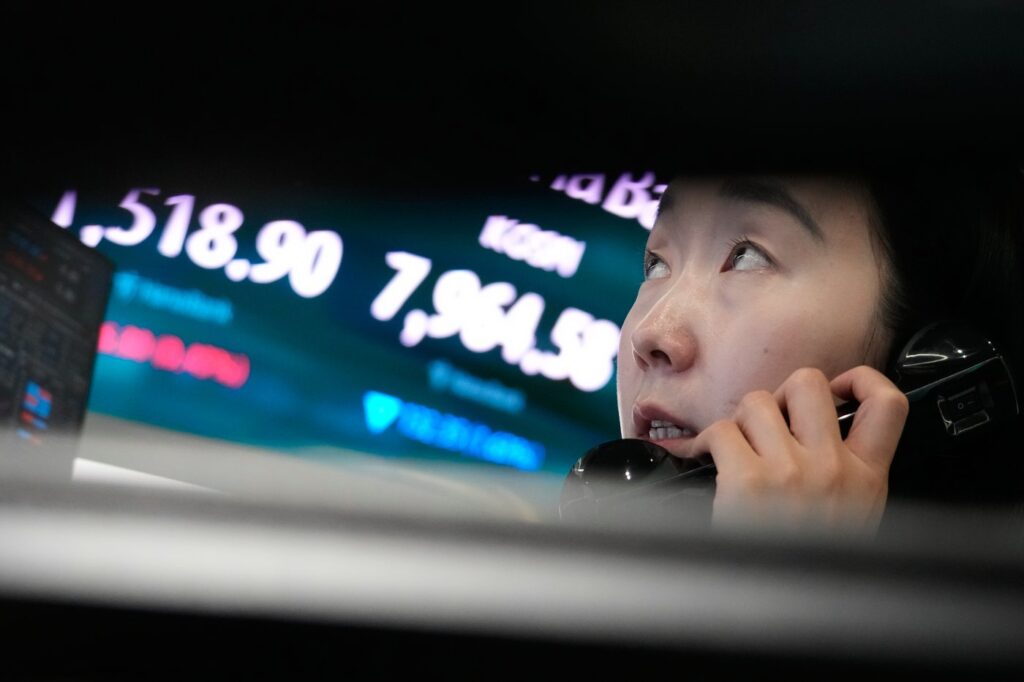
Asian shares experienced a noticeable decline on Wednesday, following a significant sell-off of technology stocks on Wall Street. The market reaction was compounded by rising oil prices after the United States launched airstrikes against Iran, escalating tensions in the region. These developments have raised concerns regarding the progress towards a permanent ceasefire in the ongoing Iran war, which has now lasted over three months.
The U.S. military conducted attacks early on Wednesday, in response to an Army helicopter crash near the Strait of Hormuz, which President Donald Trump attributed to Iran. In retaliation, Iran declared that it would respond to any attack or threat. This renewed flare-up of violence has led to uncertainties about the security of the Strait of Hormuz, a crucial passage for global oil transportation, causing oil prices to rise once again.
Brent crude, the international oil benchmark, saw an increase of 0.9%, reaching $92.30 per barrel, reversing a decline earlier in the day. Comparatively, it was trading at around $70 per barrel prior to the conflict that began in late February. Benchmark U.S. crude rose by 1% to $89.04 per barrel. ING commodities strategists, Warren Patterson and Ewa Manthey, noted in their analysis that the situation remains volatile, highlighting the challenges faced by both Iran and the U.S. in establishing a sustainable ceasefire that ensures the safe passage of vessels through the Strait of Hormuz. They also commented on the seasonal demand for oil, which typically exerts upward pressure on prices during this time of year.
In the realm of technology stocks, U.S. futures slipped lower following declines for major chipmakers such as Micron Technology, Advanced Micro Devices (AMD), and Marvell Technology during the previous trading session. In South Korea, the Kospi index fell sharply by 4.7%, closing at 7,720.59, after a notable surge the day before. Samsung Electronics, a key player in memory and logic chip manufacturing, witnessed a drop of 5.8%, while shares of SK Hynix plummeted by 6.3%.
Japan's Nikkei 225 index also took a hit, dropping 1.4% to 64,524.84 after reports indicated that Japan's producer price index had surged by 6.3% in May compared to the previous year—the fastest growth observed in over three years. Notably, shares of SoftBank Group, which has heavily invested in artificial intelligence, fell by 8.9%. However, Tokyo Electron, another chipmaker, managed to rise by 5.3%.
In Hong Kong, the Hang Seng index fell by 1.1% to 24,296.62, and the Shanghai Composite index decreased by 0.7% to 3,980.24. Recent official data indicated that China's producer prices had surged to nearly a four-year high of 3.9% in May, further influencing market sentiments.
Australia's S&P/ASX 200 index saw a modest increase, gaining 0.2% to reach 8,624.50. Meanwhile, Taiwan's Taiex index was trading 1.6% lower, and India's Sensex experienced a rise of 0.6%.
On Wall Street, the S&P 500 benchmark dipped by 0.3% to 7,386.65. Meanwhile, the Dow Jones Industrial Average slightly increased by 0.2% to 50,872.11, while the tech-heavy Nasdaq composite dropped by 1% to 25,678.82. Significant fluctuations were observed in shares of U.S. chipmaker Micron Technology, which saw its stock plummet from an early gain of 4% to a 10% decline, eventually closing 1.4% lower. Marvell Technology shares fell by 7.6%, and AMD stock decreased by 3%.
Investors are closely monitoring upcoming updates on U.S. inflation, as the conflict in Iran continues to exert upward pressure on global energy prices. In currency markets, the U.S. dollar remained steady against the Japanese yen at 160.36, while the euro traded at $1.1550, a slight increase from $1.1543.








