

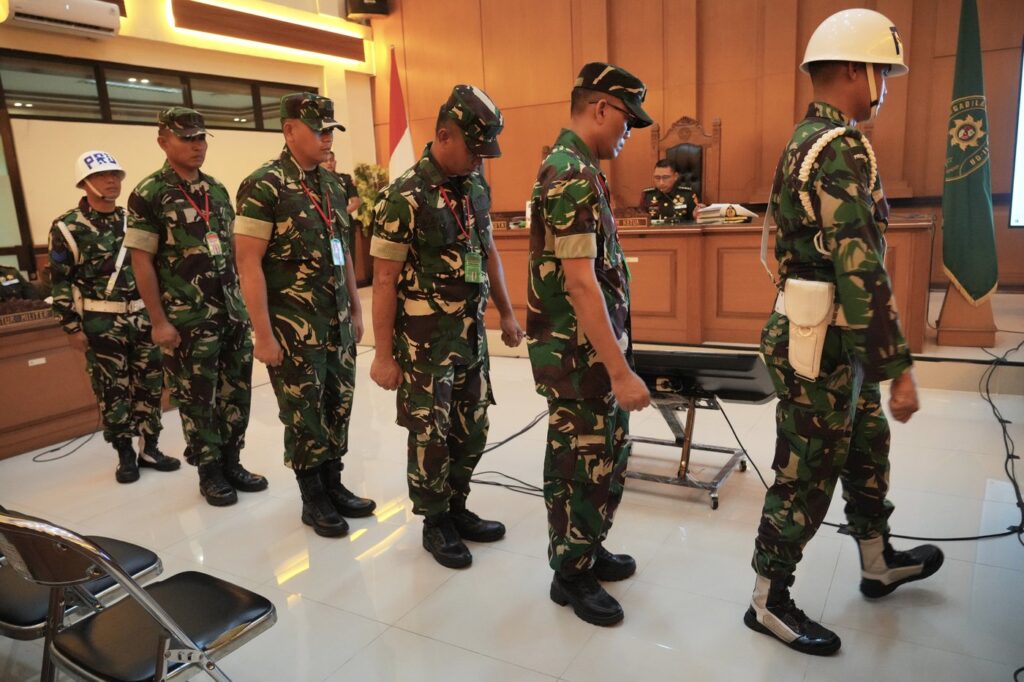
An Indonesian military court has convicted four service members for their involvement in an acid attack on Andrie Yunus, a prominent human rights activist. The attack occurred in March when Yunus, who is known for his advocacy work with the Commission for the Disappeared and Victims of Violence (KontraS), was assaulted as he rode his motorcycle in central Jakarta after recording a podcast that criticized the military’s influence on the government.
The convicted individuals, consisting of three navy marines—Sgt. Edi Sudarko, First Lt. Budhi Hariyanto Widhi Cahyono, and Capt. Nandala Dwi Prasetya—and one air force officer, Lt. Sami Lakka, were sentenced to prison terms ranging from 18 months to three years. Sgt. Sudarko received the heaviest sentence of three years, while Cahyono was sentenced to two and a half years, Prasetya to two years, and Lakka to 18 months. Sudarko and Cahyono were also dismissed from their military positions due to their roles in the attack.
The presiding judge, Fredy Isnartanto, stated that the defendants betrayed their military duties and their actions severely damaged the image of the Indonesian military. He emphasized that Yunus suffered not only physical injuries, including severe burns and permanent damage to his right eye, but also enduring trauma as a result of the attack.
Following the verdict, human rights organizations expressed their dissatisfaction with both the sentencing and the legal proceedings, alleging that the trial did not adequately investigate potential higher-level involvement in the attack. Amnesty International Indonesia condemned the relatively lenient sentences, warning that the proceedings risked becoming a "show trial." They called for a more extensive inquiry into the possible orchestration of the attack beyond the four convicted service members.
Indonesia’s National Commission on Human Rights, known as Komnas HAM, reported that their investigation suggested that the attack was a coordinated and planned operation, indicating the involvement of additional individuals. They identified multiple human rights violations associated with the case, including breaches of the rights to security, freedom from torture, and access to justice.
During the trial, prosecutors maintained that the defendants acted on their own initiative out of anger at Yunus’s activism, arguing that there was no direct order from higher-ups. The prosecution initially sought a two and a half year sentence for all four service members.
Yunus, 27, has gained recognition for his commitment to combating impunity in Indonesia. His advocacy includes work on security sector reform and civil liberties, and he was actively involved in protests against proposed revisions to the military law that would increase military influence over civilian matters. His colleagues have reported ongoing intimidation related to his activism.
Notably, Yunus opted not to testify during the military trial, citing ongoing medical recovery from skin graft surgeries and a lack of trust in the military court system. The Advocacy Team for Democracy, which represents him, noted his concerns about the fairness of the proceedings.
A civilian court, the South Jakarta District Court, recently partially granted Yunus’s pretrial motion, ordering an ongoing police investigation to ensure justice and the protection of human rights. This court recognized pressure from Komnas HAM for continued investigation into the identities of other potential perpetrators, including civilians. Both Komnas HAM and the Civil Society Coalition suggest that more than a dozen individuals could be involved in the planning and execution of the acid attack.
This case revives broader concerns regarding military impunity in Indonesia and echoes other unresolved attacks on activists, notably the 2004 case of Munir Said Thalib, a prominent human rights advocate who was poisoned under suspicious circumstances.








