

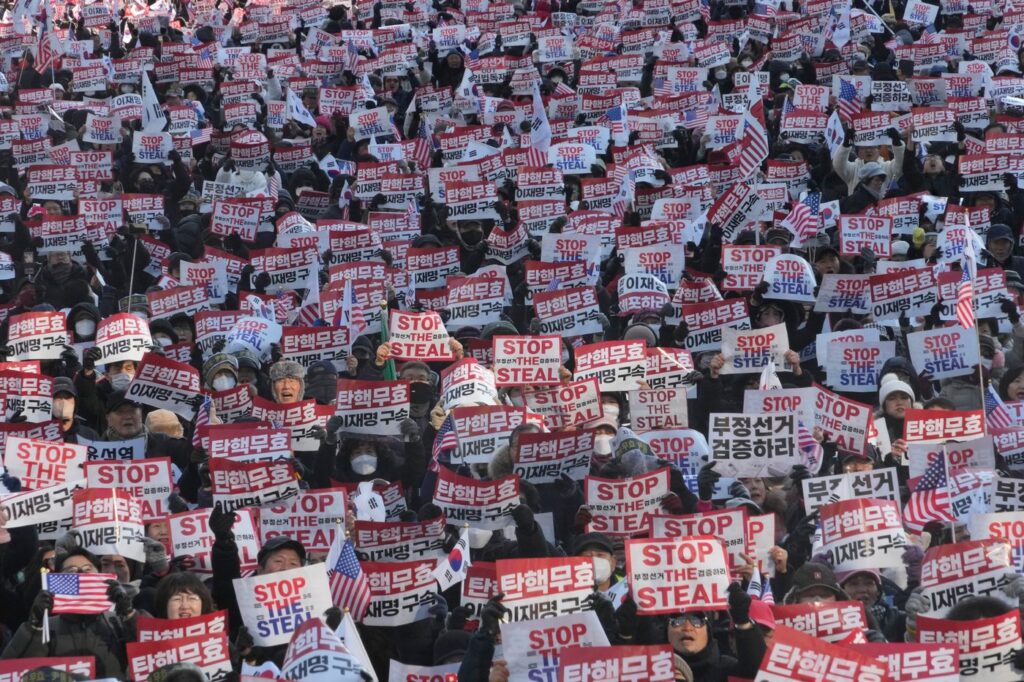
SEOUL, South Korea (AP) – On Tuesday, South Korea began implementing a controversial law that imposes heavy punitive damages on news organizations and social media influencers who disseminate false or manipulated information. Critics, including journalists and civil liberties advocates, have expressed concerns that the vague language of the law may hinder public discourse and promote a culture of censorship.
The law permits courts to impose damages that can amount to five times the actual losses suffered by news outlets and significant social media platforms, including YouTube creators, if they distribute illegal or deliberately misleading content with the intent to cause harm or profit. Furthermore, individuals who share information declared false or manipulated by a court more than twice could face fines of up to 1 billion won (approximately $656,000). Large social media platforms must also take action, such as removing disputed content or suspending accounts, upon receiving alerts about false information.
This legislation is backed by President Lee Jae Myung’s liberal Democratic Party and was passed by the National Assembly in December 2023, despite opposition from conservative lawmakers. Proponents argue that the law is essential for addressing the rise of fake news and disinformation, which they claim threaten democracy by fostering division and inciting hate speech.
However, organizations such as the Journalists Association of Korea have warned that the potential for large-scale damage claims could stifle journalistic freedoms. They emphasize that even well-intentioned laws can undermine democratic principles if they discourage critical media coverage of government, politicians, and corporations. In a public statement, they voiced concerns about the unintended chilling effects the law might promote among both media entities and ordinary citizens who wish to exercise their rights to criticize those in positions of power.
In response to the legislative move, the Seoul Foreign Correspondents’ Club has also raised alarms regarding its implications for media operations and the free exchange of information. The surge in concern surrounding South Korea's online discourse correlates with past political turbulence, notably following then-President Yoon Suk Yeol's brief imposition of martial law in 2024.
Yoon, who was later impeached and convicted for rebellion, previously propagated unverified claims of election fraud to rally support against his political opponents. Critics assert that his rhetoric exacerbated existing political divides by spreading misinformation, complicating the national dialogue and hindering reconciliation between factions.
The Korea Media and Communications Commission has attempted to downplay fears of state-sponsored censorship, asserting that it is the operators of online platforms—not the government—who will determine if content is classified as false or manipulated. They also highlighted provisions in the law that exempt reporting conducted in the public interest from potential damages.
Nonetheless, experts like Kim Hong-yeol, a professor at Duksung Women’s University, caution that the law could lead to extensive self-censorship, discouraging journalists and the public from discussing sensitive topics. This, in turn, might force internet companies to adopt overly stringent moderation practices to avert legal repercussions, possibly resulting in the deletion of legitimate content.
While major South Korean tech companies such as Naver and Kakao are reportedly enhancing their processes for reporting and addressing misinformation, it remains uncertain how international platforms like Google’s YouTube will align with these new regulations. YouTube, in a statement, indicated its commitment to maintaining transparency while safeguarding users, emphasizing its intention to engage with all stakeholders as it navigates these legal implications.
Following the law's passage, U.S. Under Secretary of State Sarah B. Rogers expressed criticism via social media, suggesting that the legislation undermines international tech cooperation and advocates for civil remedies for victims of misinformation rather than empowering regulatory entities to impose viewpoint-based censorship.








