

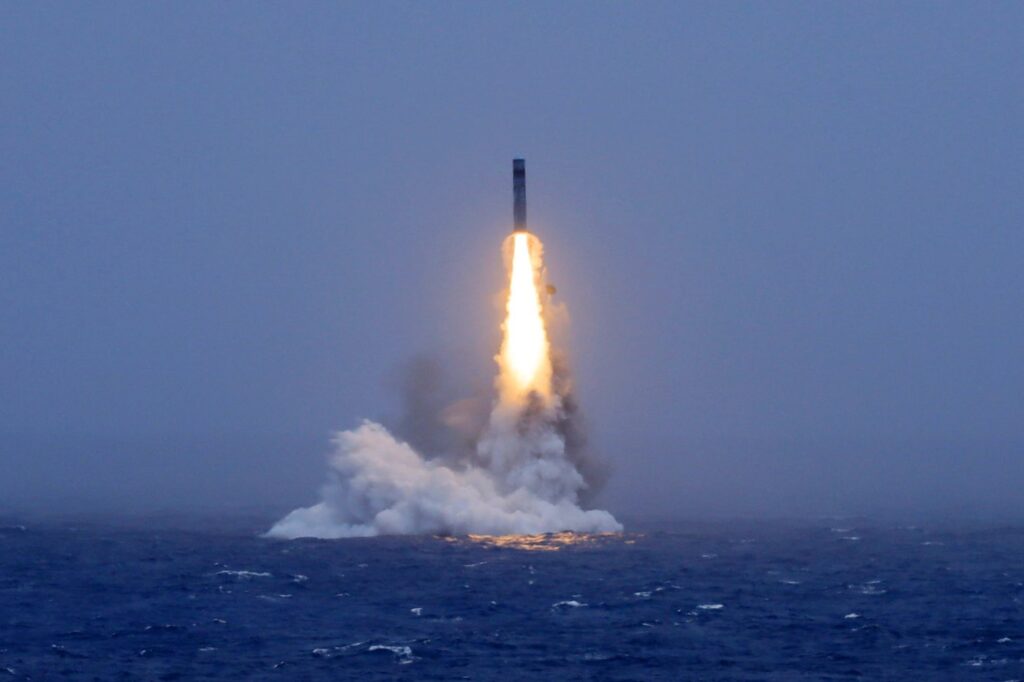
BANGKOK (AP) — On Monday, China's navy conducted a test-launch of a long-range ballistic missile from a nuclear-powered submarine, an action that, according to experts, underscores Beijing's advancing skills and capabilities within its nuclear deterrence strategy. This missile test is seen as a significant development, especially given the context of increasing military tensions in Asia.
The test triggered protests from both the United States and several countries in the Asia-Pacific region. This incident marks the second occurrence in recent years where China has launched a ballistic missile into international waters. While some countries in the region received prior notice from China, others criticized the lack of sufficient warning. Experts believe that such actions contribute to escalating militarization in Asia.
China disclosed the missile test publicly only after its completion, stating that the missile was fired into the Pacific Ocean. The official Xinhua News Agency labeled the launch as part of routine annual training, asserting that it complied with international law and was not aimed at any specific country or target. However, details regarding the type of missile remained unspecified.
The missile was equipped with a dummy warhead instead of a nuclear one. Although launching a missile in international waters is infrequent, the United States has similarly conducted missile tests under comparable circumstances. Xinhua subsequently released a photo of the missile, but experts claim that the imagery was insufficient to definitively identify the missile as either a JL-2 or a JL-3, both of which are submarine-launched ballistic missiles. However, the state-owned tabloid, Global Times, speculated that it was most likely a JL-3 missile, which boasts a range exceeding 10,000 kilometers (6,200 miles), compared to the shorter-range JL-2.
The missile launch has drawn specific criticism from the New Zealand government, which noted that it occurred within treaty waters of the South Pacific Nuclear Free Zone, thereby contradicting the intentions of the 1986 Treaty of Rarotonga, which aims to prohibit nuclear weapons throughout the region. China ratified these protocols in 1987, committing not to test nuclear weapons within the zone or to threaten signatory nations.
In response to the missile test, officials from Australia, Japan, and other countries have voiced their concerns. Chinese authorities have advised other nations to refrain from overinterpretation of the event. However, Drew Thompson, a senior fellow at the S. Rajaratnam School of International Studies, pointed out that the lack of transparency surrounding China’s military modernization contributes to uncertainties regarding its intentions.
Australian Prime Minister Anthony Albanese remarked that the lack of adequate notice from China rendered the missile test a provocative act. He emphasized that the test of a nuclear-capable intercontinental ballistic missile represents a substantial concern, particularly in a region where calls for nuclear disarmament are prominent. Similarly, New Zealand's Foreign Minister, Winston Peters, expressed the view that the launch was both unwelcome and troubling.
Solomon Islands Prime Minister Matthew Wale stated that while China is regarded as a friendly nation, such military actions do not align with the expectations of friendship, indicating a desire for stability in the region without threats from any parties.
Amidst growing military assertiveness from China, its leader, Xi Jinping, has prioritized the modernization of the People’s Liberation Army. Despite having the world's largest standing army and the biggest navy, China’s nuclear arsenal is still smaller than that of the U.S. and Russia. However, the country is actively expanding its nuclear stockpile and developing advanced long-range missiles and drones.
China's projected defense budget is expected to reach $270 billion by 2026, exhibiting a growth rate of around 7% over the past four years. Independent analyses suggest that actual military spending may be substantially higher, with estimates for 2024 reaching $313.7 billion. Concerns about the potential for military conflict between China and Taiwan, coupled with the increasing militarization of the region, have prompted neighboring countries to bolster their defense expenditures. For instance, Japan is planning to double its military budget, while the Philippines has allowed the U.S. to expand its military presence in the country.
The recent missile launch further complicates already tense relations between Beijing and Tokyo, especially in light of comments from Japanese Prime Minister Sanae Takaichi regarding the potential for military engagement over Taiwan. As geopolitical dynamics continue to shift, regional tensions remain high, with calls for transparency and reduced military provocations becoming increasingly critical.








