

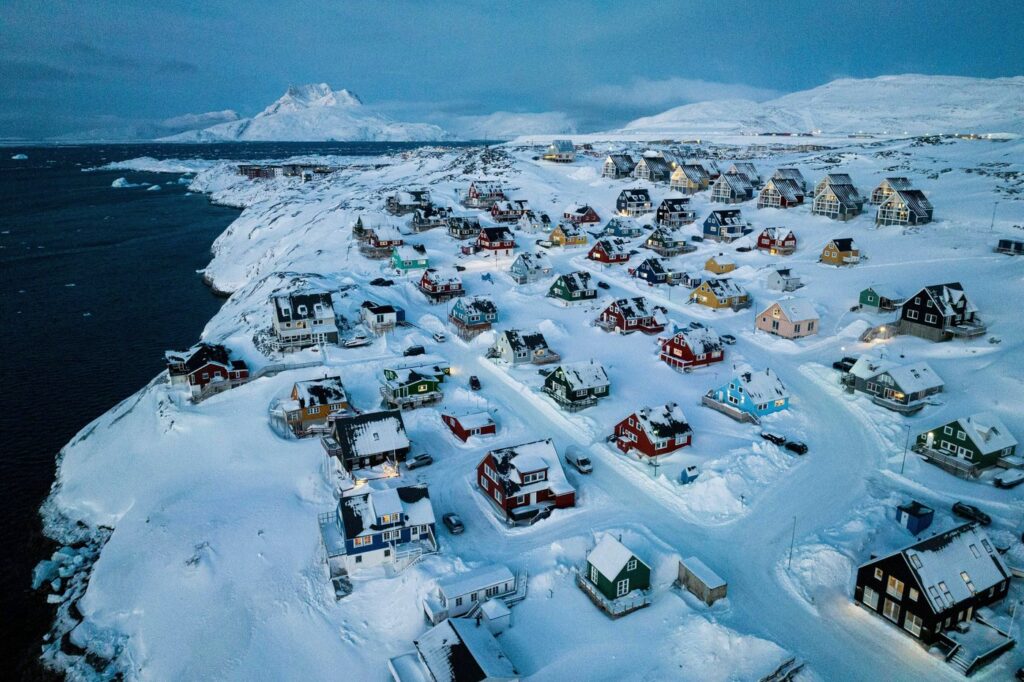
Greenland, the world's largest island, holds significant strategic importance due to its location above the Arctic Circle, making it a crucial component of global security strategies. The increasing international tensions, global warming, and shifts in the world economy have positioned Greenland at the center of discussions about trade and security. U.S. President Donald Trump has shown considerable interest in Greenland, hoping to assert American control over the mineral-rich territory that is pivotal for Arctic and North Atlantic defense.
Trump's repeated requests for the island and even threats of military takeover have caused concern among the NATO alliance and European allies who count on the U.S. as a longstanding defense partner. Despite Trump's overtures, Denmark—Greenland's governing country—has firmly rejected his approaches. The Greenlandic government emphasizes the importance of self-determination for its people, which includes the 56,000 mostly Inuit inhabitants who have often been overlooked in global conversations.
Trump has frequently referenced Greenland when discussing territorial expansion, declaring its significance for U.S. security during a NATO summit. He argued that Greenland is vital for the protection of not just the U.S. but the world at large, noting that it is not particularly important to Denmark. While earlier in his presidency Trump hinted at the possibility of using military force to gain control, he has since retracted those statements.
Greenland's strategic location off Canada's northeastern coast has been critical to North American defense since World War II. The U.S. occupied the island to prevent Nazi Germany from controlling it and to safeguard North Atlantic shipping routes. After the Cold War, the Arctic was a zone of international cooperation. However, climate change is altering the landscape by thinning Arctic ice, potentially opening up new trade routes. This has reignited competition among global powers like Russia and China for access to the region's mineral resources.
China's designation as a "near-Arctic state" in 2018 signifies its ambitions in the region, with plans to establish a "Polar Silk Road" as part of its Belt and Road Initiative. In response, then-U.S. Secretary of State Mike Pompeo expressed concerns about the militarization of the Arctic, urging against a similar situation to the South China Sea. Concurrently, Russia is increasing its military presence in the Arctic, restoring Soviet-era infrastructure and constructing new military facilities to assert influence over the region.
The war in Ukraine, launched by Russia on February 24, 2022, has intensified European worries regarding security in the Arctic. Russian President Vladimir Putin acknowledged NATO's activities as a concern and promised to enhance Russian military capabilities in the area, though he opened the door to potential international cooperation.
The U.S. already maintains a military presence at Pituffik Space Base in northwestern Greenland, established under the Defense of Greenland Treaty signed in 1951. This base is essential for various defense operations that support NATO. Greenland's geographic location also plays a role in monitoring naval movements in the North Atlantic, particularly through the GIUK (Greenland, Iceland, United Kingdom) Gap.
Some experts, such as Thomas Crosbie from the Royal Danish Defense College, argue that an American takeover of Greenland would not enhance U.S. security strategies. He stated that the U.S. already reaps the benefits of its alliance with Greenland without necessarily needing territorial control. Furthermore, Denmark's parliament has approved a bill allowing the establishment of U.S. military bases in Denmark, reflecting a cooperative defense relationship with the U.S. But, Danish Foreign Minister Lars Løkke Rasmussen warned that the agreement could be terminated if the U.S. attempts to annex any part of Greenland.
Greenland's mineral wealth, particularly in rare earth minerals used in technology and high-tech industries, has drawn attention from the U.S. and other nations aiming to reduce reliance on China for these critical resources. However, developing these resources poses challenges due to the island's harsh climate and stringent environmental regulations.








