

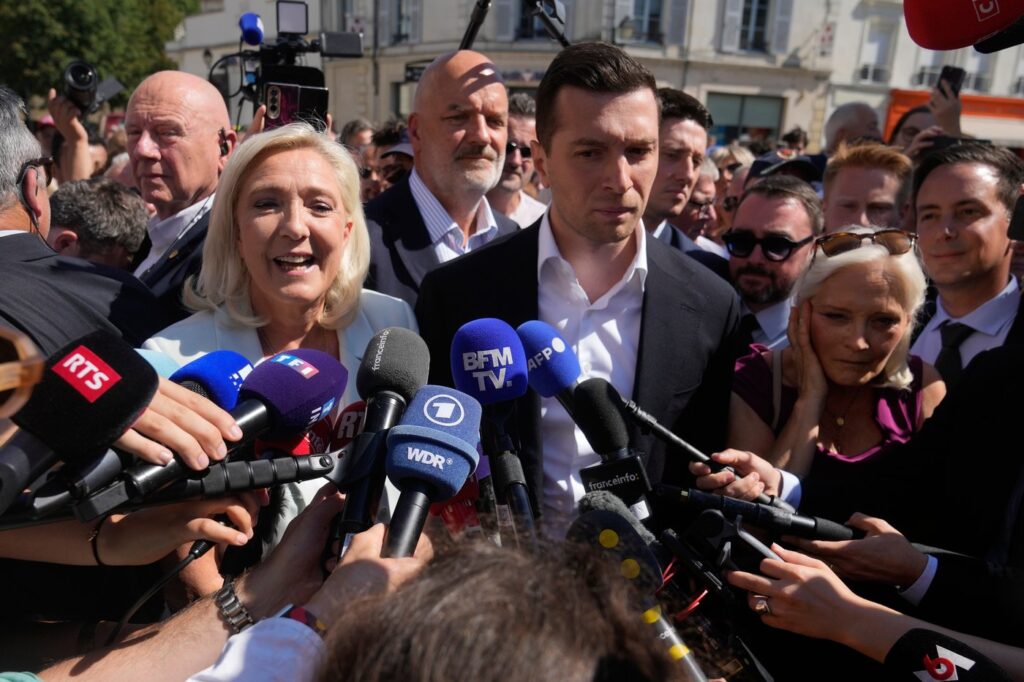
PARIS — France is gearing up for a significant electoral showdown in the coming year, with the added intrigue of an unusual candidacy. Far-right leader Marine Le Pen is set to run for the presidency for an unprecedented fourth time, despite having been convicted twice for embezzlement of public funds. This development raises eyebrows as she aims to lead the European Union's largest nation.
On Tuesday, a Paris appeals court made a pivotal decision that enables the 57-year-old Le Pen to proceed with her campaign. The court reduced a previous ban on seeking public office that threatened her political aspirations, allowing her to remain a formidable contender less than ten months before the election. As she faces her legal troubles head-on, Le Pen is portraying herself as a resilient politician fighting against the system for the benefit of France.
Luc Rouban, a senior researcher at Paris’ Sciences Po school of political sciences, reflects on her narrative: “Her argument is essentially this: ‘Despite all the obstacles and all the ordeals I’ve been through, I’m still standing, I’m still running. I entered politics to carry this national project for France through to the end.’” This assertion plays into her story of persistence and determination.
Legal complications continue to loom over the electoral landscape. While the Paris appeals court mitigated both the ban and prison sentence imposed last year, it mandated that Le Pen serve one year of home detention under electronic monitoring. This presents a surreal possibility of a presidential candidate campaigning with an electronic tag on her ankle. However, her declaration on Tuesday to challenge the ruling to the highest court in France has provided her with a reprieve, allowing her to postpone the monitoring requirement until the court makes its decision.
The timeline for the Court of Cassation to issue a ruling remains uncertain, but it indicated that the process would likely conclude before the first round of the election in April, followed by a knockout round in May. “I will therefore campaign without an electronic bracelet,” Le Pen confidently stated, emphasizing her resolve to avoid incarceration while seeking public office.
If Le Pen were to win the presidency, she would gain legal immunity, effectively rendering the electronic monitoring moot during her term. However, if her legal obligations persist post-presidency, she might face resumed monitoring, albeit possibly with judicial leniency given her status as a former president, according to Julien Jeanneney, a public law professor at the University of Strasbourg.
Critics voice concerns regarding her suitability for the presidency due to her embezzlement conviction. Many citizens, like Bernadette Flament, a 73-year-old resident near a recent campaign stop, express that having a convicted individual govern France is unacceptable, highlighting a growing demand among voters for higher ethical standards in politics.
The precedent set by former president Nicolas Sarkozy, who became the first in modern French history to serve prison time for criminal conspiracy, adds to the scrutiny Le Pen faces. Sarkozy underwent electronic monitoring following his release, illustrating the expectation for accountability among public officials.
In a strategic move, Le Pen announced that she would campaign in tandem with her protege, Jordan Bardella. This approach, reminiscent of past U.S. presidential ticket pairings, aims to capitalize on Le Pen's experience alongside Bardella’s appeal to younger voters. At just 30, Bardella, as the president of the National Rally party, possesses a notable presence on social media platforms, increasing their visibility among Gen Z voters.
It is important to note that, unlike in the United States, French voters select only one individual for the presidency, and the subsequent choice of prime minister is at the president's discretion. Nonetheless, Le Pen’s collaborative campaign could broaden their electoral base by merging traditional conservative values with Bardella’s modern, pragmatic style.








