

HONG KONG (AP) — Asian shares experienced a decline, while oil prices surged on Thursday amidst escalating conflicts in the Middle East, particularly with fresh attacks launched by both Iran and the United States. U.S. futures showed a slight increase as tensions continued to mount following a breakdown of a temporary ceasefire, as stated by U.S. President Donald Trump.
The United States intensified its military actions with airstrikes against Iran, prompting Iran to retaliate by targeting Bahrain, Kuwait, and Qatar. This escalation marked a significant shift in the geopolitical landscape of the region, greatly affecting global economic sentiments.
In Japan, Tokyo's Nikkei 225 index regained some ground, increasing by 1.6% to close at 67,849.98. The rise was largely attributed to gains in technology-related stocks, with notable performances from chip equipment maker Tokyo Electron, which saw a 5% jump, and SoftBank Group, focusing on artificial intelligence, rising by 0.4%.
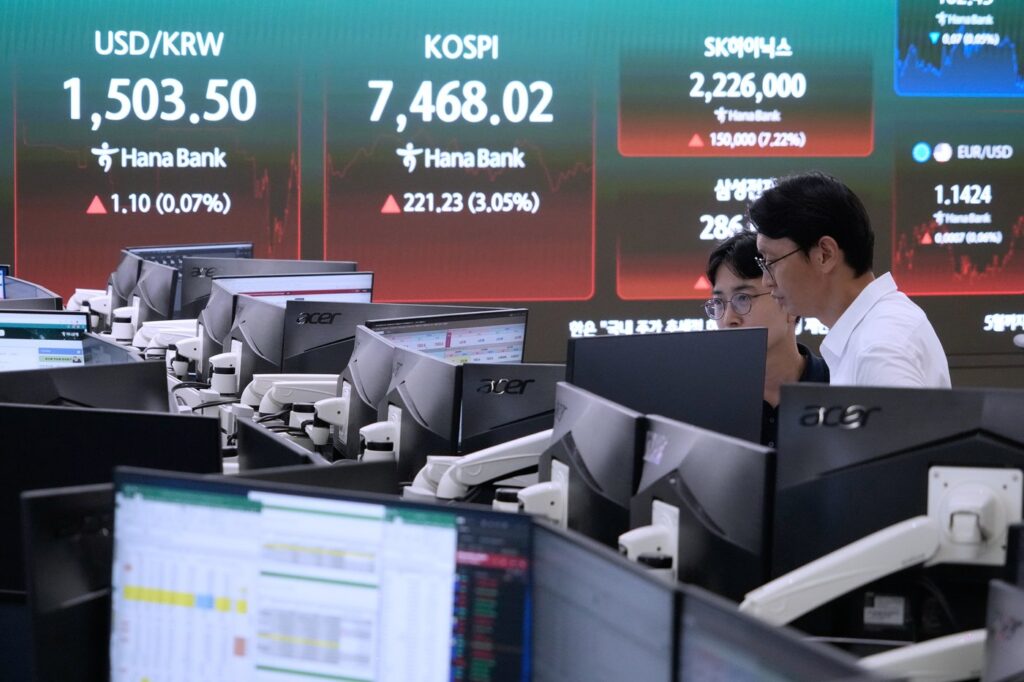
South Korea's Kospi index displayed volatility, inching up by 0.1% to 7,255.09 after experiencing a significant drop of 5.4% the previous day. Major players in the South Korean technology sector had mixed outcomes; Samsung Electronics fell by 1.3%, while memory chip manufacturer SK Hynix increased its stock by 3.6%.
Meanwhile, the Shanghai Composite index in China fell by 0.5% to 3,952.49, reacting to reports of a 4.1% increase in the country’s producer price index compared to the previous year. This increase was higher than the 3.9% rise noted in May, with some experts attributing this surge to the ongoing conflict in Iran and its economic repercussions.
The Hang Seng index in Hong Kong dipped by 0.8% to 24,011.61. Notably, shares of Luxshare, an Apple supplier, dropped 5% following its trading debut. Conversely, Chinese AI company Zhipu, or Z.ai, experienced a remarkable surge of 11.5% after announcing plans to raise approximately $4 billion through a share sale.
In Australia, the S&P/ASX 200 index lost 0.5% to settle at 8,745.20. Taiwan's Taiex remained nearly flat, while India's Sensex registered a modest gain of 0.7%.
As for oil prices, they surged early Thursday, with Brent crude, the international benchmark, rising by 1.1% to $78.88 per barrel, briefly surpassing $80 the day before. Prior to the onset of the Iran conflict, Brent oil was traded at around $72 per barrel. Relief from initial peace negotiations had recently boosted prices back to pre-war levels; however, growing concerns have reemerged due to the instability caused by the cessation of the ceasefire.
U.S. crude also saw a 1.1% increase, settling at $74.32 per barrel. Analysts from ING commodities noted that the oil market continued to rally due to the fragile state of the ceasefire between the U.S. and Iran, with recent vessel tracking data indicating a decline in oil tanker crossings in the key Strait of Hormuz, heightening fears about future oil supply constraints.
On Wall Street, the S&P 500 closed 0.3% lower at 7,482.71, having dropped as much as 1.1% earlier in the session following Trump's comments regarding the ceasefire. The Dow Jones Industrial Average fell by 1.1% to 52,348.39, while the Nasdaq composite, which is heavily weighted towards technology companies, gained 0.2% to reach 25,870.65.
Notable performances in the U.S. stock market included Broadcom, a U.S. chipmaker, which surged by 4.8% after Apple announced a multiyear partnership with the company. In currency markets, the U.S. dollar declined to 162.45 Japanese yen from 162.59 yen, while the euro traded higher at $1.1430, up from $1.1417.








