

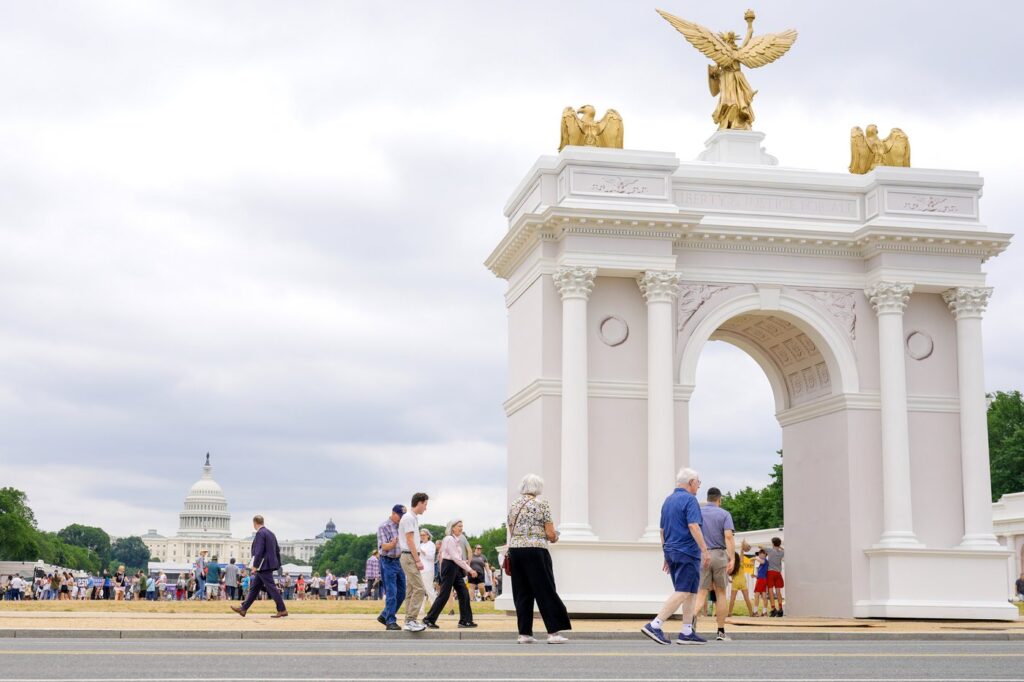
President Donald Trump is facing another review for his proposed construction of a triumphal arch in Washington, D.C., which is set to alter the capital's skyline significantly. The project requires approval from the National Capital Planning Commission (NCPC), whose staff has suggested revisions before granting the go-ahead. The commission is set to meet to discuss the feasibility and implications of the 250-foot (76-meter) arch.
According to a staff report, the NCPC staff recommends that the commission approve the preliminary site and building plans. However, they stress that the design must be adjusted to comply with the Height of Buildings Act, which aims to preserve the iconic skyline of downtown Washington. The planning commission applies this legal framework during the project's approval process.
The staff report suggests that the Commission should request revisions to the arch's design to ensure compliance with the regulations. These adjustments would involve redistributing height between the main structure, a habitable roof, and the proposed statuary. Despite changes that may be necessary, the report states that the arch, along with a public observation deck and three gilded topper statues, could still achieve Trump's desired height of 250 feet.
Additionally, the NCPC staff has called for more information regarding vehicular traffic around the proposed arch, the exterior granite material, and other project details before the Interior Department grants final approval. Trump intends to construct the arch on a traffic circle on the Virginia side of the Memorial Bridge.
Previously, the U.S. Commission of Fine Arts, a different federal agency, approved the arch's design in May. The NCPC has been reviewing the project since June, with considerations focused on how the structure fits within the capital's landscape.
Opposition voices have raised concerns that the arch is excessively large for the skyline and could obstruct significant views between the Lincoln Memorial and Arlington National Cemetery, sites designed to symbolize the reconciliation of the North and South after the Civil War. Despite the opposition, the members of both commissions—comprised of some of Trump’s allies—remain largely unswayed. Notably, Trump appointed Will Scharf, a top aide, to chair the planning commission.
Additionally, there are ongoing legal challenges against the Trump administration from a group of veterans and a historian who aim to block the construction due to concerns over visual obstruction and the integrity of the sightlines.
When compared to existing monuments, the proposed arch would stand more than twice the height of the Lincoln Memorial, which reaches 99 feet (30 meters), and nearly half the height of the Washington Monument, standing at approximately 555 feet (169 meters).
Trump has previously indicated that the arch could be funded using unused funds from donations and revenues anticipated for a separate $400 million ballroom project at the White House. However, it has been revealed that public funds will also be allocated for the arch's construction. As of now, the White House has not disclosed a cost estimate for the arch itself.








