

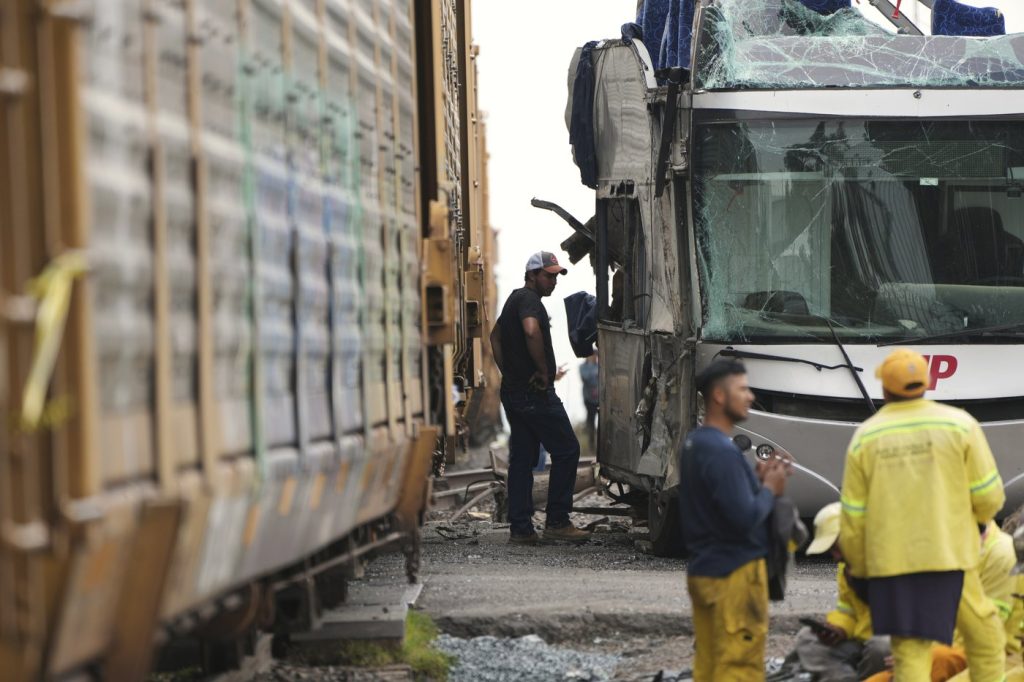
On Monday morning, a tragic accident occurred in Atlacomulco, Mexico, when a freight train collided with a double-decker bus carrying domestic and construction workers to Mexico City. The incident resulted in at least 10 fatalities and over 50 injuries, prompting families to rush to hospitals searching for loved ones.
Among the worried families was Isabel Segundo, 38, who frantically tried to reach her 17-year-old daughter, Yoana Segundo, on the bus. After an agonizing wait, Segundo expressed her relief upon learning that her daughter had survived. She, like many others, stood outside a hospital where medical personnel called out names through a megaphone, as they transported injured victims via stretchers to various medical facilities across the State of Mexico.
Authorities are investigating the incident, which was captured in videos showing the bus moving onto the tracks as traffic stalled in an industrial area about 80 miles (130 kilometers) northwest of Mexico City. A stop sign and a deteriorating railroad crossing sign were present, but there were no protective gates or lights to warn of an oncoming train. Miguel Sánchez, who worked nearby, described hearing the train's horn just before the devastating crash that he initially mistook for a less serious accident.
The bus company, Herradura de Plata, issued a statement expressing its commitment to cooperate with authorities while offering "medical, psychological, legal, and logistical" assistance to those affected. It also conveyed deep regret over the incident. Meanwhile, the train operator, Canadian Pacific Kansas City of Mexico, urged drivers to adhere to signage and comply with stop orders at railroad crossings to prevent future tragedies.
The collision left the bus in two pieces on opposite sides of the tracks. Eyewitnesses recounted the chilling aftermath as individuals were still found moving on the second floor of the bus while ambulances arrived. Wreckage included discarded clothing scattered across bus seats, emphasizing the chaos and despair of the moment. Family member Rebeca Miranda anxiously awaited news regarding her injured sister and the death of her sister's daughter-in-law, both of whom were domestic workers, voicing anger at the bus's decision to cross the tracks just before the train passed.
A report from Mexico's Rail Transportation Regulating Agency revealed that accidents at grade-level crossings have been on the rise, with 800 such incidents recorded last year compared to 602 in 2020. Past tragedies include the death of six individuals in a train crash in Guanajuato state and nine casualties in Queretaro in 2019 when a freight train collided with a passenger bus.
Alberto Maximino de Jesús, a 50-year-old laborer, was headed to Mexico City for work when the collision occurred. His wife, Florencia de Jesús Sabino, relayed his urgent call after the accident, expressing relief at his stable condition but also concerns over who would take responsibility for the traumatic event.
This horrific incident highlights the ongoing challenges associated with rail safety in Mexico, particularly regarding inadequate signage and warning systems at grade-level crossings. As families grieve and seek answers, the spotlight remains on the need for improved safety measures to prevent such tragedies from recurring.








