

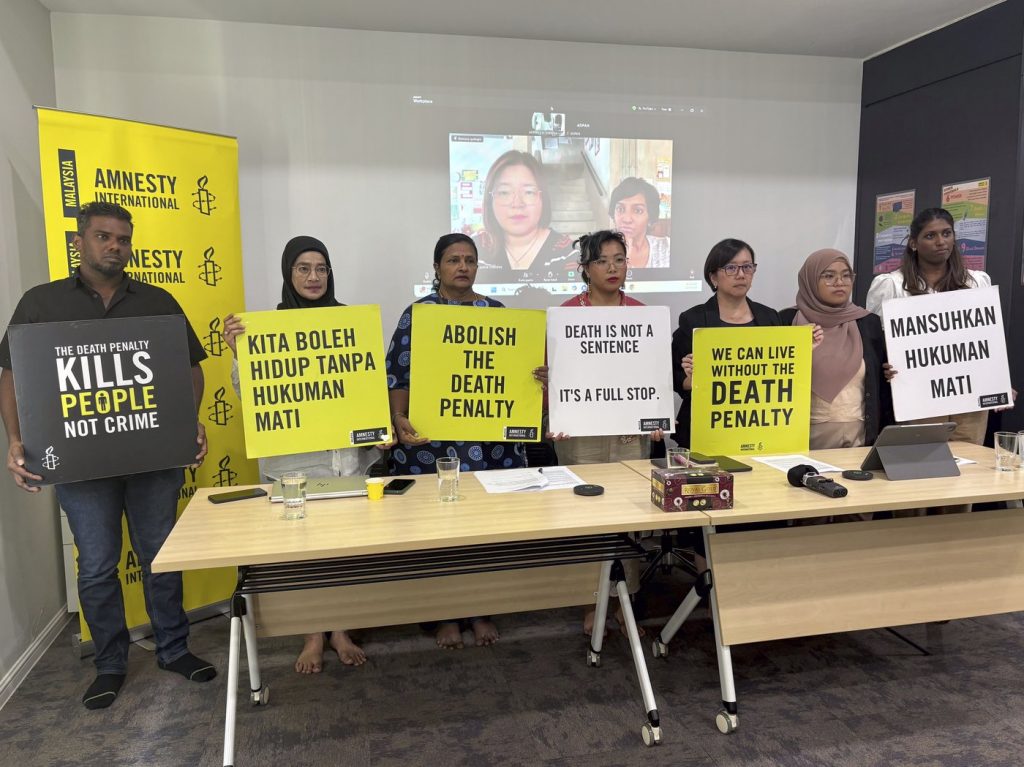
KUALA LUMPUR, Malaysia (AP) A Malaysian man, Datchinamurthy Kataiah, is scheduled to be executed this week in Singapore for heroin trafficking, according to anti-death penalty activists. This has reignited calls for a suspension of capital punishment in the city-state. If the execution proceeds, Kataiah, who is 39 years old, will become the third Malaysian national and the eleventh person to be hanged in Singapore this year.
His family received a notification on Sunday that his hanging will take place on Thursday at Changi Prison in Singapore. Kataiah was arrested in 2011 and subsequently convicted for trafficking approximately 45 grams (1.6 ounces) of heroin into Singapore. Although he was originally scheduled for execution in 2022, he received a last-minute reprieve while awaiting the outcome of a legal challenge, which was ultimately dismissed by the court in August.
Under Singapore's stringent laws, the death penalty is mandatory for individuals caught with more than 15 grams of heroin and 500 grams of cannabis. Critics argue that these laws disproportionately target low-level traffickers and couriers, often leading to severe consequences for individuals caught in difficult circumstances. At a recent joint press conference that included Amnesty International Malaysia and the Anti-Death Penalty Asia Network, Kokila Annamalai from the Transformative Collective Justice shared a letter from Datchinamurthy's sister, Rani. In her letter, she emphasized that her brother does not protest his punishment but believes that the death penalty is "too harsh and extreme for a young man's naive action."
The three rights groups, along with 30 other civil society organizations, have issued a joint statement reiterating their longstanding call to halt executions in Singapore. They also noted that three other Malaysians and a Singaporean man, all on death row for drug-related offenses, face imminent executions after having recently lost their appeals. In a notable development, the Cabinet of Singapore's Prime Minister Lawrence Wong advised President Tharman Shanmugaratnam to grant clemency to a Singaporean man facing a death sentence for drug trafficking. The president subsequently commuted the man's sentence to life in prison, marking the first clemency granted since 1998.
Activists believe this act of clemency indicates that change is possible in Singapore's approach to capital punishment. They have further urged Malaysia, which currently chairs the ASEAN bloc, to take concrete steps to protect its disadvantaged citizens from exploitation by drug syndicates. Malaysia recently abolished the mandatory death penalty in 2023, substituting it with prison terms ranging from 30 to 40 years. According to Amnesty International's 2024 global report, Malaysia commuted over 1,000 death sentences last year.
In stark contrast, Singapore reportedly increased its executions from five in 2023 to nine last year, with six of those carried out in a two-month period. As of now, more than 40 individuals remain on death row in Singapore. Amnesty International further highlighted that the Asia-Pacific region holds the highest number of executions globally, although factors such as secrecy and restrictive state practices in countries like China, Vietnam, and North Korea hinder the ability to obtain accurate figures regarding executions.








