

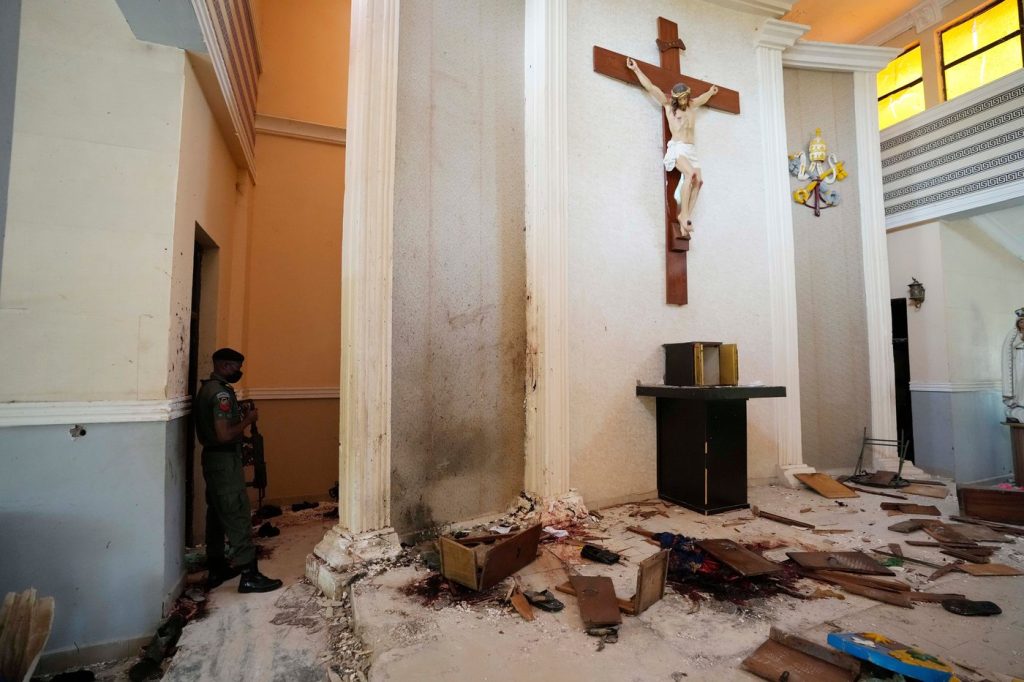
LAGOS, Nigeria (AP) – U.S. Senator Ted Cruz has been actively seeking to engage fellow evangelical Christians, pressing Congress to label Nigeria a violator of religious freedom based on allegations of "Christian mass murder," which the Nigerian government has strongly denied as unfounded. Cruz, who is a Republican and a member of the Senate Foreign Relations Committee, is advocating for Nigeria to be designated as a country of particular concern due to "severe violations" of religious freedom, a classification shared with nations such as Pakistan, Afghanistan, and China. Such a designation could lead to U.S. sanctions, and a bill he introduced last month is currently pending in the Senate without a clear path for approval.
Cruz's assertions have gained traction among some U.S. celebrities and commentators, who have echoed claims of a "Christian genocide," despite the absence of substantial evidence. His office has not responded to inquiries regarding his motivations behind these allegations.
Nigeria, home to approximately 220 million people, has a nearly equal population of Christians and Muslims. The nation has long struggled with insecurity stemming from various sources, including the Boko Haram extremist group that aims to enforce a radical interpretation of Islamic law while selectively targeting Muslims whom they consider insufficiently Islamic. The violent incidents in Nigeria have diverse motivations, incorporating religious factors alongside clashes over dwindling resources, communal disputes, and ethnic tensions.
While both religious communities are affected by violence, analysts indicate that the majority of armed group victims tend to be Muslims, particularly in Nigeria's predominantly Muslim northern regions where most attacks occur. Reports from both Muslim and Christian groups have at times characterized the violence as "genocide" in the context of religious attacks, especially in conflict-prone areas of north-central and northwestern Nigeria, where confrontations arise between farming communities—mostly Christians—and Fulani herders, who are primarily Muslims.
Joseph Hayab, a former chairman of the Christian Association of Nigeria based in Kaduna state, contended against the notion of a "Christian genocide." He acknowledged that while thousands of Christians have lost their lives over the years, the situation is reportedly better than it used to be, although every death remains condemnable.
The Nigerian government has publicly rejected Cruz’s claims. Information Minister Idris Muhammed stated to the Associated Press that "there is no systematic, intentional attempt either by the Nigerian government or by any serious group to target a particular religion." Nigeria was first added to the U.S. list of countries of particular concern in 2020, which the State Department cited for systematic violations of religious freedom; however, this designation was rescinded in 2023, interpreted by observers as an effort to enhance diplomatic relations ahead of then-Secretary of State Antony Blinken's visit.
In response to Cruz's latest allegations, the Christian Association of Nigeria has sought to highlight enduring issues regarding the persecution of Christians in Nigeria. The U.S. Commission on International Religious Freedom's 2024 report noted attacks impacting both Christians and Muslims, bidding farewell to the idea that violations are exclusively targeting one group, stating that "violence affects large numbers of Christians and Muslims in several states across Nigeria."
Recent data compiled by the U.S.-based Armed Conflict Location and Event Data program registered 20,409 fatalities linked to 11,862 assaults against civilians in Nigeria from January 2020 to September 2023. Of these incidents, 385 were identified as targeting Christians, resulting in 317 deaths, while 417 fatalities occurred among Muslims in 196 attacks during the same timeframe. Although religious affiliations have motivated certain aspects of Nigeria's security crisis, analysts stress that overarching complexities render it inadequate to classify all violence as solely religiously driven.
Experts have dismissed claims of genocide in Nigeria, asserting that the ongoing violence does not fit the legal definition outlined by the U.N. convention on preventing genocide, which emphasizes intent to destroy a particular group. Olajumoke Ayandele, an assistant professor specializing in conflict studies, remarked, "If anything, what we are witnessing is mass killings, which are not targeted against a specific group," warning that exaggerations surrounding genocide could escalate tensions among communities. Chidi Odinkalu, a professor at Tufts University, echoed the sentiment that Nigerian authorities must address the rampant violence afflicting the nation.








