

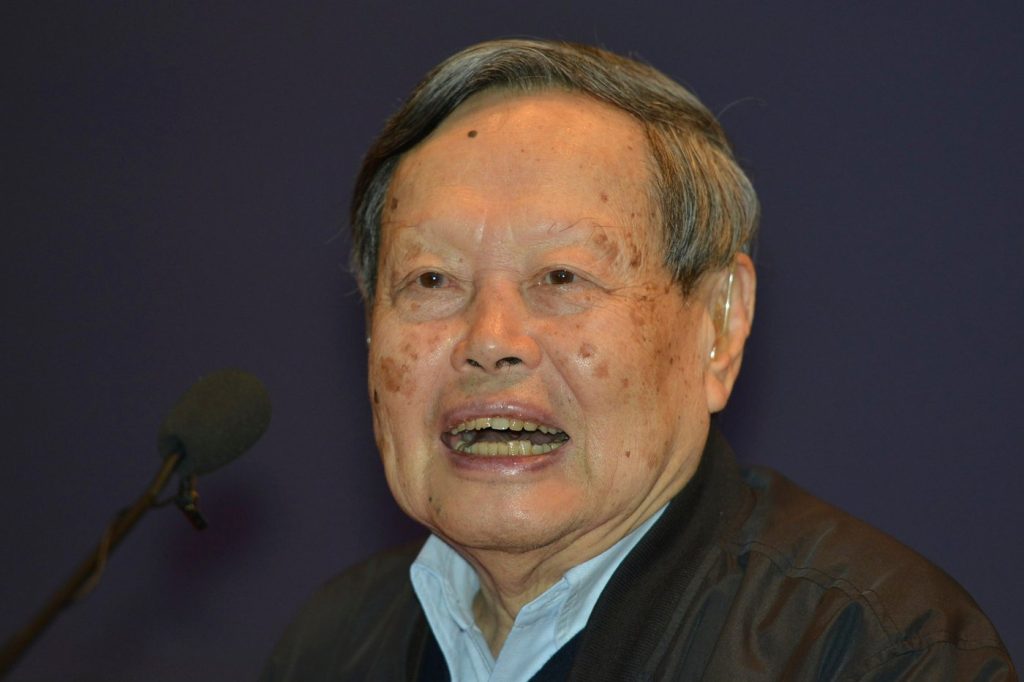
BEIJING (AP) Chen Ning Yang, a distinguished physicist and Nobel Prize winner, passed away in Beijing on Saturday at the age of 103. Yang was widely recognized as one of the most influential scientists in modern physics. Tsinghua University, where he studied and later served as a professor, announced his death, attributing it to an illness but did not provide further details.
In a statement, Tsinghua University hailed Yang as "one of the greatest physicists of the 20th century," emphasizing his revolutionary contributions to the field of modern physics and his pivotal role in advancing scientific education in China.
Yang was awarded the Nobel Prize in 1957 alongside Tsung-Dao Lee for their pioneering investigation of parity laws, which resulted in significant discoveries related to elementary particles. This achievement made them the first Chinese-born laureates in physics. During his Nobel Banquet speech, Yang expressed pride in his Chinese heritage as well as a strong dedication to modern science, which he viewed as a critical aspect of human civilization rooted in Western origins. He remarked, “I am heavy with an awareness of the fact that I am in more than one sense a product of both the Chinese and Western cultures, in harmony and in conflict.”
Known informally as Frank or Franklin, Yang was also renowned for developing the Yang-Mills theory in collaboration with American physicist Robert Mills. Born in 1922, Yang grew up on the campus of Tsinghua University, where his father held a position as a math professor. He completed his undergraduate studies at Tsinghua before obtaining a master’s degree there.
In 1946, Yang moved to the United States to pursue a doctorate at the University of Chicago, where he found mentorship under Enrico Fermi, an Italian-American physicist and Nobel Prize winner. Following his studies, Yang held a professorship at the Institute for Advanced Study in Princeton, further establishing his reputation in the scientific community.
In 1986, Yang became a distinguished Professor-at-large at the Chinese University of Hong Kong, generously contributing numerous awards and articles—including his Nobel Prize—to the institution. He resumed a position at Tsinghua University in 1999, further solidifying his ties to his alma mater.
A notable aspect of Yang's life was his experience with citizenship; according to a report by China's state news agency Xinhua in 2017, he had obtained American citizenship, a decision he described as painful and one that estranged him from his father. However, in 2015, he renounced his U.S. citizenship, reflecting on the opportunities the country provided him for studying science.
Throughout his life, Yang was a devoted family man, having three children. His legacy in the scientific community remains profound, and his contributions to physics are celebrated worldwide.
The world of science mourns the loss of Chen Ning Yang, whose work not only advanced the field of physics but also served as a bridge between cultures, enriching both Chinese and Western scientific endeavors.








