

On Friday, Nigeria's President Bola Tinubu announced the replacement of top security officials amid ongoing security challenges plaguing the country, particularly in the conflict-impacted northern regions. The reshuffle included the dismissal of Chief of Defense Staff Christopher Musa, Chief of Naval Staff Emmanuel Ogalla, and Chief of Air Staff Hassan Abubakar. The changes come as the Nigerian government seeks to address persistent violence and unrest, with no specific reason provided for the shake-up.
Recent weeks have seen increased public anxiety over potential coup rumors, intensified by the arrest of over 20 military officers, including a brigadier general and a colonel, in September. Despite the government's assurance dispelling these rumors, fears remain prevalent, reflecting a broader concern regarding military stability in West African nations. This comes in the context of military coups having taken place in neighboring Mali, Burkina Faso, and Niger within the last three years.
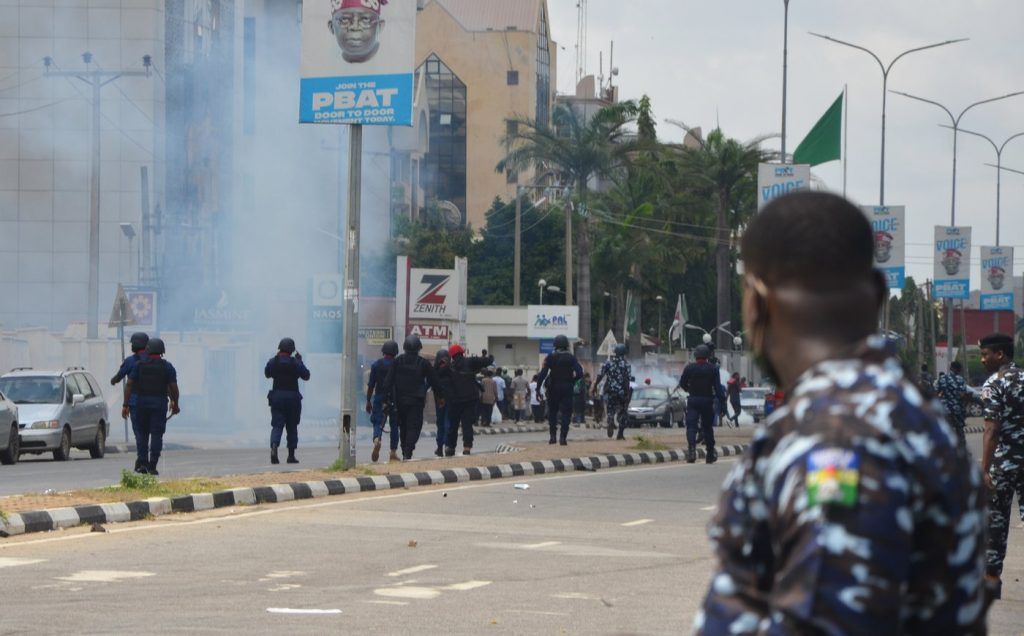
This week, Abuja was the scene of protests as demonstrators clashed with police, who used tear gas to disperse crowds demanding the release of Nnamdi Kanu, the leader of the Indigenous People of Biafra separatist group. This group advocates for the independence of Nigeria’s southeastern region. The protests highlight the ongoing tensions within the country, further complicated by the rise of various armed groups across Nigerian territory.
Among these groups is Boko Haram, Nigeria’s homegrown jihadi organization, which has seen a notable resurgence this year. Established in 2009, Boko Haram has sought to impose its radical interpretation of Islamic law while opposing Western education. In addition, its splinter group, Ansaru, and the Islamic State West Africa Province—an affiliate of the Islamic State group—have also perpetrated acts of violence, contributing to the nation's insecurity. Criminal enterprises involved in kidnapping for ransom and looting tactics known as "bandits" are also prevalent, reflecting a multifaceted security dilemma.
In recent months, there have been reports of Islamic extremists increasingly attacking military outposts, laying mines on roads, and raiding civilian settlements. These incidences have raised concerns over a potential return to the significant instability experienced during the peak of Boko Haram's activities, despite official claims of military successes against such groups. Earlier this year, the United States approved a substantial arms sale worth $346 million to Nigeria to strengthen its defense capabilities against militancy and banditry.
President Tinubu has appointed Olufemi Oluyede, the former chief of army staff, as the new chief of defense staff. Three other appointments were made, including W. Shaibu as chief of army staff, I. Abbas as chief of air staff, and S.K. Aneke as chief of naval staff. The president has tasked this new leadership with enhancing the professionalism, vigilance, and camaraderie that are essential to the Nigerian Armed Forces.
As Nigeria grapples with a myriad of security threats, including ongoing civil unrest and armed insurgency, the geopolitical landscape of West Africa continues to be closely monitored by analysts, who warn that the region may witness further military upheaval. Senator Iroegbu, a security analyst in Abuja, noted that these changes in Nigeria's military leadership signal a potential shift towards prioritizing regime stability over broader security challenges.








