

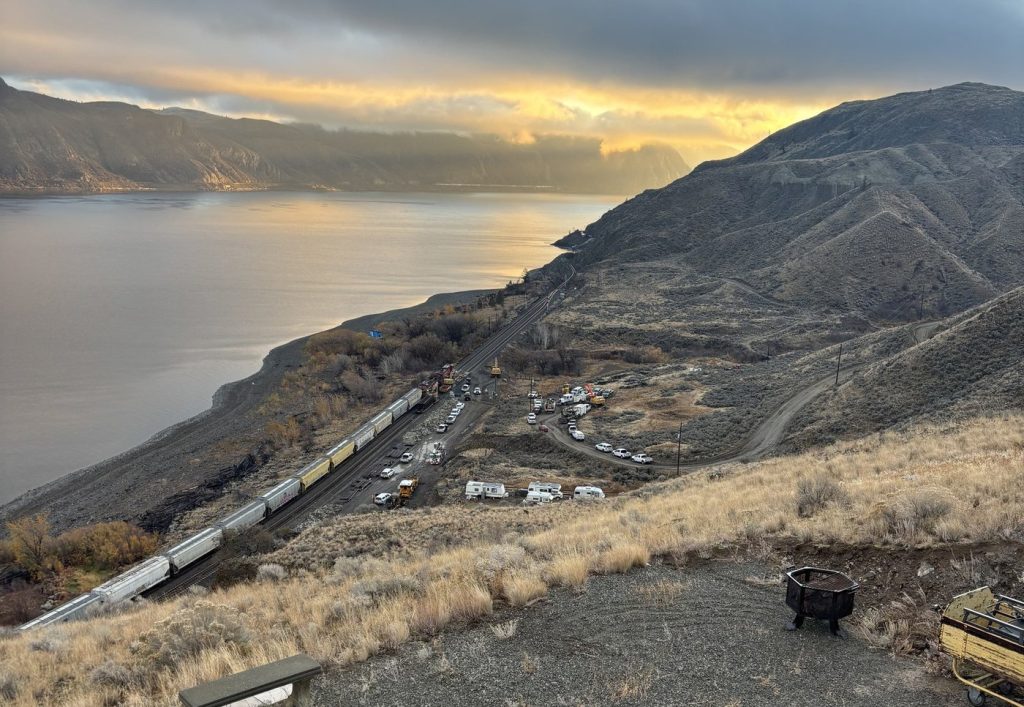
KAMLOOPS — Cleanup efforts are currently in progress following the derailment of multiple cars from a Canadian Pacific Kansas City (CPKC) train. The incident occurred approximately 20 kilometers west of Kamloops, British Columbia, on Saturday evening around 7 p.m. Fortunately, no injuries were reported in connection with the derailment, which involved about 17 rail cars leaving the tracks.
According to a statement released by CPKC, a preliminary assessment revealed that four of the derailed cars were loaded with fuel, while five carried gypsum, a powdery substance commonly used in drywall production. Additionally, one car contained pulp products, with the remaining rail cars being empty. Notably, three of the empty cars had previously carried gasoline.
The railway company disclosed that some product had leaked from two of the fuel-loaded cars, and a containment boom was promptly deployed at the derailment site to mitigate any environmental impact. Michael Grenier, a director with the Thompson-Nicola Region District Area J, inspected the scene on Sunday morning and located one car transporting gypsum positioned precariously on the embankment leading to Kamloops Lake. In addition, he noticed another car filled with jet fuel resting at the lake's edge.
An online communication from the Ministry of Environment confirmed that the derailment, which transpired near Cherry Creek, resulted in spills of both fuel and gypsum. The Thompson-Nicola Region District later issued a statement assuring the public that there is currently no anticipated risk to the Savona Community Water System. Furthermore, other privately-owned domestic water systems in the area are collaborating with Interior Health to assess any potential impacts stemming from the incident.
Officials from the Thompson-Nicola Region District, the Ministry of Environment, and Interior Health are maintaining close surveillance of the situation, while CPKC is actively working to clean and contain the products involved in the derailment. Grenier remarked that the railway company is committed to removing all contained products that have entered the lake.
In light of the circumstances, Grenier expressed confidence regarding the safety of the community, stating, “We satisfied ourselves that there was no immediate threat to the Savona Community Water System.” Meanwhile, CPKC has initiated an investigation to determine the underlying cause of the derailment.
This incident highlights the importance of prompt response measures in the event of a train derailment, particularly when hazardous materials are involved. The ongoing cleanup efforts and assessments by local health and environmental authorities underscore the region's commitment to ensuring the safety and well-being of its residents and natural resources.








