

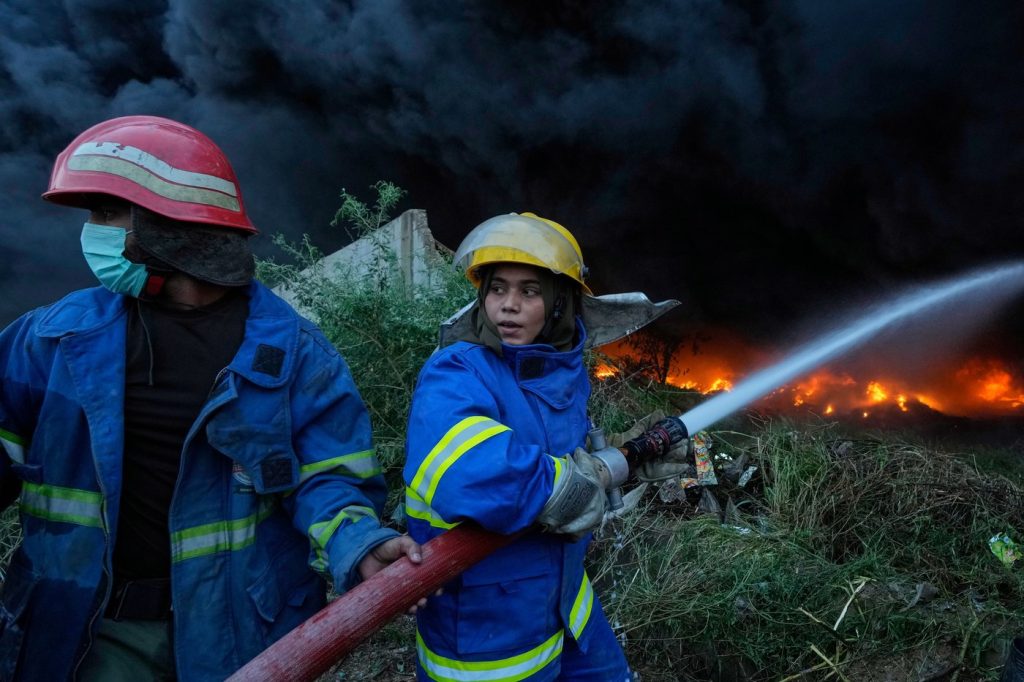
KARACHI, Pakistan (AP) - An intense blaze engulfed a storage facility in Karachi last week, sending thick black smoke billowing into the sky. Firefighter Syeda Masooma Zaidi, along with her predominantly male firefighting team, swiftly responded to the emergency, battling the flames fueled by truck and car tires. The suffocating heat and acrid air posed significant challenges as the team worked diligently to extinguish the fire that threatened nearby factories.
After several hours, the firefighters successfully brought the blaze under control, averting any loss of life, although the financial damages were considerable, amounting to tens of thousands of dollars. As Zaidi and her colleagues emerged from the smoke, they were greeted with cheers from onlookers who observed their bravery and resilience in the face of danger.
At just 23 years old, Zaidi represents a significant shift in a country where women firefighters have only recently begun to emerge. The landscape of firefighting in Pakistan started to change with the pioneering efforts of Shazia Perveen, who became the first woman firefighter in 2010 in eastern Punjab province. By 2024, women began joining firefighting services in Sindh province, further establishing their presence in this traditionally male-dominated field.
Currently, women make up less than 1% of Pakistan's firefighting workforce; however, there are expectations for continued growth in female participation. Zaidi, along with her female colleagues, aims to challenge stereotypes and demonstrate that women are equally capable in high-pressure roles. Her chief fire officer, Humayun Khan, has commended the contributions of women like Zaidi, while Dr. Abid Jalaluddin Shaikh, chief of the Sindh Emergency Service, notes that initiatives are now yielding tangible results.
Zaidi's rigorous training at the Punjab Rescue Service Academy equipped her with essential skills, including high-angle rescues and fire emergency management. Despite her expertise, she often encounters skepticism regarding her abilities due to prevailing cultural attitudes. “When we arrive, people say, ‘She’s a girl – how can she rescue anyone?’” Zaidi explained. “Every time we save a life, we prove that women can also do this job.”
Her fellow firefighter, Areeba Taj, echoed this sentiment, recounting their experiences amid the chaos of emergency situations. They work closely with their supervisor, Ayesha Farooq, who emphasizes the unique strengths women bring to rescue situations, especially in cases involving women and children. Farooq believes that by participating in emergency services, these women earn respect for themselves and their country.
Zaidi, who grew up in a large family with seven brothers and one sister, remains motivated by a sense of courage, duty, and faith. She is determined to continue breaking down barriers and proving that women can excel in this challenging profession. The recent incidents in Karachi have reinforced this message as Zaidi and her colleagues head back to their fire station, ready to respond to the next alarm and prove once again that gender is no barrier to bravery.








