

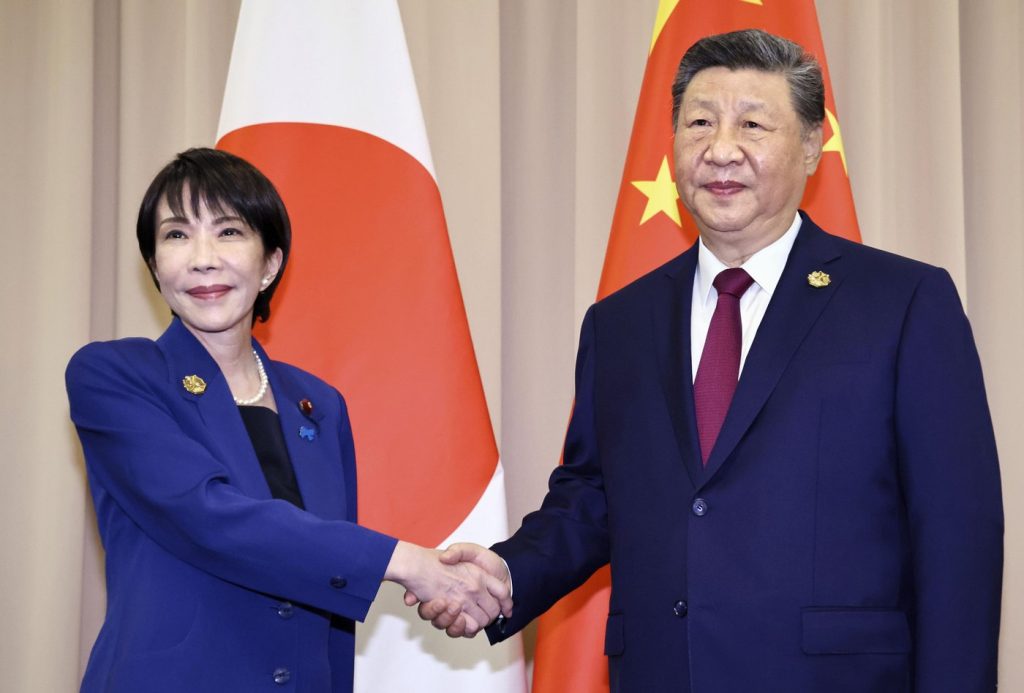
BEIJING (AP) - Less than a month into her term, Japan's Prime Minister Sanae Takaichi has heightened tensions with China by suggesting that a Chinese military move against Taiwan could elicit a military response from Japan. Her comments represent a significant shift from the more cautious stance taken by previous Japanese leaders regarding Taiwan, underscoring her more aggressive approach to reliance on military force in response to perceived threats.
During a parliamentary committee session on November 7, Takaichi indicated that a Chinese naval blockade or aggression towards Taiwan could justify a Japanese military reaction. Her statement has evoked a strong reaction from China, which considers Taiwan a critical part of its territory and views any foreign involvement as interference in a domestic issue. The Chinese government has consistently labeled Taiwan’s status as a "red line” that must not be crossed by outside forces, particularly the United States, which is known to supply Taiwan with military aid.
Takaichi’s remarks drew attention as they went beyond the vague concerns about China’s posture toward Taiwan mentioned by her predecessors. While previous Japanese officials have articulated apprehensions regarding China’s threats to Taiwan, they have been reluctant to discuss Japan’s potential military involvement. Following her initial statement, Takaichi reaffirmed her comments, though she indicated a desire to refrain from speculating about specific situations moving forward.
Historically, Japan’s military involvement has been constrained by its post-World War II constitution, which limits the use of force to self-defense. However, Takaichi, an ally of former Prime Minister Shinzo Abe, seems to be pushing the boundaries of this limitation. Abe had previously succeeded in broadening the military's powers, enabling Japan to assist allies in cases deemed an existential threat. Takaichi has suggested that a Chinese incursion into Taiwan could indeed meet that threshold.
In response to her comments, the Chinese government mobilized a significant diplomatic backlash. China’s foreign and defense ministries, alongside state media outlets, condemned Takaichi’s remarks. Notably, the Chinese consul general in Osaka, in a now-deleted social media post, remarked that China would have to respond to such provocations decisively. Japan's Foreign Minister Toshimitsu Motegi criticized the inappropriate nature of the consul's comment and reaffirmed Japan's stance on Taiwan, declaring that the nation’s position remains unchanged despite the criticisms from China.
As tensions escalated, China issued a travel advisory against visiting Japan, affecting what is a crucial sector for Japan’s economy. In the nine months leading up to this incident, around 7.5 million Chinese tourists had visited Japan, making them the largest group of foreign tourists in the country. Meanwhile, China's Education Ministry warned Chinese students in Japan about recent crimes against their compatriots, although it stopped short of advising against travel entirely.
Additionally, China's coast guard announced an increased patrolling effort around a contested group of uninhabited islands claimed by both nations, further intensifying the dispute. Japan is particularly concerned about potential economic ramifications should China decide to limit the export of rare earth materials vital for many of Japan’s industries, especially automotive manufacturing.
As diplomatic interactions continued to unfold, Japan remained cautious. Foreign Minister Motegi conveyed plans to engage China in discussions aimed at preventing serious fallout on diplomatic relations. Efforts are underway to mitigate escalating tensions while navigating the complexities introduced by Takaichi’s assertive posture on Taiwan.
In a broader context, Japan's alliance with the United States looms large as both nations navigate the evolving regional security landscape. While Takaichi's public comments serve to bolster her hawkish stance on China, her administration faces the challenge of remaining aligned with historic pacifist policies, as she attempts to balance national security with diplomatic prudence.








