

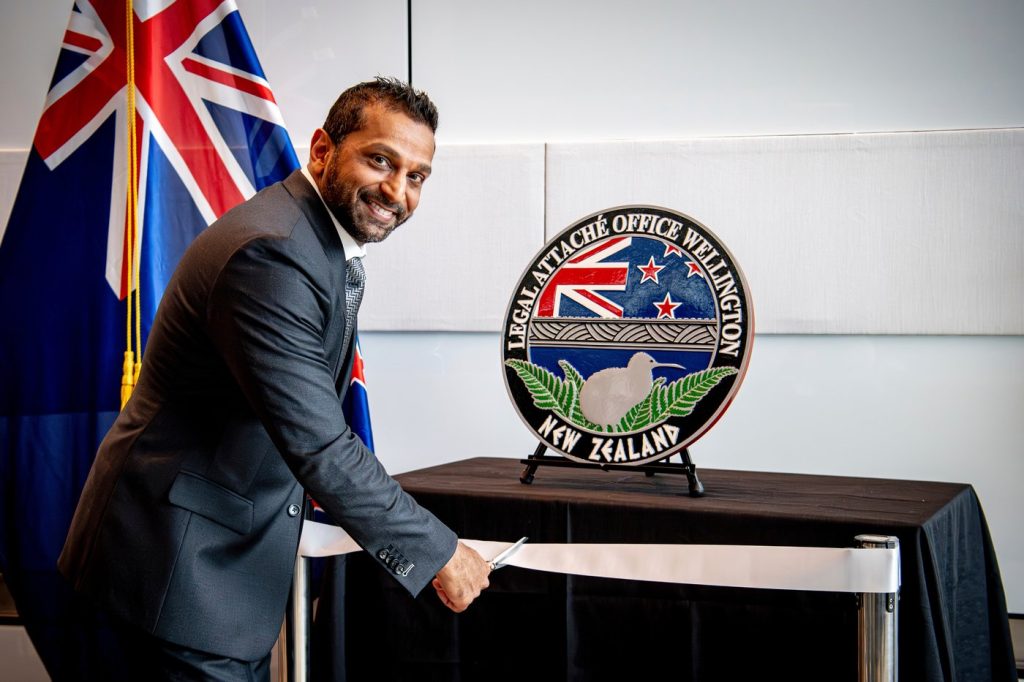
In Wellington, New Zealand, a controversial incident unfolded involving inoperable pistols gifted by FBI Director Kash Patel to senior New Zealand security officials. These guns, specifically 3D-printed replica revolvers resembling toy Nerf guns, were surrendered for destruction as they were deemed illegal under New Zealand law. Police documents revealed that the revolvers were identified as the Maverick PG22, a working model inspired by brightly colored toy guns.
The strict gun regulations in New Zealand require individuals to obtain a special permit beyond a standard gun license to legally possess pistols. Law enforcement officials have not clarified whether the senior officials who received the gifts held the necessary permits, indicating that, without them, the officials could not legally retain the guns. Following the surrender, police communications confirmed that the gifted firearms fit within the legal definition of firearms under New Zealand's stringent laws regarding 3D-printed weapons. In the country, these weapons are classified the same as conventional firearms.
Patel's visit to New Zealand marked him as the highest-ranking official from the Trump administration to travel to the country, where he was inaugurating the FBI’s first standalone office. Requests for comments from Patel's spokesperson went unanswered. According to documents received by the Associated Press, inoperable weapons can be treated as functional under New Zealand law if they can be easily modified to become operational. Daniel Millar, police armory team leader, stated in an email that making these guns operable would require minimal tools and skills, further raising concerns about potential misuse.
Concerns about the safety of 3D-printed weapons are further compounded by academic insights. Professor Alexander Gillespie from the University of Waikato emphasized the risks associated with such firearms, highlighting the danger of them being successfully modified for illicit use, as well as the risk of accidental explosions given their home-manufactured nature. The online instructions for creating the Maverick PG22 warn that it lacks modern safety features and should only be used in controlled environments.
Five officials received the gifted revolvers on July 31, including Andrew Hampton, the director-general of New Zealand's intelligence agency NZSIS, and Andrew Clark, head of the technical intelligence agency GCSB. Police Minister Mark Mitchell and Judith Collins, responsible for overseeing military and spy agencies, were also recipients. All five officials voluntarily returned their gifts for destruction on September 25 after determining they did not meet legal possession requirements.
The New Zealand Police declined to release images of the guns, citing potential damage to diplomatic relations with the United States, which raised further concerns regarding transparency. They did not clarify how revealing images of Patel's gifts could adversely affect New Zealand's relationship with the U.S., despite the availability of photos and instructions for making the Maverick PG22 accessible online.
New Zealand's history with firearms regulation has been impacted by heightened gun control measures since the tragic 2019 Christchurch mosque shootings, where an Australian gunman killed 51 worshippers. Although the Maverick PG22 is not among the now-prohibited semiautomatic firearms, significant restrictions still prevent individuals from possessing certain weapons without appropriate permits. The cultural attitude towards gun ownership in New Zealand is generally cautious, with ownership perceived more as a privilege than a right.
Rural areas do have common usage of firearms, primarily for pest control, but violent gun crime is relatively rare, leading many urban residents to have minimal exposure to firearms. Furthermore, it is uncommon for police officers in New Zealand to carry guns while on patrol, as they typically leave their firearms locked in their vehicles.








