

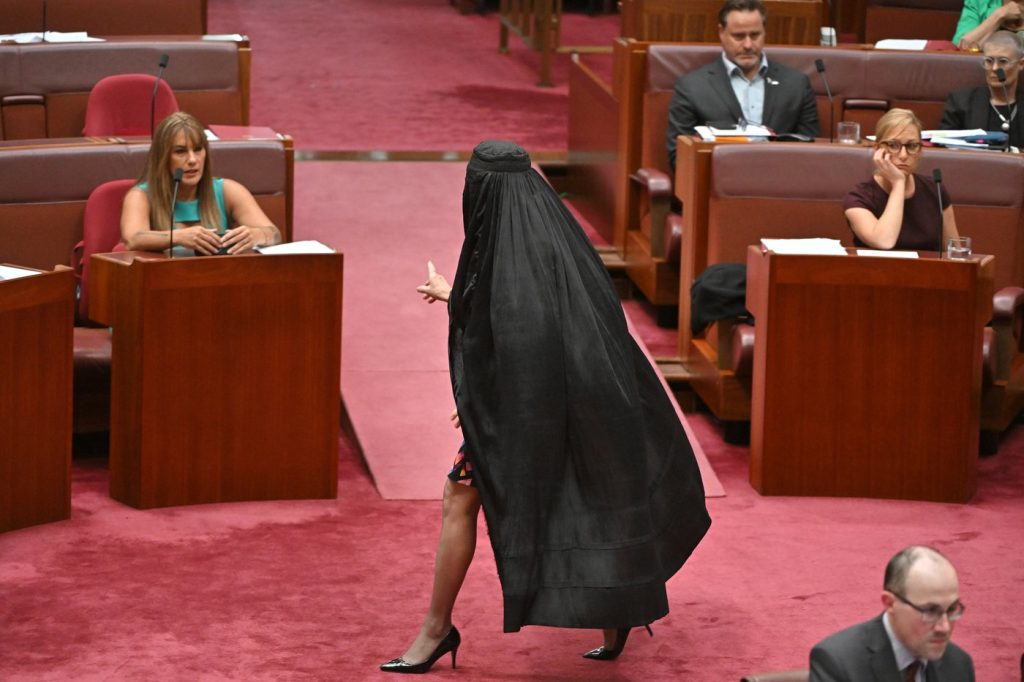
MEBOURNE, Australia (AP) – An Australian senator advocating for a national burqa ban faced significant repercussions on Tuesday after she wore the Muslim garment in the Parliamentary chamber. Pauline Hanson, the 71-year-old leader of the One Nation anti-Muslim and anti-immigration party, was suspended for the remainder of the year due to her actions considered disrespectful by her colleagues.
Hanson created a stir on Monday when she entered the Senate clad in a burqa to protest the refusal of her fellow senators to consider her proposed bill that would prohibit burqas and other full-face coverings from public spaces. Her act was perceived as a stunt rather than a sincere form of protest. Following her action, senators suspended Hanson's participation for the remainder of that day. Absent an apology from her, they then enacted a censure motion on Tuesday—this was a severe penalty reflecting growing discontent among the Senate members.
The censure led to one of the most stringent penalties imposed on a senator in recent years, barring her from attending seven consecutive Senate sitting days. The Senate was scheduled to adjourn for the year on Thursday, meaning that her suspension would extend into February when Parliament resumes next year.
In a response to the media, Hanson expressed her belief that she would be judged by the electorate in the upcoming 2028 elections rather than her Senate peers. She argued, "They didn’t want to ban the burqa, yet they denied me the right to wear it on the floor of Parliament. There is no dress code on the floor of Parliament, yet I’m not allowed to wear it. So to me, it’s been hypocritical." This stance echoed her previous protest in 2017 when she wore a burqa in the Senate, a move that had garnered outrage at the time but did not lead to any punitive measures against her then.
Penny Wong, the Malaysian-born government leader in the Senate, who is not Muslim, formally introduced the censure motion, criticizing Hanson for "mocking and vilifying an entire faith" practiced by nearly 1 million Australians out of a total population of 28 million. Wong denounced Hansen's actions as "hateful and shallow pageantry," indicating that such behavior threatens the social fabric of Australia and could lead to harmful consequences, particularly for vulnerable populations, including schoolchildren.
Mehreen Faruqi and Fatima Payman, the only Muslims currently serving in the Senate, highlighted the implications of Hanson’s actions. Faruqi remarked that Hanson's actions should ignite initiatives to confront the structural and systemic racism in Australia. Payman, who wears a hijab, also condemned Hanson's usage of the burqa as "disgraceful" and "a shame,” emphasizing the sensitivity surrounding such representations and protests within the parliamentary context.
Previously, in a widely publicized incident, Hanson had breached a racial anti-discrimination law when she made derogatory remarks on social media directed at Faruqi, prompting a ruling that she must appeal. Rateb Jneid, president of the Australian Federation of Islamic Councils, described Hanson’s actions as part of an ongoing trend of behavior that vilifies Muslims, migrants, and minorities.
Pauline Hanson has long been a controversial figure in Australian politics, widely recognized for her divisive views on race since her inaugural speech in Parliament in 1996, where she asserted that Australia was in danger of being "swamped by Asians" due to its non-discriminatory immigration policies.








