

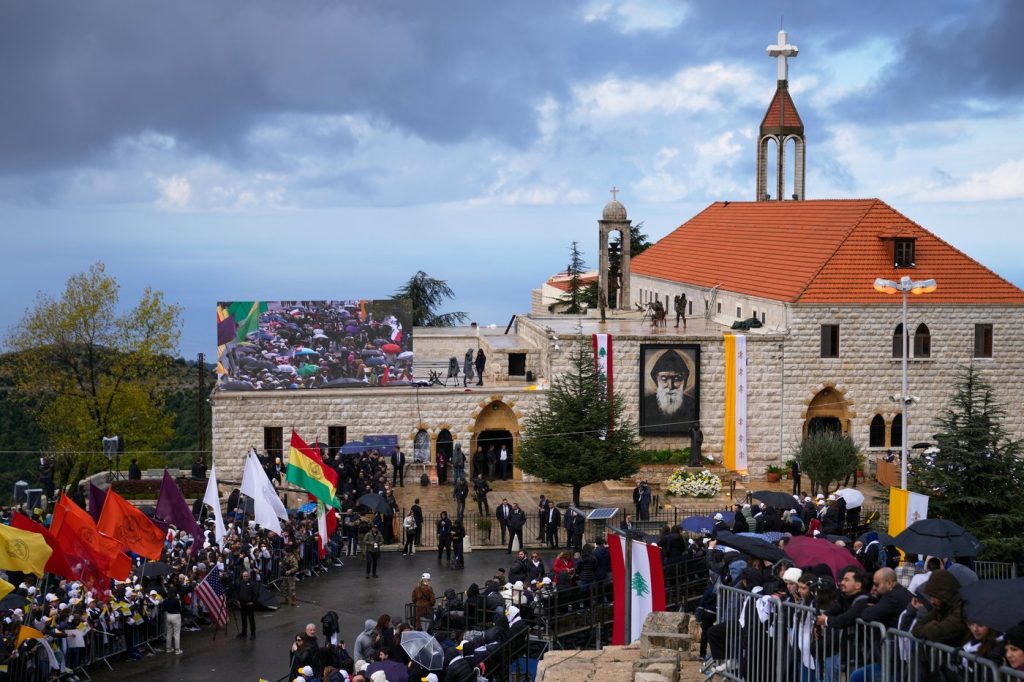
ANNAYA, Lebanon (AP) — Pope Leo XIV began his first full day in Lebanon on Monday with a message of peace and religious coexistence as he prayed at the tomb of St. Charbel Makhlouf, a revered Lebanese saint recognized by both Christians and Muslims. His visit signifies an effort to promote harmony in a region fraught with conflict.
The bells rang as Leo's covered popemobile made its way through rain, while thousands of enthusiastic Lebanese lined the streets to welcome him into Annaya, approximately 40 kilometers (25 miles) from Beirut. Many of the crowd waved Lebanese and Vatican flags, showering his vehicle with flower petals and rice.
Pope Leo XIV, making history as the first pope to visit St. Charbel's tomb, quietly prayed and presented a lamp as a gift of light to the monastery. "Sisters and brothers, today we entrust to St. Charbel’s intercession the needs of the church, Lebanon, and the world," he stated in French. "For the world, we ask for peace. We especially implore it for Lebanon and for the entire Levant."
Following his visit to the tomb, Leo traveled to Harissa, north of Beirut, where he was greeted passionately by priests and nuns at the Our Lady of Lebanon Basilica. The crowd expressed their admiration through cheers of "Viva il Papa" (“Long live the pope”) as they sought to touch him, showcasing the deep connection and respect that the community holds for him.
Pope Leo XIV was scheduled to participate in an interfaith gathering with Lebanese Christian and Muslim leaders in Beirut later in the day. This event aims to reinforce his message of peaceful coexistence in Lebanon, particularly amidst the ongoing turmoil in Gaza and significant political tensions in Lebanon. The pope's visit comes during a challenging period for Lebanon, which has faced severe economic crises and political deadlock, including the catastrophic Beirut port blast in 2020.
The Rev. Youssef Nasr, the secretary-general of Catholic Schools in Lebanon, emphasized the importance of the pope's presence at such a critical time, stating, "We, as Lebanese, need this visit after all the wars, crises, and despair that we have lived. The pope’s visit gives a new push to the Lebanese to rise and cling to their country."
Lebanon is experiencing a profound divide, particularly surrounding calls for the disarmament of Hezbollah, a Lebanese militant group and political entity. During his visit, Leo traveled in a closed popemobile—a notable difference from Pope Francis, who often used an open vehicle. Security was tight, with Lebanese troops stationed along the route of Leo’s motorcade.
That evening, the pope was set to conclude his day at a rally for Lebanese youth at Bkerki, the Maronite church's seat, where he would encourage young people to persevere in their homeland despite numerous challenges prompting an exodus of citizens.
On his arrival in Lebanon from Turkey, Pope Leo XIV had called on Lebanon’s political leaders to set aside their differences and work towards genuine peace-making. He emphasized the need for Lebanese Christians to remain in the country, as they constitute about one-third of the population of 5 million, making Lebanon the only Arab nation with a Christian head of state following a power-sharing agreement established after independence from France.
Despite the challenges faced by the Christian community in Lebanon, which has been a stabilizing force amid nearby turmoil, there remains hope. "We will stay here," declared May Noon, a pilgrim outside the St. Charbel Monastery, affirming the resilience of the Christian community. Bishop Antoine-Charbel Tarabay’s remarks mirrored this sentiment, stressing the urgency to support the Christian presence in Lebanon for future generations. He articulated the gratitude felt by Lebanese people for Leo’s choice to visit, recognizing their suffering and assuring them they are not forgotten.








