

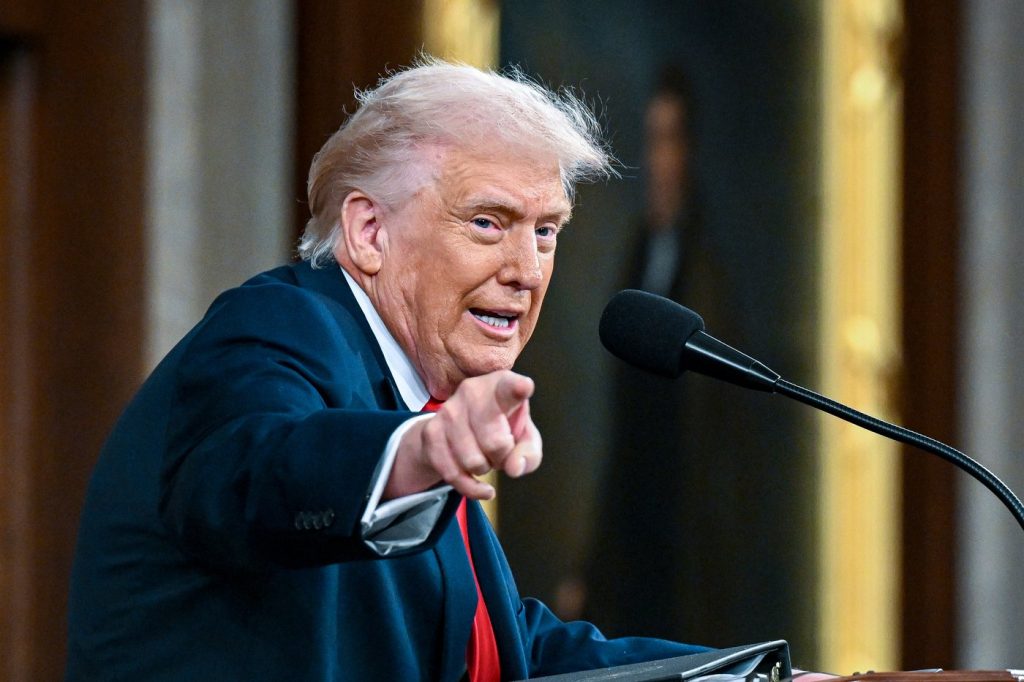
WASHINGTON (AP) – President Donald Trump praised his immigration and border security record during his State of the Union address, emphasizing the significant decline in migrant arrivals at the southern border since he assumed office in January 2025. He claimed, "Today our border is secure," asserting that the United States now has the "strongest and most secure border in American history," citing the admission of zero illegal aliens over the past nine months.
While Trump focused on these achievements, he largely neglected the repercussions of federal enforcement operations in cities like Minneapolis and Chicago, where residents protested against the tactics employed by federal officers. Notably, the shooting deaths of two U.S. citizens in Minneapolis in January sparked widespread backlash against the government's actions, raising questions about the immigration officers' enforcement methods under Trump's administration.
Immigration has consistently been a cornerstone of Trump's political agenda and a decisive factor in his re-election in 2024. His administration has implemented sweeping changes in enforcement policies and allocated billions of dollars to support agencies responsible for executing his immigration agenda. This shift is anticipated to influence immigration enforcement strategies throughout Trump's current term, affecting everything from detention statistics to asylum adjudications.
One significant trend is the decline in border arrests. Under President Joe Biden, Republicans closely monitored the influx of migrants at the U.S.-Mexico border, often labeling it a crisis. The number of individuals arrested while attempting to enter the U.S. illegally peaked at nearly 250,000 in December 2023 but began to decrease throughout Biden's term. By December 2024, just before Trump took office, the number of arrests had dropped to slightly over 46,000. As of February 2025, that figure plummeted to less than 8,000 and has remained at that level or lower since.
In stark contrast, arrests made by U.S. Immigration and Customs Enforcement (ICE) experienced a surge. In December 2024, ICE reported 8,507 arrests, a number that rose significantly in 2025, climbing to 17,000 by February, reaching nearly 30,000 by June, and peaking at 32,771 by September. This escalation in arrests corresponds with the relaxation of restrictions on those eligible for arrest and removal.
Accompanying the rise in ICE arrests is a dramatic increase in the number of detainees held in ICE's facilities across the nation. Allocated $45 billion to expand its detention capacity, the Department of Homeland Security is moving toward building or renting new facilities. Average daily detention numbers, which hovered around 40,000 in December 2024, climbed to 70,000 by February 2025, with plans to reach a capacity of up to 100,000 detainees.
ICE's significant funding is driving a robust expansion of immigration enforcement operations. With approximately $30 billion dedicated to hiring 10,000 new deportation officers and other funds aimed at completing Trump's promised border wall, the agency is ramping up efforts to improve border security. This emphasis also extends to the hiring of additional Customs and Border Protection officers and enhancing the immigration courts.
The asylum process has also become increasingly challenging under Trump's administration. The number of immigrants seeking asylum at the U.S.-Mexico border has swelled, contributing to significant backlogs in immigration courts. Consequently, the denial rates for asylum applicants have surged; in Trump's second term, these rates increased by 22.5%, following a previous trend of rising rejections during his first term.
Lastly, the deportation strategy employed by the Trump administration continues to be characterized as targeting the "worst of the worst." However, data indicates a notable decrease in the percentage of individuals with criminal histories among those arrested by ICE. In mid-October, only about 55% of arrests involved individuals with prior criminal backgrounds, contrasting with 86% before Trump took office. Critics argue that merely being arrested does not necessarily imply severe criminal behavior, as many involved minor infractions rather than serious felonies. The shift reflects a broader approach by ICE, which is increasingly conducting collateral arrests and employing various tactics to boost arrest numbers.








