

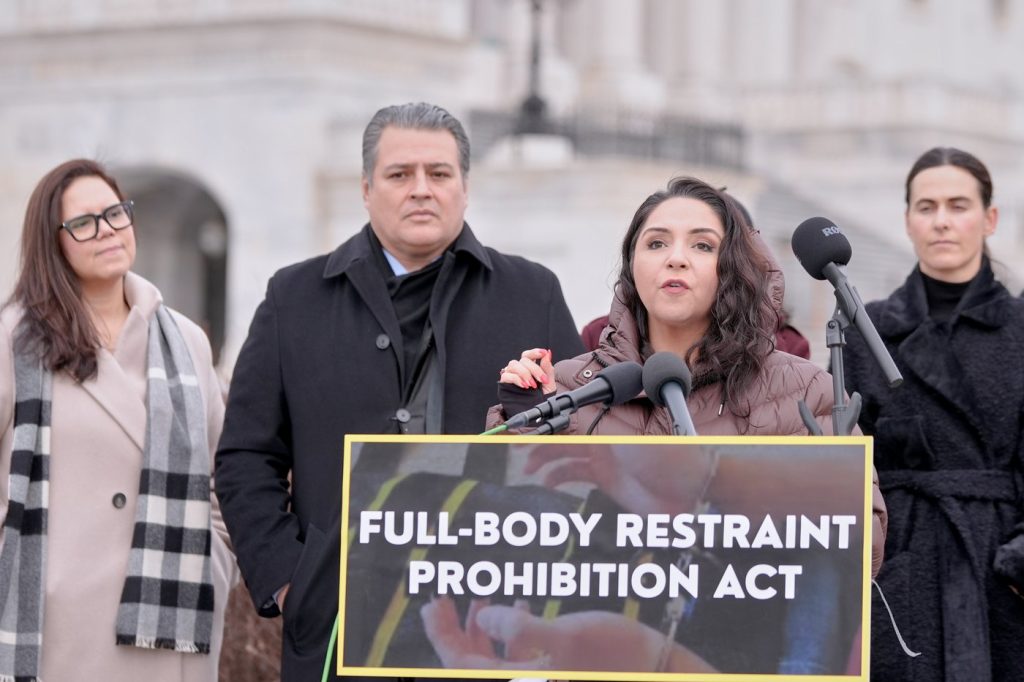
The Department of Homeland Security (DHS) is facing potential restrictions on its use of a full-body restraint device known as the WRAP under new legislation introduced in the House of Representatives. The bill, named the Full-Body Restraint Prohibition Act, is sponsored by U.S. Representative Delia Ramirez, a Democrat from Illinois. This proposed legislation aims to prohibit any future purchases of the WRAP and establish oversight and reporting requirements concerning its use.
In announcing the bill, Rep. Ramirez referenced an Associated Press investigation that highlighted numerous instances of U.S. Immigration and Customs Enforcement (ICE), a division of DHS, using the WRAP on individuals during deportation flights since as far back as 2020. Ramirez remarked that the device "fuels destruction in our communities and human suffering," noting that the legislation is a step toward ending the pain and violence associated with DHS practices.
The WRAP, produced by Safe Restraints Inc., based in California, has been the subject of multiple federal lawsuits, with critics likening its misuse to forms of punishment and even torture. Advocates have raised concerns that ICE is not keeping proper records of the WRAP's application, as mandated by federal law concerning the use of force. This lack of documentation complicates efforts to track how many individuals have been subjected to these restraints.
Moreover, the Associated Press identified a dozen fatal incidents over the past decade where local law enforcement and jailers applied the WRAP, with autopsy findings indicating that restraint contributed to the deaths. Despite a 2023 report from DHS's civil rights division expressing concerns over the device, ICE has continued its usage amid reports of fatalities linked to the restraint in local jurisdictions.
The DHS has not provided detailed responses to the AP regarding its use of the WRAP, nor has it commented on the new bill. Federal purchasing records indicate that DHS has spent approximately $268,523 on the WRAP since it began procurement in late 2015 during the Obama administration, with the Trump administrations accounting for about 91% of that expenditure.
Charles Hammond, CEO of Safe Restraints Inc., asserted that the WRAP was created as a "safer, more humane, pain-free alternative to other restraint methods." He cautioned that removing the WRAP would force authorities to revert to older restraint techniques that have historically caused pain, injury, and even death. The company produced a modified version of the WRAP specifically for ICE, incorporating design changes that allow for extended use during flights and long bus rides.
However, the AP investigation reveals that ICE agents frequently deploy the WRAP with a much lower threshold than recommended by the manufacturer. Detainees reported that ICE officers restrained them even after they had already been shackled, often using the device as a means of intimidation or punishment for expressing fear about deportation or requesting legal assistance. Hammond acknowledged that if detainees were not being violent but merely protesting verbally, their restraint could be considered an improper application of the device.
The investigation prompted a coalition of 11 Democratic U.S. senators to write to immigration officials, expressing their concerns about ICE's use of full-body restraints in deportation flights and highlighting the associated human rights implications.








