

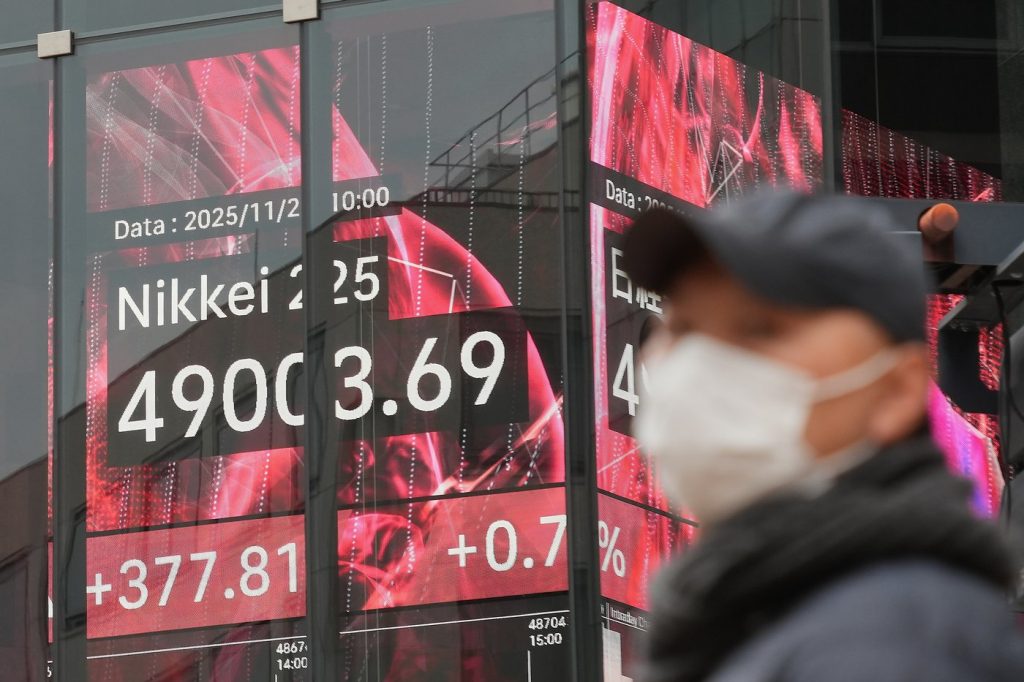
BANGKOK (AP) - Asian shares experienced a mostly positive trend on Tuesday, following a pullback in U.S. stocks that surrendered some of the previous week's gains, primarily due to the increase in global bond yields. Meanwhile, U.S. futures and oil prices remained largely unchanged.
Tokyo's Nikkei 225 index rose by 0.5% to reach 49,534.36. The surge was mainly attributed to financial shares, which were the biggest gainers after a hint from the governor of the Bank of Japan regarding a potential interest rate hike later in the month.
In Hong Kong, the Hang Seng index jumped 0.7% to close at 26,209.07, while the Shanghai Composite index saw a decrease of 0.3%, reaching 3,902.78. Australia's S&P/ASX 200 added 0.2%, finishing at 8,582.80. The South Korean Kospi index experienced a significant leap of 1.5%, closing at 3,977.85, driven by buying interest in technology shares such as Samsung Electronics, which surged 2.8%. Chipmaker SK Hynix also saw substantial gains, rising by 3.4%.
Taiwan's benchmark Taiex climbed by 1%, while India's Sensex edged slightly lower with a 0.1% decrease.
On Monday, the S&P 500 index slipped by 0.5%, breaking a five-day winning streak and closing at 6,812.63. The Dow Jones Industrial Average fell by 0.9%, finishing at 47,289.33, and the Nasdaq composite dipped 0.4% to reach 23,275.92. The previous week's rally had been fueled by growing optimism that the Federal Reserve would cut its main interest rate in the coming week to support the slowing job market.
Concerns regarding job stability in U.S. manufacturing were reflected in a survey by the Institute for Supply Management, which indicated that manufacturers are prioritizing headcount management over hiring. Many in the sector expressed that ongoing tariffs are complicating matters significantly.
Yields for long-term U.S. Treasurys have increased, contributing to a worldwide rise in yields after Bank of Japan Governor Kazuo Ueda hinted at an potential increase of their benchmark interest rate in an upcoming meeting. Japan's benchmark interest rate has lingered near zero for years, aiming to stimulate sluggish growth; however, inflation has recently held above the Bank of Japan's target of approximately 2%.
Thomas Mathews from Capital Markets commented that the prospect of the Bank of Japan resuming its hiking cycle sooner than expected has created ripples through global bond and equity markets, although he believes they could still endure further tightening.
The rise in bond yields often draws investors away from stocks or cryptocurrencies, as higher yields can diminish the appeal of more expensive investments. Bitcoin, which had been soaring around $125,000 in October, fell towards $85,500, marking a drop of roughly 6% from the previous day and trading around $86,650 early Tuesday. Stocks related to the crypto industry also experienced declines, with Coinbase Global down by 4.8% and Robinhood Markets losing 4.1%.
On a positive note, Synopsys stocks rose by 4.9%, benefitting from news of Nvidia's $2 billion investment in their stock as part of an expanded partnership. Nvidia, which has become one of the most influential stocks on Wall Street, rebounded from an early loss to close with a gain of 1.6%.
Markets had a mixed reaction to what appeared to be a strong start for the holiday shopping season. Consumer spending during the Black Friday and Cyber Monday retailing bonanza was anticipated to surpass expectations, despite ongoing uncertainties regarding the outlook for the U.S. economy. Williams-Sonoma saw an increase of 1.3%, while Best Buy experienced a decline of 2.6%.
In European markets, France's CAC 40 slipped by 0.3% on Monday, affected in part by a 5.8% loss for Airbus. The European aerospace company announced that most of its fleet of 6,000 A320 jets had received an update following a software glitch that posed potential complications for flight controls. Travelers experienced minor disruptions as airlines rushed to implement necessary updates after Airbus issued the warning.
In commodity markets, U.S. benchmark crude oil rose by 2 cents to $59.34 per barrel, while Brent crude, the international standard, dropped by 4 cents to $63.13 per barrel. The dollar strengthened against the Japanese yen, rising to 155.61 from 155.41, and the euro also gained ground, advancing to $1.1612 from $1.1608.








