

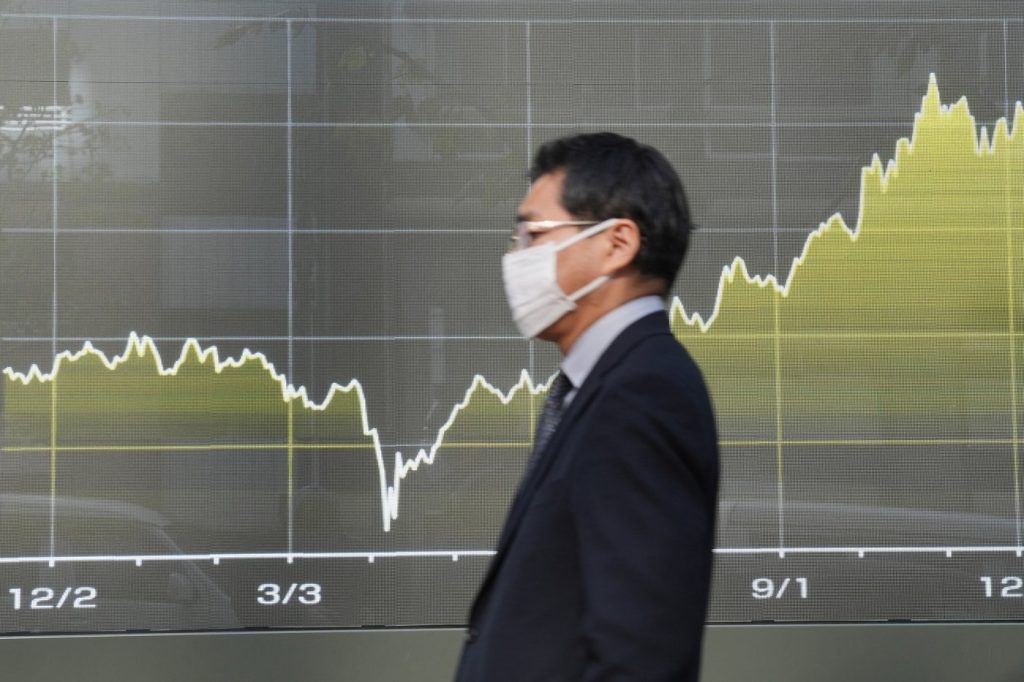
Asian shares experienced a mostly downward trend on Tuesday as U.S. stocks pulled back from their record highs, while U.S. futures saw a slight increase. In particular, Tokyo's Nikkei 225 index stood out, gaining 0.2% to reach 50,691.39.
In contrast, Chinese markets were on the decline as investors awaited news from the Central Economic Work Conference, an annual meeting of the Chinese Communist Party's leadership focused on economic planning. Hong Kong's Hang Seng index decreased by 0.8% to 24,549.54, and the Shanghai Composite index dipped 0.1% to 3,918.83. South Korea's Kospi fell 0.3% to 4,140.44, while Taiwan's Taiex index decreased by 0.5%. The S&P/ASX 200 in Australia also retreated, falling 0.2% to 8,607.80 after the Reserve Bank decided to maintain its cash rate at 3.6%.
On the U.S. stock market front, Nvidia, a leading computer chip manufacturer, witnessed a 2.3% increase in after-hours trading. This surge followed President Donald Trump's announcement permitting the sale of the H200 chip, which is utilized in artificial intelligence development, to select customers in China. Trump stated on his social media platform that he had informed Chinese leader Xi Jinping, who reportedly responded positively.
Nvidia's shares also rose 1.7% during regular trading on Monday. Analysts suggest that this development could have significant implications, indicating that it may expedite China's buildout of AI infrastructure and enhance the competitiveness of Chinese AI models against those in the United States.
Investors are now turning their attention to the upcoming Federal Reserve meeting scheduled for Wednesday, where financial experts anticipate a cut to the benchmark interest rate to address a weakening jobs outlook. In Monday's trading session, the S&P 500 recorded a 0.3% decline, marking its second loss in 11 days, although it remains within 0.6% of the all-time high of 6,846.51 set in October. The Dow Jones Industrial Average decreased by 0.4% to end the day at 47,739.32, while the Nasdaq composite dipped 0.1% to 23,545.90.
In notable moves within the media sector, Netflix suffered a downturn of 3.4% following Paramount's announcement of a competitive bid to acquire Warner Bros. Paramount is proposing to buy Warner Bros. Discovery shares at $30 each, offering a more expedited cash payout, as opposed to Netflix's earlier offer of a cash-and-stock combination for Warner Bros. amid its pending split with Discovery. Last week, Warner Bros. Discovery's board accepted Netflix's offer but is now facing scrutiny from federal regulators. President Trump expressed concerns over the potential Netflix-Warner Bros. merger, stating it "could be a problem" due to consolidation of power in the industry.
The shares of Warner Bros. Discovery rose by 4.4% following Paramount's unsolicited bid, while Paramount Skydance's stock surged 9%. In another significant development, Confluent's stock soared by 29.1% after IBM announced plans to acquire the data processing company for $11 billion. IBM stated that the acquisition would enhance its customers' deployment of artificial intelligence tools, with IBM's own shares rising by 0.4% in response.
As the U.S. stock market stabilizes following several weeks of volatility, there is a growing expectation that the Fed will reduce interest rates for the third time this year. Lower interest rates typically stimulate economic growth and boost investment prices, although they also risk exacerbating inflation. Analysts are particularly interested in the guidance the Fed provides regarding future interest rates post-meeting, as many on Wall Street speculate that the central bank might attempt to temper expectations for additional rate cuts in 2026.
Inflation continues to remain stubbornly above the Fed's target of 2%, with officials divided on whether the persistent inflation or a slowing job market poses a greater threat to the economy. In other early Tuesday market activity, U.S. benchmark crude oil prices fell by 18 cents to $58.70 per barrel, while Brent crude dropped by 13 cents to $62.36 per barrel. The U.S. dollar strengthened to 155.96 Japanese yen from 155.92 yen, and the euro rose to $1.1646 from $1.1638.








