

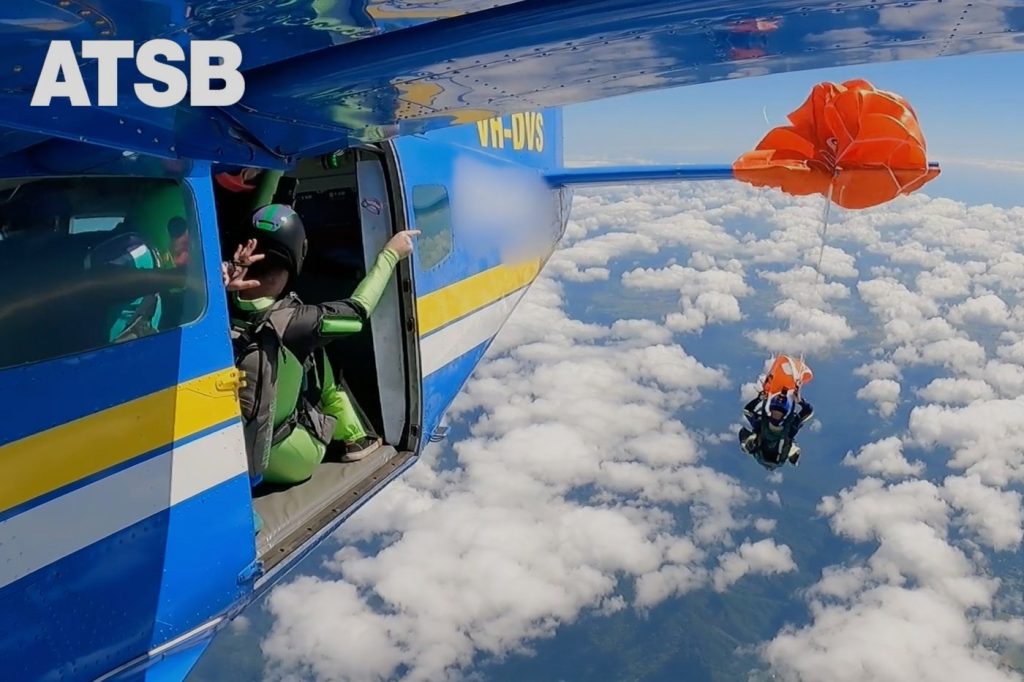
MELBOURNE, Australia (AP) — On Thursday, Australian accident investigators released gripping visuals of a skydiver whose parachute became entangled with an airplane's tail, leaving him in a precarious situation at an altitude of 4,500 meters (15,000 feet). The incident occurred on September 20, 2025, at Tully Airport in Queensland state, involving skydiver Adrian Ferguson.
During the unexpected mishap, Ferguson managed to free himself by using a hook knife, although he did sustain minor injuries to his legs. Importantly, the pilot, alongside 16 other parachutists aboard the Cessna Caravan that day, emerged unscathed from the event.
The Australian Transport Safety Bureau (ATSB) shared the video footage along with its investigative report detailing the occurrence. At the time of the incident, the aircraft had already reached the desired altitude for a planned 16-way formation jump. A 17th parachutist was positioned at an open door to record the jump on video as the others exited the aircraft.
As Ferguson attempted to leave the plane, he experienced an alarming turn of events when the ripcord of his reserve parachute became snagged on a wing flap. This caused the parachute to deploy prematurely, yanking Ferguson backward unexpectedly. In a tumultuous moment, he inadvertently knocked the camera operator away from the aircraft, sending the operator into a free fall. Ferguson then struck the plane’s horizontal stabilizer with his legs, and the parachute became ensnared around the tail, leaving him dangling dangerously.
Demonstrating quick thinking and composure under duress, Ferguson utilized a knife to sever 11 lines attached to the parachute, allowing him to fall from the plane while still partly attached to remnants of the torn chute. He then successfully deployed his main parachute, which inflated fully despite being entangled with the remains of his reserve chute, leading to a safe landing.
While this chaotic situation unfolded, most of the other skydivers had already jumped from the aircraft. The pilot was left with two skydivers still aboard and faced the challenge of controlling the plane with part of the reserve parachute still wrapped around the tail. A mayday call was issued, and the pilot prepared to evacuate by using an emergency parachute. However, Brisbane air traffic authorities assessed that the pilot retained enough control over the aircraft to land it safely at Tully, which was executed without any further incident.
Angus Mitchell, the chief commissioner of the ATSB, highlighted the importance of carrying a hook knife, stating that while it is not a regulatory requirement, it could be a lifesaver in incidents involving premature reserve parachute deployments. This incident serves as a reminder of the critical safety measures and preparations needed in the high-stakes environment of skydiving.








