

NUSEIRAT, Gaza Strip (AP) – Haneen al-Mabhouh, confined to a wheelchair, dreams of rebuilding her family and cradling a new baby. She longs to walk again, but with her right leg amputated after an Israeli airstrike on her home in July 2024, her life remains on hold as she waits for necessary medical treatment abroad.
The devastating airstrike occurred while she and her family were asleep, tragically claiming the lives of all four of her daughters, including her 5-month-old baby. Al-Mabhouh’s husband suffered severe burns, and she was left with her legs crushed under the rubble, leading to the amputation of her right leg above the knee. She articulates her grief, “For the past year and a half, I have been unable to move around, to live like others. For the past year and a half, I have been without children,” she expressed from her parents’ home.
Despite a 2-month-old ceasefire in Gaza, the aid has been minimal for thousands of Palestinians who have undergone amputations due to ongoing Israeli bombardments. The World Health Organization (WHO) estimates there are approximately 5,000 to 6,000 amputees from the two-year conflict, with 25% of them being children. The lack of prosthetic limbs and long medical evacuation delays impede their recovery.
Recently, the WHO confirmed a shipment of essential prosthetic supplies was permitted into Gaza, marking the first significant delivery in two years. While Israel has allowed little to no ready-made prosthetic limbs or materials since the onset of the war, the Israeli military body COGAT has not provided specifics regarding the quantity of prosthetic supplies entering Gaza or its policies concerning them.
Al-Mabhouh recalls the strike's aftermath, where for weeks in the hospital, she was unaware of her children's fate. After enduring multiple surgeries and still facing mobility challenges, she is restricted to her parents’ house, relying on assistance for basic tasks. The ache of losing her daughters weighs heavily on her; she mournfully shares, “I never got to hear her say ‘mama,’ see her first tooth or watch her take her first steps.” Her dream of having another child is contingent upon receiving medical treatment. “It’s my right to live, to have another child, to regain what I lost. Now my future is paralyzed. They destroyed my dreams,” she laments.
Medical evacuations for the 16,500 Palestinians awaiting urgent medical treatment abroad remain alarmingly slow. As of December 1, only 235 patients have been evacuated since the ceasefire began, averaging just under five a day. Prior to this, the average was around three a day. While Israel has indicated readiness to facilitate medical evacuations via the Israeli-controlled Rafah crossing, uncertainties persist due to Egypt’s conditional access to the crossing.
Dr. Richard Peeperkorn, the WHO's representative in the region, highlights logistical challenges, mentioning that the backlog arises from a shortage of countries willing to host evacuated patients. He urges the need for new medical evacuation routes, particularly to receive patients in the Israeli-occupied West Bank and East Jerusalem, where hospitals are prepared for incoming cases.
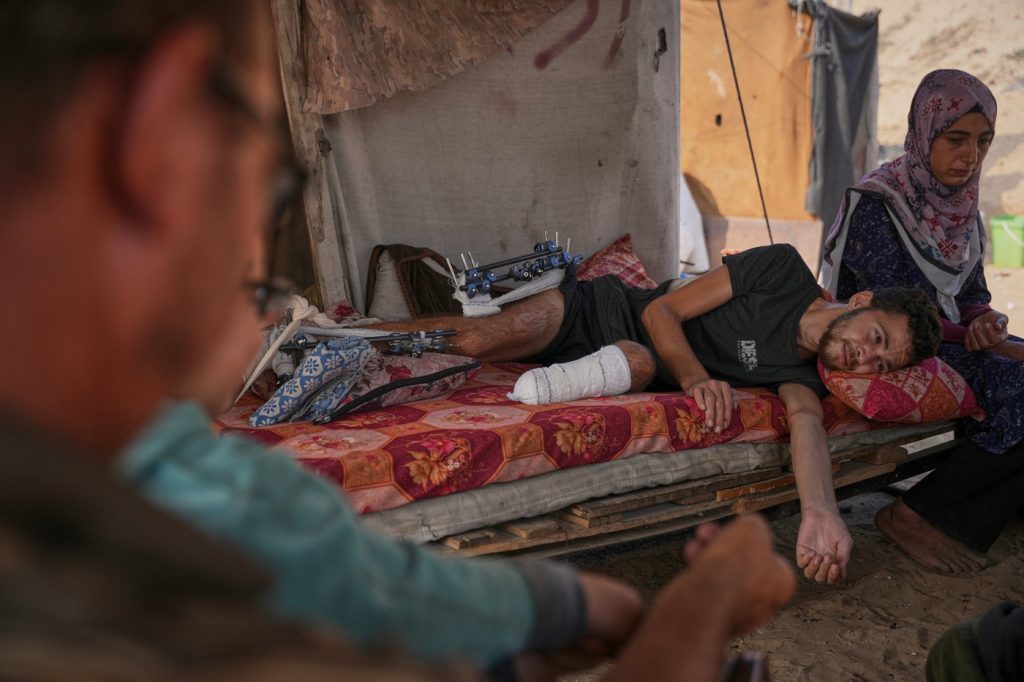
As patients like Yassin Marouf and Mohamed al-Naggar await treatment, life halts. Marouf, a 23-year-old whose left foot was amputated and right leg severely injured from Israeli shelling, struggles to perform basic activities. Similarly, 21-year-old al-Naggar, who lost a leg to shrapnel, dreams of returning to university and becoming independent, stating, “I’d like to travel abroad and put on a prosthetic and graduate from college and be normal like young people outside Gaza.”
According to the WHO, around 42,000 Palestinians have suffered significant injuries, including amputations and severe trauma. The overall situation remains dire, with substantial shortages of assistive products, as Gaza has only eight prosthetists who can provide fittings for artificial limbs. The Artificial Limbs and Polio Center in Gaza City received minimal supplies before the war, with only a small shipment arriving in December 2024. However, they have managed to assist just 250 cases during the conflict, and resources are rapidly depleting.
For individuals like Ibrahim Khalif, who lost his leg in an airstrike while fetching food, the struggle is compounded by the need for employment to support his family. “I used to be the provider for my kids, but now I’m sitting here,” he said, lamenting the stark difference between his past and present circumstances.








