

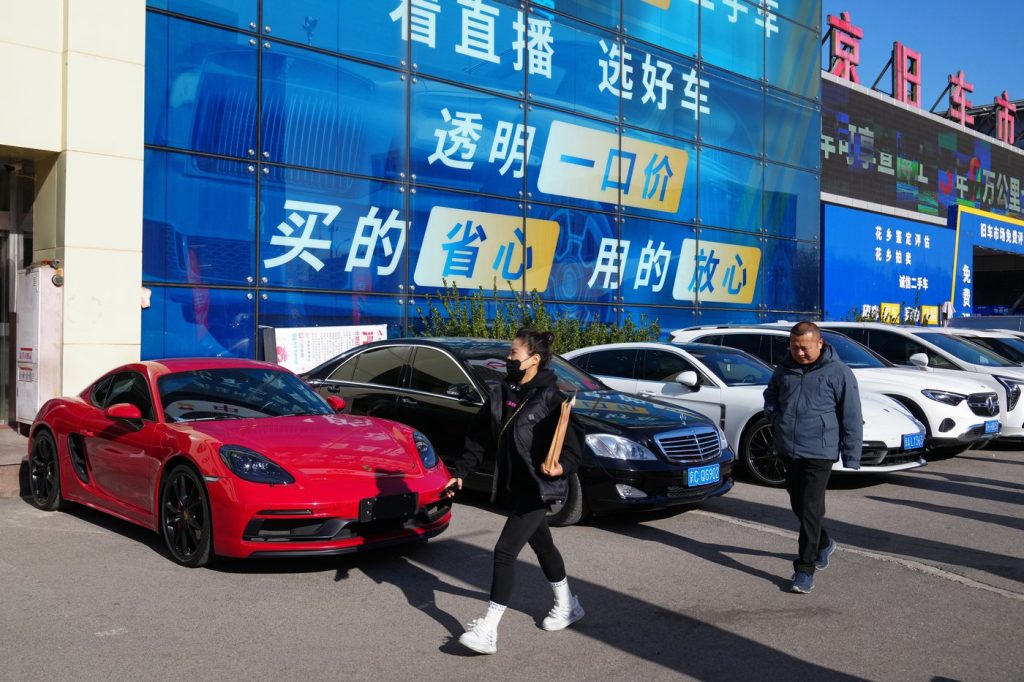
Demand for foreign luxury cars in China is declining as consumers shift towards more affordable Chinese brands that offer enhanced features at significant discounts. This trend poses challenges for established European automakers such as Porsche, Aston Martin, Mercedes-Benz, and BMW, who have historically had a strong foothold in the world's largest automotive market.
The waning interest in luxury vehicles is largely tied to a sluggish Chinese economy, which has resulted from a prolonged property downturn. As a consequence, many consumers are less willing to make substantial purchases, with affluent buyers becoming increasingly cautious about showing their wealth, according to Paul Gong, head of China Automotive Industry Research at UBS.
Government incentives, such as a 20,000 yuan ($2,830) trade-in subsidy for electric and plug-in hybrid vehicles, have encouraged buyers to opt for lower-priced models, predominantly produced by Chinese manufacturers. This has significantly impacted the market for premium vehicles, which are typically priced above 300,000 yuan ($42,400). According to S&P Global Ratings, the market share of premium car sales more than doubled from 2017 to 2023, reaching 15% of total sales. However, this trend has reversed, with premium car sales dropping to 14% in 2024 and 13% in the first three quarters of 2025.
Chinese automakers, including BYD, are proving more competitive than many Western brands. They are actively innovating and launching new electric and hybrid vehicles at lower prices, even within the premium segment. Claire Yuan, director of corporate ratings for China autos at S&P, highlighted that the competitiveness and affordability of Chinese products are increasingly eroding the momentum of foreign brands.
The share of Chinese brands in the passenger car sales market has surged to nearly 70% for the first 11 months of 2025, as reported by the China Association of Automobile Manufacturers (CAAM). In contrast, German brands held a mere 12% share, followed by Japanese brands at around 10%, and U.S. brands with nearly 6%. BYD has outpaced Volkswagen to become the largest car seller in China and leads in sales of "new energy vehicles," including electric and hybrid cars.
Luxury car sales have significantly decreased, with prominent brands reporting substantial declines. Mercedes-Benz's sales in China fell by 27% year-over-year in the third quarter of 2025, while BMW saw an 11.2% drop in total sales over the first nine months of the year. Additionally, Ferrari reported a 13% reduction in shipments to China, Hong Kong, and Taiwan during the same timeframe, marking the only region experiencing such a decline.
Ola Källenius, CEO of Mercedes-Benz, expressed concerns to investors about the ongoing "hyper-competition" in China, stating that the market will remain tense for the premium and luxury segments. This has also affected the second-hand luxury vehicle market, where dealerships are facing rising challenges. At a Beijing Porsche center, a 2024 Panamera 2.9T, having a mileage of around 20,000 kilometers (12,400 miles), was listed at 950,000 yuan ($134,300), down from the initial price of approximately 1.4 million yuan ($198,454).
Sales personnel in the second-hand luxury car market have reported a grim situation, with prices for premium vehicles dropping significantly over the past year due to decreased interest among buyers. Some dealers noted that this trend correlates with the current economic climate, as potential clients are cautious about spending, thus driving down demand for high-end vehicles.
The CAAM recently announced that China’s monthly auto production surpassed 3.5 million units for the first time in November. Nonetheless, due to softening demand and the suspension of trade-in subsidies in certain regions, domestic auto sales have seen a 4% year-over-year decrease.
Overall, the luxury car market in China appears to be facing formidable challenges, with shifting consumer preferences and increased competition from domestic manufacturers. As the economic landscape continues to evolve, foreign luxury carmakers will need to adapt to the changing dynamics to maintain their positions in this critical market.








