

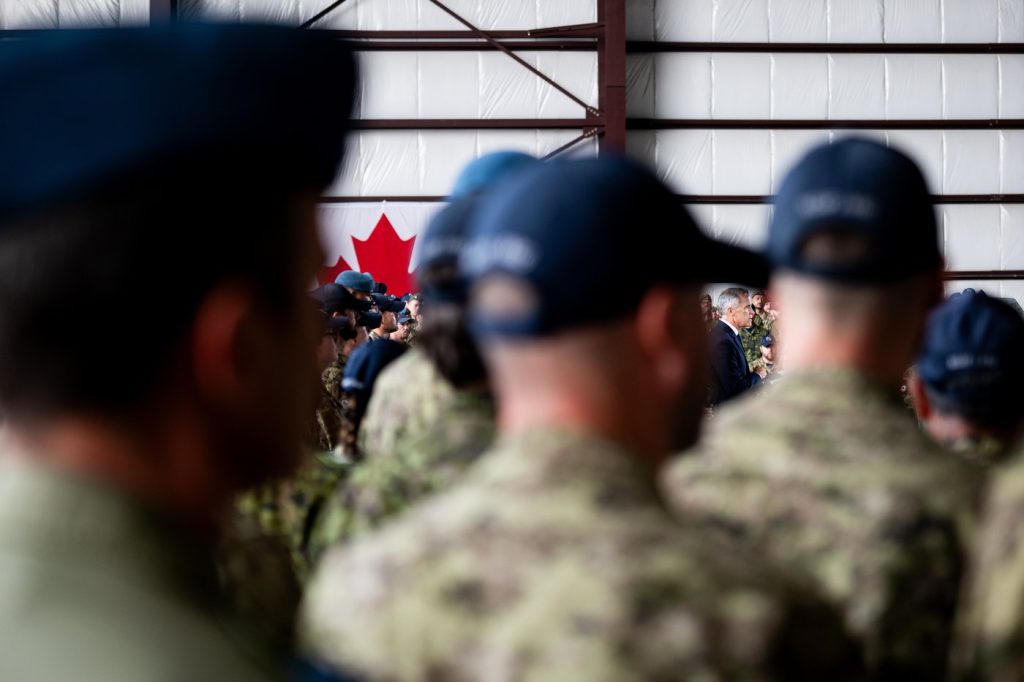
OTTAWA — Canada is significantly increasing its defense spending, injecting tens of billions of dollars into the sector, bringing funding levels to heights not seen since the Cold War. This move is intended to fulfill NATO commitments and to stimulate the domestic economy.
However, it remains uncertain whether the National Defence department, which has historically struggled to fully utilize its allocated budget, can efficiently deploy these funds to reassure allies about Canada’s military seriousness. Defense Minister David McGuinty expressed confidence in the government's ability to meet its goals, assuring that Ottawa is "moving quickly" on the financial management side. He emphasized a "disciplined approach" to procurement, breaking down expenditures into manageable parts to make progress.
McGuinty highlighted substantial expenditures already underway, including a $2 billion increase in military salaries for the year, renewed $900 million aid to Ukraine, and various new procurement initiatives along with infrastructure enhancements. Canada's prior reputation within NATO was marred when U.S. politicians criticized it for consistently missing defense spending commitments. A Pentagon document revealed that former Prime Minister Justin Trudeau informed U.S. officials that Canada would "never" meet the NATO commitment of allocating 2 percent of GDP toward national defense.
In a notable shift, documents prepared for Trudeau ahead of the 2024 NATO summit indicated that reaching the 2 percent goal was a gradual process, stating that it "cannot happen overnight." With the change in leadership, the message from Ottawa has transformed remarkably. Prime Minister Mark Carney announced in June 2025 that Canada would meet the target that year, further committing to reaching a 5 percent threshold by 2035.
The implications of failing to meet this target are significant, as U.S. President Donald Trump has repeatedly warned NATO countries that they cannot rely on U.S. support without fulfilling their defense obligations. In a December 9 interview, Trump claimed, "NATO calls me daddy," reflecting on his influence over alliance spending decisions.
Carney's inaugural federal budget proposed nearly $82 billion in defense spending over the next few years, allocating $9 billion for the current year alone. Nevertheless, many details regarding the allocation of these funds remain unclear to external observers. NATO projections suggest Canada is on track to spend approximately $63 billion on defense in the current fiscal year.
David Perry, president of the Canadian Global Affairs Institute, noted that it would take months for Canadians to determine if all the earmarked funds successfully elevate Canada to the 2 percent benchmark. While he expressed skepticism about whether every dollar would be utilized, he believed that Canada would meet the political expectations within NATO, especially since the Department of National Defence has lapsed less funding than usual this year.
Anessa Kimball, director of the Center for International Security at Laval University, commented that the 2025 budget offers an incomplete overview, lacking essential components such as the proposed new submarine fleet and a comprehensive fiscal strategy through 2035. She indicated that the budget might even fall half a billion dollars short of the 2 percent target. Nevertheless, Kimball expressed optimism that Canada would be "close enough" to meet the requisite standards to avoid diplomatic friction.
U.S. Ambassador to Canada Pete Hoekstra supported Carney's assurances that Canada would achieve the 5 percent goal, remarking that indications show Ottawa is serious about increasing military funding. This commitment should alleviate any existing bilateral tensions over defense for now. The 5 percent figure also includes "defense-adjacent" spending, such as infrastructure projects, which count toward the NATO commitment, simplifying the achievement of the ambitious target.
Kerry Buck, former ambassador of Canada to NATO, noted that this carve-out makes practical sense, as the alliance still requires funding for infrastructure to support military operations—for example, upgrading older bridges in Europe to manage tank weights. The 2025 budget posits that the near-term 1.5 percent target can be met through anticipated provincial and municipal spending, meaning Ottawa needs to focus primarily on the remaining 3.5 percent.
However, Kimball warned that maintaining momentum toward heftier commitments would be challenging. Perry acknowledged the difficulty of reaching 2 percent, noting the considerable stretch required to attain 3.5 percent, asserting that increasing defense spending would necessitate reallocating resources from other government funds. Ultimately, Carney must also persuade both Parliament and the voting public of the necessity for higher defense expenditures since all future funding will require approval.








