

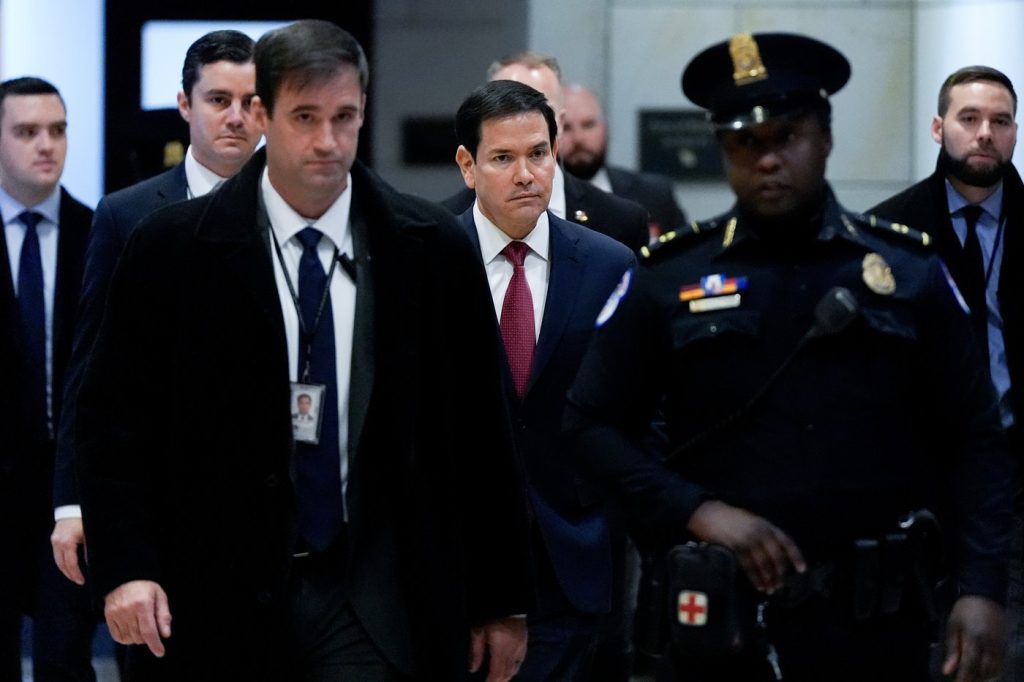
WASHINGTON (AP) — Secretary of State Marco Rubio is set to hold a formal State Department news conference on Friday, with discussions anticipated to focus on critical international issues, including the Russia-Ukraine conflict and ongoing peace efforts between Israel and Hamas. Additionally, the Trump administration's increasing military pressure on Venezuela is expected to be a significant topic of conversation.
This highly anticipated year-end appearance in the State Department briefing room is noteworthy, as it marks the first time the room has been utilized since August, when regular on-camera press briefings were suspended by the department. As Rubio has taken on the role of national security adviser, he has become a vocal advocate for President Donald Trump’s “America First” policies, addressing various priorities including visa restrictions and a comprehensive overhaul in foreign assistance.
The conference will occur prior to key meetings in Miami scheduled for Friday and Saturday, where U.S. officials, including Trump’s special envoy Steve Witkoff, are expected to engage with representatives from Egypt, Turkey, and Qatar to discuss the progression of the Gaza ceasefire plan. This initiative has seen slow advancement since its announcement in October, with Witkoff and other officials aiming to establish a “Board of Peace” to oversee the territory following two years of conflict and the potential creation of an international stabilization force.
Looking ahead, Witkoff, along with Jared Kushner and possibly Rubio, will meet with Russian President Vladimir Putin’s adviser Kirill Dmitriev in Miami on Saturday to discuss the latest developments of a U.S.-proposed plan aimed at resolving the Russia-Ukraine war. This proposal has undergone numerous changes, as Trump’s approach has wavered between showing support for Ukraine and expressing understanding toward Putin’s assertive demands, particularly regarding territorial concessions that Kyiv has consistently rejected.
In terms of U.S.-Venezuela relations, Rubio has emerged as a prominent proponent of military operations targeting suspected drug-trafficking vessels in the Caribbean and eastern Pacific. Since early September, these military actions have intensified pressure on Venezuelan President Nicolás Maduro, who faces allegations of narcoterrorism in the United States. Amid this backdrop, Trump indicated in a recent NBC News interview that he would not exclude the possibility of war with Venezuela, although both Rubio and Defense Secretary Pete Hegseth have clarified that current operations are aimed at narcoterrorists rather than regime change.
Additionally, the timing of Rubio’s news conference coincides with the Trump administration’s announcement of a significant $11 billion arms sales package to Taiwan, a move that has incensed Beijing, which has threatened to retake the island by force if deemed necessary. Trump's policy oscillations regarding China have seen him impose heavy tariffs on imports while simultaneously expressing willingness to ease pressures in high-level discussions with President Xi Jinping.
Since assuming his position, Rubio has quickly implemented Trump’s “America First” agenda, which has included measures to dismantle the U.S. Agency for International Development (USAID) and reduce the size of the diplomatic corps. This restructuring has drawn criticism, with detractors arguing that cuts to foreign aid jeopardize humanitarian efforts worldwide, a claim Rubio and others refute by highlighting ongoing disaster relief operations and new global health agreements with former USAID partner nations.
As the State Department prepares for Rubio's major news conference, the implications of his policies and responses to pressing international challenges will undoubtedly draw significant attention, shaping dialogues within U.S. foreign strategy moving forward.








