

MELBOURNE, Australia (AP) — Australians will gather to light candles at 6:47 p.m. on Sunday (7:47 GMT) to honor the victims of last week's tragic mass shooting during a Jewish festival at Bondi Beach, which resulted in the deaths of 15 people. This collective act of remembrance coincides with the federal and New South Wales state governments' declaration of Sunday as a national Day of Reflection, marking the worst mass shooting in Australia since the 1996 incident in Tasmania that claimed 35 lives.
Prime Minister Anthony Albanese announced a review of the nation's federal law enforcement and intelligence agencies following the attack, which has been linked to the Islamic State group. The investigation aims to ensure that appropriate powers and structures are in place to protect Australians and enhance their safety.
On the day of reflection, Indigenous leaders conducted a traditional smoking ceremony at Bondi Pavilion in the morning. An impromptu memorial has formed at the site, filled with flowers and heartfelt messages, though it is set to be cleared on Monday. Rabbi Levi Wolff expressed hope that thousands would gather later that day to pay their respects while emphasizing solidarity with the Jewish community against hate. “Australians appreciate that this is an attack that wasn’t just against the Jewish people... but this is an attack on the Australian values,” Wolff stated at the memorial.
Governor-General Sam Mostyn, representing King Charles III, accepted an invitation from the National Council of Jewish Women to lay flowers at the memorial alongside women of diverse faiths. Mostyn described the shooting as “unspeakably, ghastly acts of terror” and endorsed calls from rabbis for acts of kindness—referred to as mitzvahs—across the nation in response to the tragedy. She underscored the importance of community and compassion, stating, “Everyone in this country belongs.”
Last Sunday, the peaceful Hanukkah celebration was violently disrupted by two gunmen, leaving many wounded, with 13 victims still receiving care in Sydney hospitals. One of the alleged assailants, 24-year-old Naveed Akram, who was shot by police during the incident, has been charged with multiple counts of murder and intent to murder. His father, Sajid Akram, was killed by police on the scene.
In light of the attack, police significantly increased their presence at Bondi Beach, deploying officers armed with rifles to ensure public safety. The initial responders faced criticism for being equipped only with handguns, which lacked the necessary firepower to confront the assailants. New South Wales Police Commissioner Mal Lanyon reassured citizens that the heightened security was not due to an elevated threat level but rather a measure to allow the community to come together in mourning.
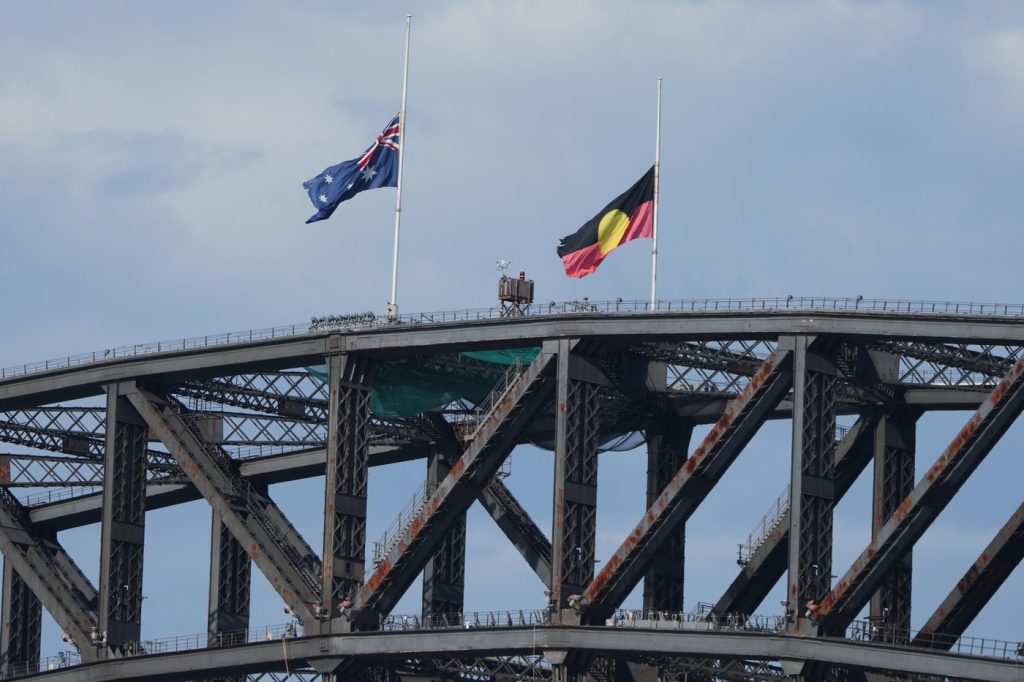
Flags were flown at half-staff on the Sydney Harbor Bridge and government buildings in a show of solidarity with the Jewish community. Television and radio stations paused for a minute of silence at 6:47 p.m. in remembrance of the victims. Rabbi Eli Feldman encouraged the wider Australian community to join the Jewish people at Bondi for the final day of Hanukkah, emphasizing the unifying power of light against darkness.
In reviewing national security operations, Albanese's department aims to assess whether federal agencies are adequately equipped to protect citizens from threats. The Australian Security Intelligence Organisation had previously investigated connections associated with Naveed Akram in 2016 but did not determine that he posed a threat. Concerns have been raised regarding the rising tide of antisemitism in Australia since the onset of the Israel-Hamas conflict in 2023, leading to feelings of betrayal among victims’ families and the broader Jewish community, who seek accountability and change.








