

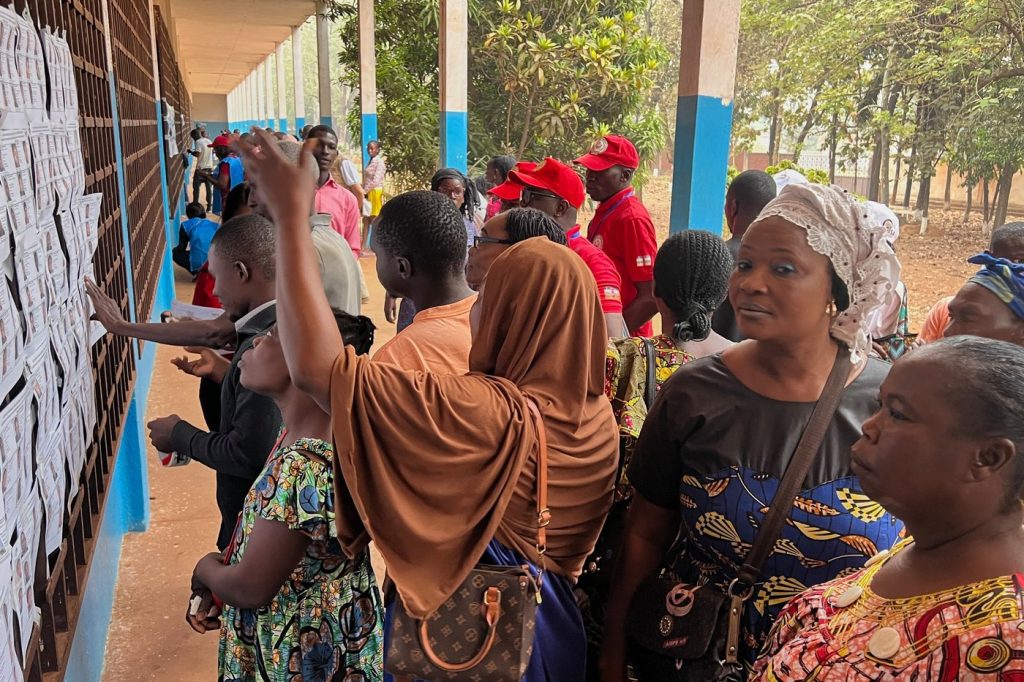
BANGUI, Central African Republic – Voters in the Central African Republic are participating in national elections to select a new president and federal lawmakers. Incorporated into the election process is incumbent President Faustin Archange Touadéra, who is expected to win a third term. His presidency has been marked by efforts to stabilize the country, aided by Russian mercenaries.
Touadéra has positioned himself as one of Russia's closest allies in Africa. Analysts believe that a successful bid for a third term would strengthen Russia's security and economic interests in the Central African Republic, even as Moscow is under scrutiny regarding the actions of its mercenaries across the continent. The country was one of the first in Africa to welcome Russian-backed forces, with Moscow pledging to support local authorities and combat armed groups.
However, this year saw rising tensions over Russia's desire to replace the private Wagner mercenary group with the newly formed military unit known as Africa Corps. The electoral process is unprecedented in scale, with approximately 2.4 million registered voters participating in presidential, legislative, regional, and municipal elections.
On election day, initial reports indicated delays, with voting beginning an hour late in some outlying districts of the capital, Bangui. Many voters reported difficulties, such as not finding their names on electoral rolls or uncertainty about their designated polling stations. One voter, Barthélemy Wadenguende, emphasized the concern about extended voting hours due to the delays.
Preliminary results are expected to be announced within a week. In the event that no presidential candidate garners more than 50% of the votes, a runoff election will be conducted. Touadéra is contending against six challengers, including well-known opposition figures Anicet-Georges Dologuélé and Henri-Marie Dondra, both of whom have previously served as prime ministers.
Notably absent from the election is the main opposition coalition, the Republican Bloc for the Defense of the Constitution, which announced a boycott in October, citing a perceived unequal political environment. Neither Dologuélé nor Dondra are part of this coalition. Analysts indicate that, given Touadéra's consolidation of control over state institutions and the absence of formidable opposition, he is favored to win.
Supported by Russian backing, Touadéra's campaign emphasizes his commitment to achieving peace, stability, and economic revitalization for a nation of approximately 5.5 million people that has long endured conflict. The Central African Republic has been troubled by ongoing clashes between pro-government forces and rival armed factions, particularly since 2013 when predominantly Muslim rebels overthrew President François Bozizé. Despite a peace agreement in 2019, strengthened hostilities ensued as some of the 14 armed groups that signed the accord withdrew and continued their hostilities.
In a recent interview, Touadéra stated, “Our country has suffered greatly from brutal regime changes, a cycle that repeats every ten years. I call on the people of the Central African Republic to choose the stability of institutions and a prosperous Central African Republic.” His primary challenger, Dologuélé – a candidate in both the 2016 and 2020 elections – argues that his administration would be focused on restoring a nation heavily impacted by poverty and economic stagnation.
Dologuélé has stressed the urgent need to revitalize the economy, stating, “What country is this that produces nothing and exports almost nothing, except beer? We must revive the economy.” Experts suggest that the most pressing concern for voters is the state of security in the country.
The United Nations peacekeeping mission, known as MINUSCA, has been vital for logistical support during elections and has around 14,000 military personnel and 3,000 police officers managing security at polling sites. Given the country’s challenging geography, which includes dense forests and poorly maintained roads, the electoral body faced obstacles in delivering election materials to remote communities.
In November, the U.N. Security Council extended the mission's mandate for another year, although it noted the need for a gradual scale-down due to budget limitations. Lewis Mudge, Central Africa director at Human Rights Watch, remarked that ongoing peace agreements and the presence of international support, including Russian assistance, have helped to improve security conditions compared to the last electoral cycle in 2020.








