

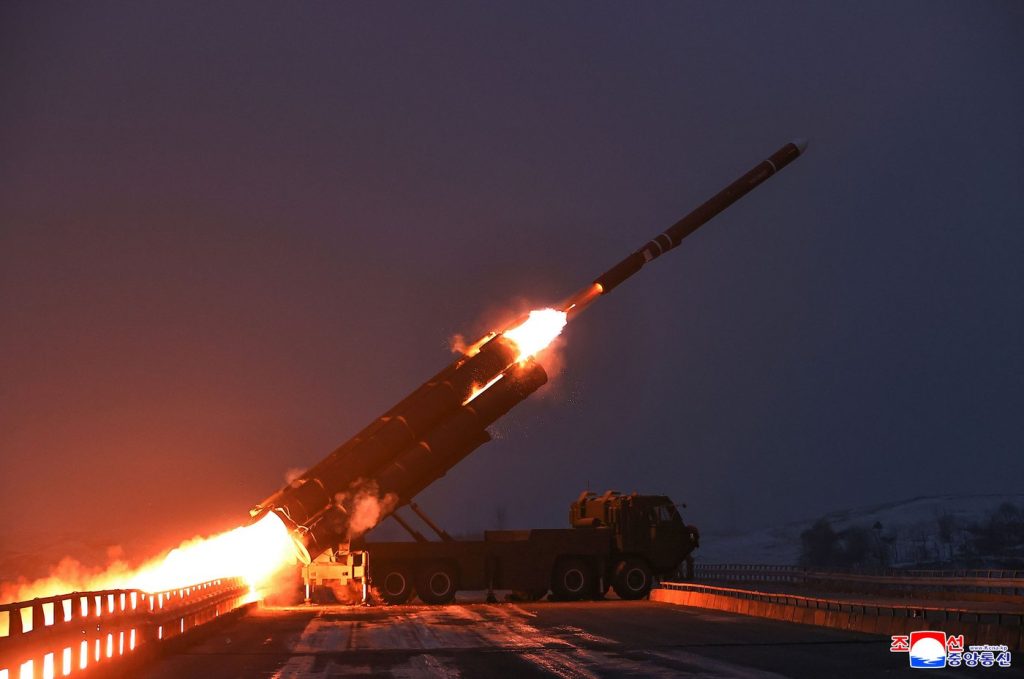
SEOUL, South Korea (AP) - North Korea announced on Monday that it conducted a test of long-range strategic cruise missiles, launching them into the sea as part of its efforts to bolster the country's nuclear deterrence capabilities. This announcement follows recent developments regarding North Korea's nuclear capabilities, including progress in the construction of its first nuclear-powered submarine.
The missile launches on Sunday were part of a broader display of military capability by North Korea, occurring just ahead of the upcoming Workers' Party congress scheduled for early next year. This congress, the first in five years, is expected to draw significant international attention to see whether North Korean leader Kim Jong Un will prioritize new strategies in dealing with the United States, particularly amid calls from Washington to resume stalled diplomatic talks.
According to the official Korean Central News Agency (KCNA), Kim expressed "great satisfaction" with the cruise missile launches, which took place off North Korea's west coast. He characterized the missile tests as a "responsible exercise of the right to self-defense and war deterrence," emphasizing the need to assess North Korea's nuclear deterrent capability in light of perceived external threats to the nation's security.
South Korea's Joint Chiefs of Staff reported awareness of multiple cruise missile launches originating from the North Korean capital region on Sunday morning. The South Korean military reiterated its commitment to defense readiness against any North Korean provocations, emphasizing close cooperation with the United States.
U.N. Security Council resolutions forbid North Korea from conducting launches involving its substantial inventory of ballistic missiles. While the recent cruise missile tests are not explicitly prohibited, they represent a significant threat to both the United States and South Korea due to the missiles' ability to maneuver and fly at low altitudes, which helps them evade radar detection. Analysts suggest North Korea could target U.S. navy vessels and aircraft carriers in a conflict scenario utilizing these cruise missiles.
In the days leading up to the recent launches, North Korea also conducted tests of new anti-air missiles off its eastern coast and released images showcasing the nearly completed hull of a prospective nuclear-powered submarine, which could potentially be armed with nuclear missiles.
The push for sophisticated military enhancements, including a nuclear-powered submarine, is part of Kim's strategy to address what he perceives as security threats primarily emanating from the United States. Furthermore, North Korea's recent alignment with Russia, including the provision of troops and military equipment to support Russian President Vladimir Putin’s military operations in Ukraine, is speculated to have facilitated the acquisition of critical technologies for North Korea.
Since the collapse of nuclear negotiations with former U.S. President Donald Trump in 2019, North Korea has intensified its weapons testing efforts to expand its nuclear arsenal. However, in a measured response to Trump's attempts for renewed dialogue, Kim indicated in September that he might be open to discussions if the U.S. abandons its "delusional obsession" with North Korean denuclearization. Observers argue that Kim may believe that a larger nuclear arsenal could provide him with increased leverage in any forthcoming negotiations with Trump.








