

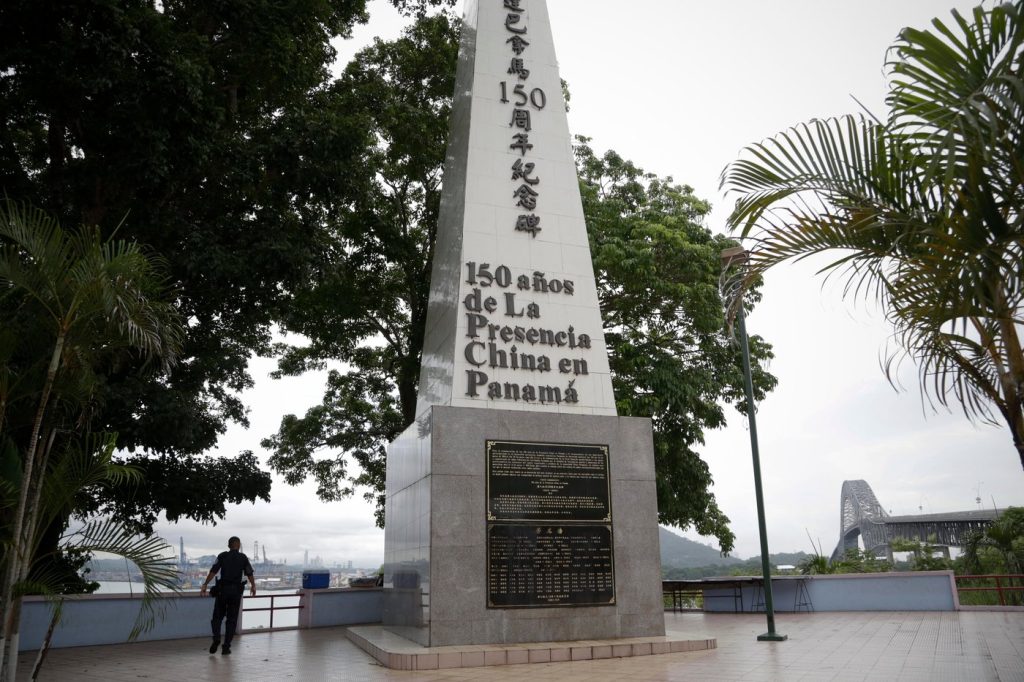
PANAMA CITY (AP) – In a recent turn of events, China condemned the demolition of a monument dedicated to the Chinese community in Panama, coinciding with increasing pressure from the Trump administration for the Central American nation to sever ties with Beijing. This monument, which celebrated 150 years of Chinese presence in Panama and acknowledged the role of Chinese migrants in constructing railroads and the Panama Canal, was torn down by local authorities without prior notice.
The monument, erected in 2004, featured traditional Chinese architectural elements including a ceremonial arch, curved roof tiles, and stone lions. It was situated at a scenic overlook near the Panama Canal, serving as a poignant reminder of the contributions made by the Chinese community to the country's infrastructure and economy. The demolition happened overnight, and by morning, only two broken stone lions remained, laying next to the curb as construction workers cleared the site.
The Chinese Embassy in Panama reacted strongly, accusing local authorities of "brazenly and forcibly" demolishing the monument, which they argued has significantly harmed the friendly relations between the Chinese and Panamanian people. Xu Xueyuan, the Chinese ambassador, expressed outrage on social media, emphasizing that the monument represented 171 years of efforts and sacrifices from the Chinese community, which had now been "shattered to pieces." He demanded an explanation for the act, questioning the motivations behind such a destructive decision.
Amid growing tensions, U.S. President Donald Trump has previously stated that China exerts control over the Panama Canal, although these claims have been widely disputed and dismissed by Panama’s government. Trump’s administration continues to advocate for diminished economic ties between Latin American countries and China, which have intensified in recent years, seeing China surpass American investment in many parts of the region.
The local government, specifically the Arraiján mayor's office, justified the monument's removal by citing "structural risks" to public safety, while also denying that the action was politically motivated. However, they did not provide clarity on why the demolition occurred during the night, raising further questions about the decision-making process.
Panama's President José Raúl Mulino condemned the demolition as "barbarity," asserting that there was no justification for such an action. He promised that the federal government would oversee the reconstruction of the monument, stating that the Chinese community "deserves all our respect." Mulino called for an immediate investigation into the matter, labeling the act of demolition as "irrational" and "unforgivable."
The incident has sparked widespread anger among both Panamanians and members of the Chinese community. Some individuals staged protests at the site, while several businesses chose to close in solidarity against the demolition. Jaime Bustos, a Panamanian tour guide, expressed his shock upon witnessing the dismantled monument, emphasizing the significant contributions of the Chinese community to the nation’s development and economy. Bustos described the demolition as a "cruel act," underscoring the deep-rooted connections between the two communities.
This demolition incident has ignited discussions around cultural heritage, community relations, and foreign influence, reflecting the complexities of Panama's international relations postures amidst growing geopolitical tensions.








