

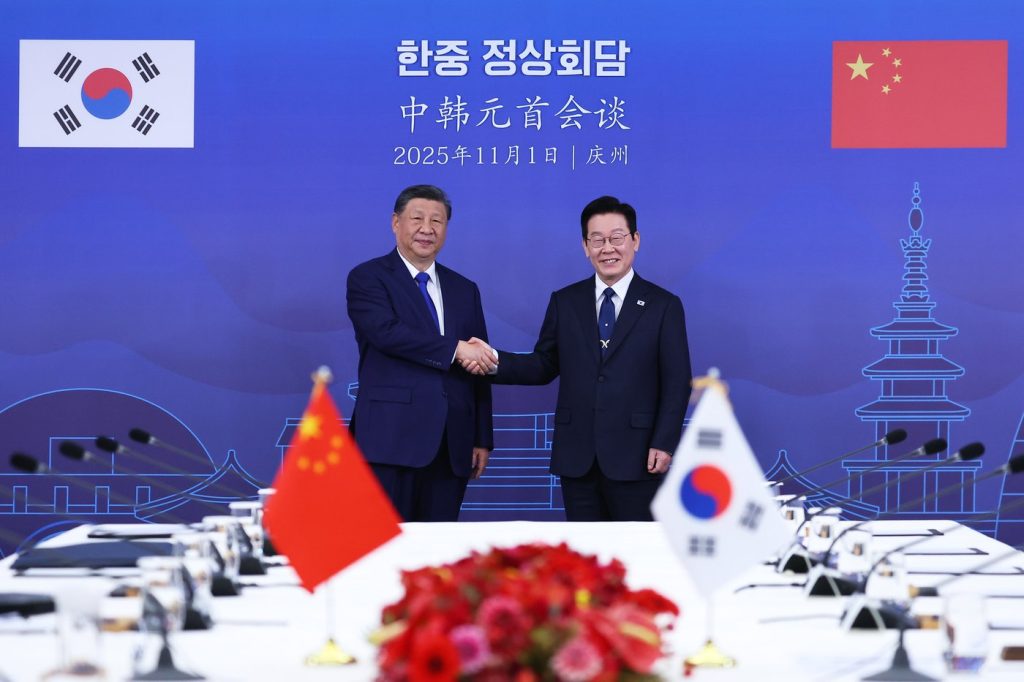
HONG KONG (AP) — South Korean President Lee Jae Myung is set to embark on a pivotal four-day visit to China starting Sunday. This visit marks Lee's first trip to China since he took office in June, aiming to strengthen ties between the two nations amid rising tensions in the region, particularly between China and Japan regarding Taiwan—a self-governing island that Beijing claims as sovereign territory.
Lee's visit follows heightened diplomatic friction after Japan's Prime Minister Sanae Takaichi warned that Japan's military could intervene should China take aggressive action against Taiwan. During his stay in China, Lee is scheduled to meet with Chinese President Xi Jinping, marking their second encounter in two months.
Prior to his trip, Lee participated in an interview with China’s state broadcaster, CCTV, at the presidential office known as Cheong Wa Dae. Lee emphasized the significance he places on South Korea-China relations, highlighting his government's respect for the “One-China” policy concerning Taiwan. He stated that the healthy development of Beijing-Seoul relationships relies on mutual respect and praised Xi as a "truly reliable neighbor."
In light of escalating military tensions, China conducted extensive military drills around Taiwan to deter separatist activity and foreign interference. The Chinese Foreign Ministry has accused Taiwan's ruling party of seeking independence with U.S. assistance. In December, U.S. plans for large-scale arms sales to Taiwan provoked Beijing, resulting in sanctions against 20 American defense companies.
Lee noted that while South Korea values its cooperation with the United States as a military ally, it does not necessitate antagonistic relations with China. He acknowledged that previous misunderstandings have negatively impacted bilateral relations and expressed a desire for his visit to mitigate these issues to advance cooperation between the two nations.
During the backdrop of Lee's visit, North Korea launched multiple ballistic missiles into the sea, showcasing their military capabilities ahead of a ruling party congress. This act further emphasizes the urgency of engaging China to leverage its influence over North Korea, the longstanding ally that poses challenges to regional stability.
Officials from South Korea outlined that the purpose of Lee’s trip is to bolster bilateral ties while also addressing the ongoing security dilemmas on the Korean Peninsula. During a bilateral summit on Monday, discussions between Lee and Xi are set to focus on substantive methods to tackle security and economic challenges affecting both countries.
On Tuesday, Lee will also meet with Zhao Leji, Chairman of the National People’s Congress, and Premier Li Qiang. In these discussions, South Korea is expected to urge China to assume a “constructive role” in promoting peace on the Korean Peninsula. In previous interactions, including meetings in November, Lee has requested Xi's efforts to encourage North Korea to re-enter dialogue.
Overall, South Korea aims for ideals and efforts that yield tangible benefits for ordinary citizens in both countries, further indicating their commitment to fostering a constructive bilateral relationship even amidst regional complexities.








