

A tense calm blankets Venezuela following the recent U.S. military operation that led to the ousting of President Nicolás Maduro. The deposed leader was transported to New York to face criminal charges linked to a narco-terrorism conspiracy. President Donald Trump announced that the U.S. intends to take charge of the South American nation and exploit its extensive oil reserves for the benefit of other countries.
Maduro, along with his wife, arrived late Saturday afternoon at a small New York airport amidst significant political upheaval. This military action is viewed as the most assertive attempt at regime change by the U.S. since the 2003 invasion of Iraq, underscoring months of planning and a pressure campaign on Maduro's autocratic government.
Legal experts have raised concerns regarding the legality of the operation, as it occurred without congressional approval. In response, Venezuela's Vice President Delcy Rodriguez condemned the U.S. actions, asserting Maduro's position as the rightful leader and stating that the Venezuelan high court has appointed her as interim president.
In international reactions, Iran has issued warnings to the U.S. against military actions, particularly in light of Iran’s longstanding alliance with Maduro. The Iranian Foreign Ministry condemned the U.S. attack on Venezuela, emphasizing the escalation of tensions that could impact the region significantly. U.S. Defense Secretary Pete Hegseth remarked that adversaries should recognize America's capability to project its influence globally at any time.
Back in the U.S., widespread protests are planned against Trump’s military actions in Venezuela, with demonstrations sweeping through states such as California, Missouri, and Texas. Groups like Indivisible, which are known for their left-leaning politics, are mobilizing to challenge what they term the "illegal, unconstitutional invasion" of Venezuela, specifically opposing Trump's intentions to control the country’s oil industry.
Responses from congressional leaders and state officials vary significantly along party lines. U.S. Senator Chuck Grassley, a Republican from Iowa, supported the operation by comparing it to the capture of Panamanian dictator Manuel Noriega. On the other hand, Illinois Governor JB Pritzker criticized the military intervention as unconstitutional, calling for a focus on domestic issues rather than foreign military engagements. Senator Tammy Baldwin echoed these sentiments, asserting that Trump lacks the unilateral authority for such an action without congressional consent.
Internationally, France's foreign minister commended Maduro's removal but called for a return to democracy in Venezuela, condemning the means by which it was achieved as violating international law. Senate Democratic Leader Chuck Schumer labeled Maduro a "horrible" individual but denounced the lawless nature of the U.S. actions, warning against the historical consequences of American regime changes.
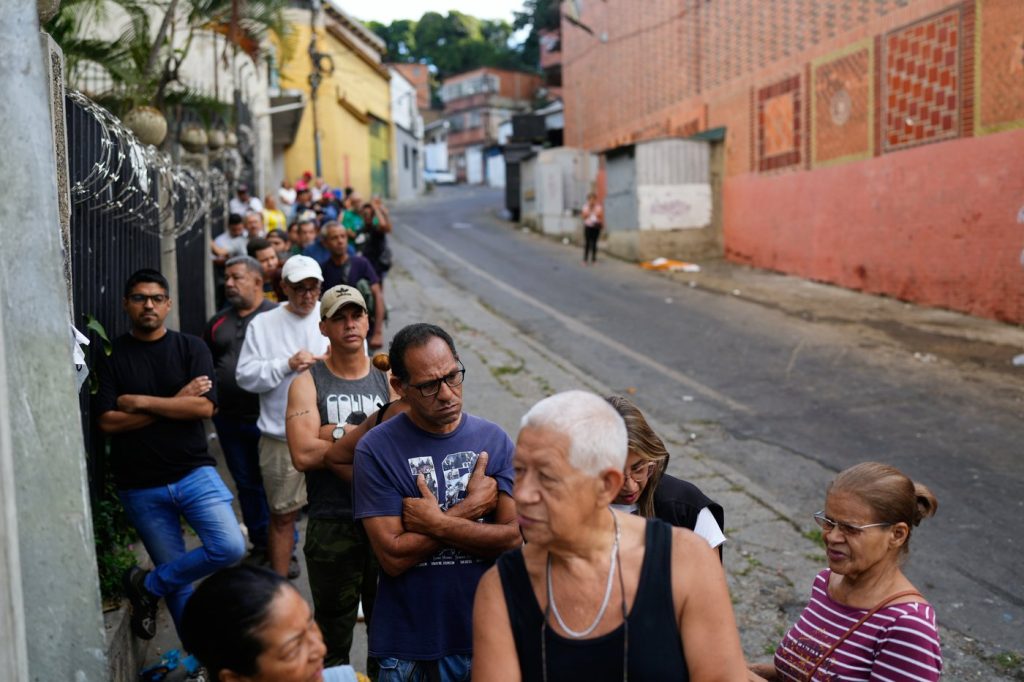
Amid the political chaos, Venezuelan capital Caracas exhibited an unusual stillness on Sunday, with empty streets and a noticeable military presence. Many businesses remained shuttered, creating an atmosphere of uncertainty following the U.S. attack aimed at capturing Maduro.
Nicolás Maduro, currently held in a notorious Brooklyn jail known for its tumultuous conditions, joins a list of infamous inmates. The Metropolitan Detention Center (MDC Brooklyn), which typically houses around 1,300 inmates, has previously imprisoned significant figures like former Honduran President Juan Orlando Hernández, who was also accused of drug trafficking.
In summary, the recent military operations in Venezuela have instigated a complex web of political responses, both domestically and internationally, raising questions about legality and long-term implications for U.S. foreign policy in Latin America.








