

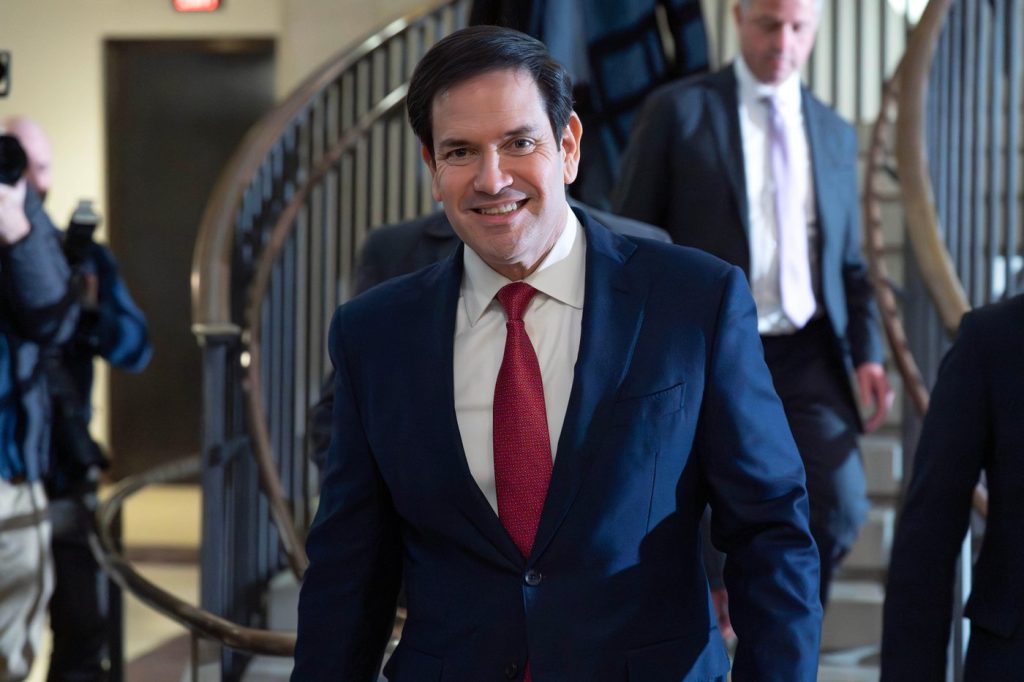
WASHINGTON (AP) — On Monday night, Secretary of State Marco Rubio and other high-ranking officials provided a briefing to Congressional leaders concerning the recent military operation in Venezuela. This operation has raised significant concerns that President Donald Trump may be entering a new phase of U.S. expansionism without consulting lawmakers or establishing a coherent strategy for governing the South American nation.
During the closed-door session at the Capitol, Republican leaders expressed their support for Trump’s decision to forcibly remove Venezuelan President Nicolás Maduro from power. However, many Democrats left the briefing with unanswered questions, particularly as Trump maintains a fleet of naval vessels off Venezuela's coast and encourages U.S. companies to reinvest in the country's struggling oil industry.
A proposed war powers resolution, which would restrict U.S. military action in Venezuela without Congressional approval, is set for a vote this week in the Senate. House Speaker Mike Johnson, R-La., reassured that "we don't expect troops on the ground." He emphasized the need for the new Venezuelan leadership to refrain from engaging in narcoterrorism or drug trafficking into the U.S., which sparked Trump's initial military campaign that has reportedly led to over 115 deaths through deadly boat strikes.
Johnson stated, "This is not a regime change. This is demand for a change in behavior," adding that they plan to leverage pressure on the new interim government as a means of persuasion as Venezuela's oil exports remain seized.
Contrastingly, Senator Jeanne Shaheen, the top Democrat on the Senate Foreign Relations Committee, expressed her concerns, saying, "There are still many more questions that need to be answered.” Representative Gregory Meeks, the leading Democrat on the House Foreign Affairs Committee, further pressed, “What is the cost? How much is this going to cost the United States of America?”
Lawmakers were notably uninformed prior to the military operation, indicating a breakdown in communication regarding Congress's traditional oversight of war-related actions. Administration officials addressed various inquiries, including the potential involvement of U.S. troops on the ground and the status of the Venezuelan opposition, which seems to have been marginalized by the Trump administration following Maduro ally Delcy Rodriguez's rise to interim presidency.
Defense Secretary Pete Hegseth, Joint Chiefs of Staff Chairman Air Force Gen. Dan Caine, and Attorney General Pam Bondi participated in the classified session, which was intended for a select group of Congressional leaders known as the “Gang of Eight,” comprising intelligence and national security committee heads.
Senator Mark Warner, the leading Democrat on the Intelligence Committee, remarked on the lack of clarity regarding Venezuela's leadership post-briefing, stating, “I wish I could tell you yes, but I can’t.” Furthermore, Senators Chuck Grassley, R-Iowa, and Richard Durbin, D-Ill., argued that they should have been included in the briefing due to their oversight roles regarding the Justice Department.
Earlier, Senate Democratic Leader Chuck Schumer warned that Trump's actions in Venezuela could mark the beginning of dangerous foreign policy shifts, as the president signals interests in Colombia, Cuba, and Greenland. Schumer highlighted that the American populace did not anticipate another series of protracted conflicts, stating that the briefing "posed far more questions than it answered."
The Republican Party exhibited mixed reactions reflecting an internal divide regarding Trump's foreign policy strategies. While some Republican lawmakers support Trump's initiatives, there remain concerns about the implications of potential military involvement overseas, especially in light of past wars in Iraq and Afghanistan.
Future steps regarding governance in Venezuela and calls for elections are currently ambiguous. The Trump administration is reportedly in discussions with Rodriguez, though Trump has been dismissive of opposition leader María Corina Machado, who was recently awarded the Nobel Peace Prize for her efforts toward a democratic transition. Despite Trump's stance, Senator Rick Scott, R-Fla., plans to engage with Machado, acknowledging her popularity and potential trajectory towards leadership in Venezuela.
In light of ongoing doubts, Senator Rand Paul, R-Ky., criticized the military actions against Maduro, arguing that such interventions set a concerning precedent for U.S. foreign policy and breach constitutional constraints regarding war initiation.








