

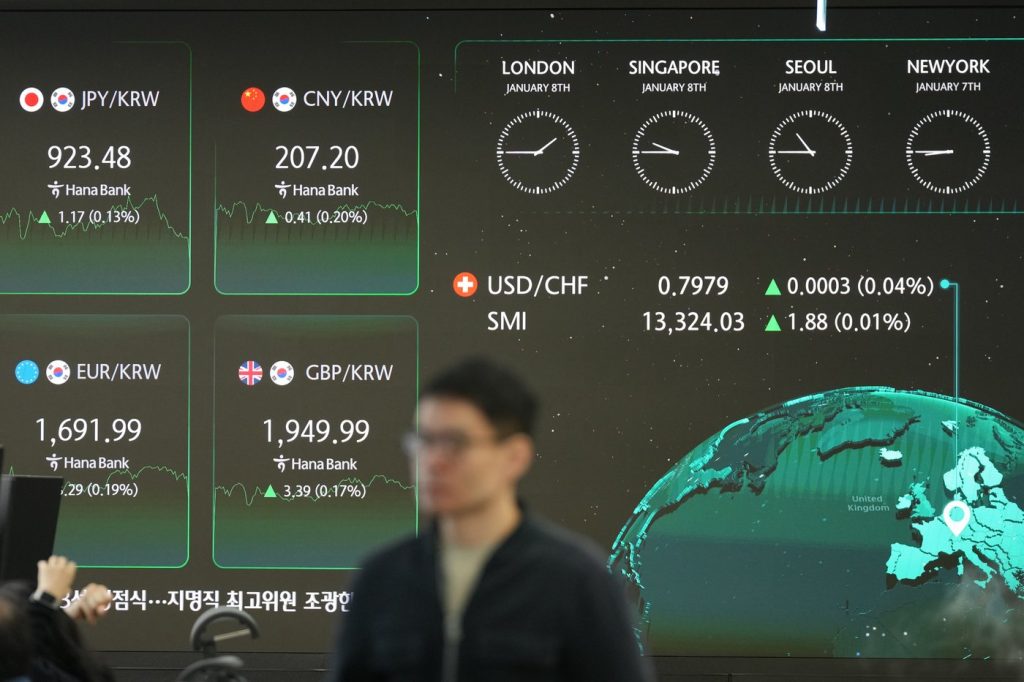
Asian shares experienced an overall upward trend on Friday, following a mixed performance on Wall Street, driven largely by U.S. President Donald Trump’s announcement regarding an increase in defense spending that sparked a rally in military-related stocks.
In Tokyo, the Nikkei 225 index rose by 1.1% to close at 51,692.70. Notably, shares of Fast Retailing, the parent company of the fashion brand Uniqlo, surged over 7% after the company reported a significant quarterly operating profit increase of approximately 34% year-on-year and revised its full-year forecasts upward.
Meanwhile, Hong Kong’s Hang Seng index saw a slight increase of less than 0.1%, landing at 26,158.21. The Shanghai Composite index increased by 0.3% to 4,095.33, driven by official data indicating that China’s inflation rate accelerated in December, marking its fastest increase in nearly three years. This uptick in inflation suggests a boost in demand, which typically leads to higher prices.
Additionally, the Chinese artificial intelligence startup MiniMax made its debut on the Hong Kong Stock Exchange on Friday, with shares skyrocketing by over 50% during early trading. In Australia, the S&P/ASX 200 index fell slightly by less than 0.1%, closing at 8,715.60. Notably, shares of mining company Rio Tinto dropped by 6% after news broke that the company was in preliminary merger discussions with Glencore, a potential deal that could result in the formation of the world's largest mining company.
Meanwhile, South Korea’s Kospi index increased by 0.7% to reach 4,582.95, and Taiwan’s Taiex index recorded a gain of 0.3%. Investors are awaiting the U.S. Labor Department's upcoming job report for December, set to be released on Friday, which may offer a clearer perspective on the job market in the U.S. Furthermore, the Supreme Court is anticipated to deliver a ruling concerning Trump’s comprehensive “Liberation Day” tariffs, which could positively influence market sentiment.
On the previous day, defense contractors saw a rise on Wall Street, buoyed by Trump’s proposal to increase military spending to $1.5 trillion by 2027. Stocks such as L3Harris Technologies appreciated by 5.2%, Lockheed Martin gained 4.3%, and Northrop Grumman increased by 2.4%. Other market movements on Wall Street remained modest, following a slight decline in optimism earlier in the week. The S&P 500 index edge up less than 0.1% to close at 6,921.46, while the Dow Jones Industrial Average saw a gain of nearly 0.6%, ending at 49,266.11. Conversely, the Nasdaq composite dipped by 0.4% to 23,480.02.
Recent U.S. data revealed a slight rise in unemployment benefit filings during the last week of 2025, remaining at historically low levels, consistent with economists’ predictions. Additionally, worker productivity showed improvement in the July to September quarter.
In the early hours of Friday, oil prices rebounded following a volatile week attributed to Trump’s removal of the Venezuelan leader. Benchmark U.S. crude prices climbed by 35 cents, reaching $58.11 per barrel, while Brent crude, the international benchmark, increased by 38 cents to $62.37. However, supply concerns continue to loom as Venezuela holds some of the largest oil reserves globally, with the U.S. actively seeking to exert control over its oil resources. This week, the U.S. seized two additional oil tankers, including one flying a Russian flag, which had reportedly evaded a blockade on sanctioned oil vessels in Venezuelan waters.
In currency markets, the U.S. dollar strengthened against the Japanese yen, rising to 157.27 from 156.80. The euro, however, experienced a slight decline, dipping to $1.1656 from the previous figure of $1.1661.








