

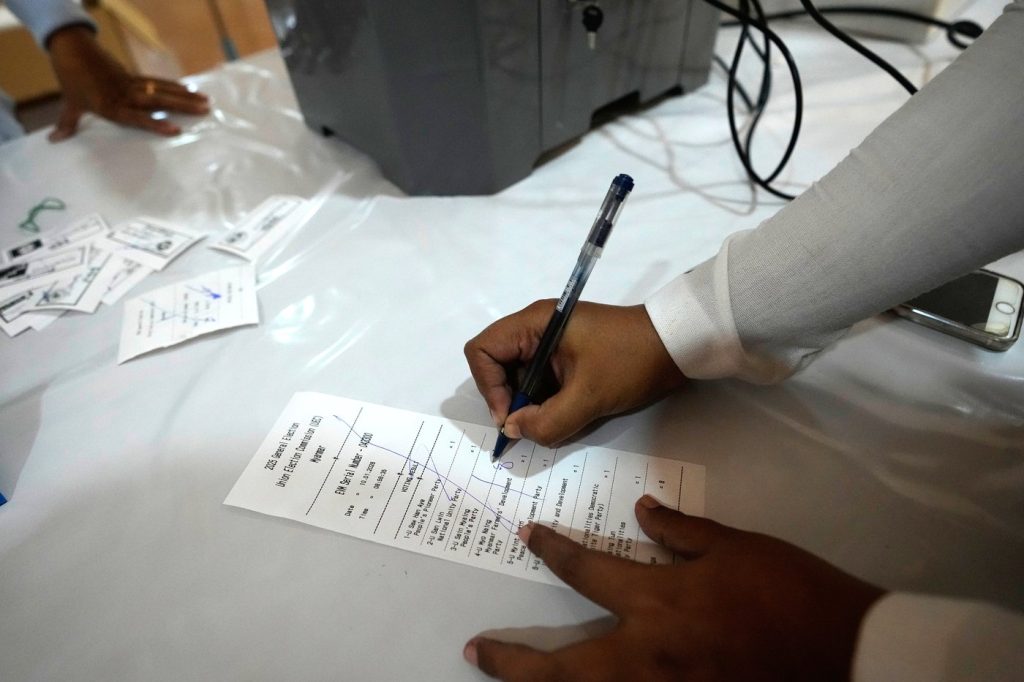
YANGON (AP) — Myanmar has resumed voting on Sunday in the second round of its first general election in five years, broadening polling to additional townships, some of which are impacted by ongoing civil war between the military government and its armed opponents. Polling stations opened at 6 a.m. local time across 100 townships, including areas in Sagaing, Magway, Mandalay, Bago, and Tanintharyi regions, as well as Mon, Shan, Kachin, Kayah, and Kayin states. Many of these areas have experienced recent clashes or remain under heightened security, highlighting the risks associated with the electoral process.
The election is organized in three phases due to ongoing armed conflicts. The first round took place on December 28 in 102 of Myanmar’s total 330 townships, with the second phase occurring on January 10, 2026. A final round is scheduled for January 25, though 65 townships will not participate due to fighting. Myanmar operates with a two-house national legislature comprising 664 seats. The party that secures a combined parliamentary majority has the authority to select the new president, who can then nominate a Cabinet and form a new government. Under the constitution, the military automatically occupies 25% of seats in each house.
Critics argue that the polls, organized by the military government, are neither free nor fair, but instead are a maneuver to legitimize military rule after it seized power from the elected government of Aung San Suu Kyi in February 2021. On the morning of voting, citizens in Yangon, the largest city, and Mandalay, the second-largest, were casting their ballots at various locations including high schools, government buildings, and religious sites.
Over 4,800 candidates from 57 parties are contending for seats in national and regional legislatures; however, only six parties are competing nationwide with a viable chance of gaining political power in parliament. The first phase of voting left the military-backed Union Solidarity and Development Party (USDP) in a dominant position, winning nearly 90% of the contested seats in the Pyithu Hluttaw, the lower house of parliament, and also secured a majority in regional legislatures. The military government reported that over 6 million people, or approximately 52% of the more than 11 million eligible voters, participated in the first phase, which they declared a success.
Aung San Suu Kyi, now 80 years old, and her party are notably absent from the elections. She is currently serving a 27-year prison sentence on charges widely regarded as spurious and politically motivated. Her party, the National League for Democracy (NLD), was dissolved in 2023 after it refused to register under new military regulations. Other political parties either declined to register or chose not to run under conditions they deemed unfair, with opposition groups calling for a voter boycott.
Tom Andrews, a special rapporteur with the U.N. human rights office, referred to the elections as a “sham election,” pointing out that the first round exhibited coercion, violence, and political exclusion. He emphasized that credible elections cannot occur when thousands of political prisoners are incarcerated, significant opposition parties are dissolved, journalists face censorship, and fundamental freedoms are repressed. According to the Assistance Association for Political Prisoners, more than 22,000 individuals are detained for political offenses, and over 7,600 civilians have been killed by security forces since the military takeover in 2021.
The army's takeover led to widespread peaceful protests that escalated into armed resistance, thereby plunging the country into a state of civil war. A new Election Protection Law mandates severe penalties and restrictions on nearly all public critiques of the electoral process, leading to the arrest of more than 330 individuals under this law for activities such as distributing leaflets or online engagement regarding the elections in recent months.
On the morning of the second round of polling, there were no immediate reports of serious disruptions, despite opposition organizations and armed resistance groups vowing to obstruct the election process. However, during the first phase of voting, the military government documented attacks in 11 of the 102 townships that participated in the polls.








