

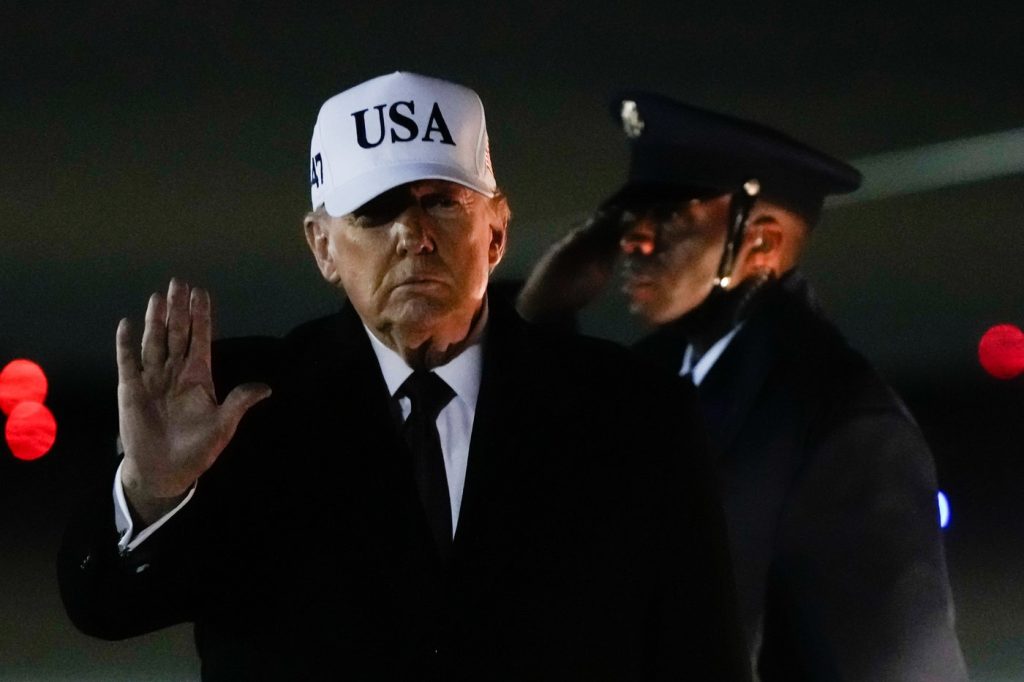
WASHINGTON (AP) – President Donald Trump finds himself at a critical juncture as he deliberates over the possibility of a U.S. military response to the Iranian government's violent crackdown on ongoing protests. This crackdown has resulted in over 600 fatalities and the arrest of thousands across the nation. Trump has consistently warned Tehran of military repercussions if his administration determines that the Islamic Republic employs deadly force against dissenters, claiming Iran is "starting to cross" that red line.
Despite Trump’s assertive rhetoric that the U.S. military is "locked and loaded," it appears that current military actions have been placed on standby as Trump reflects on his next steps, particularly following indications that Iranian officials are seeking dialogue with the White House. White House Press Secretary Karoline Leavitt noted the disparity between the public announcements from the Iranian regime and the private communications the administration is receiving, suggesting that Trump is interested in exploring those private messages. However, Leavitt also emphasized the president's readiness to use military options when deemed necessary.
In a recent development, Trump announced via social media that he would impose a 25% tariff on countries conducting business with Tehran, marking his first punitive action against Iran in response to the protests. Notable countries affected include China, the United Arab Emirates, Turkey, Brazil, and Russia. The White House has not provided additional details regarding this tariff strategy.
The administration's internal deliberations continue, with Vice President JD Vance, Secretary of State Marco Rubio, and senior National Security Council officials convening to develop a range of strategies for Trump to consider—spanning from diplomatic measures to military strikes. Trump has indicated that a "meeting is being set up" with Iranian officials but has simultaneously acknowledged the need for a prompt response due to the rapidly evolving situation.
Analysts are casting doubt on the sustainability of the protests within Iran. With an internet blackout implemented by Tehran, it has become challenging for demonstrators to gauge the full scale of their movement, which has been characterized as disorganized and leaderless. Vali Nasr, a former State Department adviser, noted that such conditions often hinder the effectiveness and longevity of protests.
Compounding the complexity of the situation, Trump is grappling with multiple foreign policy crises globally, including a recent military operation to capture Venezuela’s Nicolás Maduro. Simultaneously, he is attempting to facilitate peace negotiations between Israel and Hamas, as well as broker an agreement to resolve the ongoing conflict between Russia and Ukraine.
Supporters of Trump's administration are urging decisive action against the Iranian regime, viewing this as a strategic moment to undermine the government that has held power since the Islamic Revolution of 1979. The current protests, perceived as a significant challenge to Supreme Leader Ayatollah Ali Khamenei's authority, have arisen in the wake of Iran's economic turmoil, particularly the collapse of its national currency.
The Iranian government, through its parliamentary speaker, has voiced warnings that any U.S. military intervention would make American and Israeli targets "legitimate." Hawkish figures in Washington, including Senator Lindsey Graham and former House Speaker Newt Gingrich, have emphasized the necessity for Trump to act decisively, asserting that failure to do so would parallel former President Barack Obama's inaction regarding Syria's civil unrest in 2012.
Trump's national security team is actively reviewing military options, signaling potential for future engagement. Behnam Ben Taleblu, a senior figure at a Washington think tank, articulated concerns that continued inaction may undermine the credibility of the U.S. stance against the Iranian regime. He highlighted the significance of adopting a flexible yet assertive foreign policy that does not inadvertently support a regime facing domestic upheaval.








