

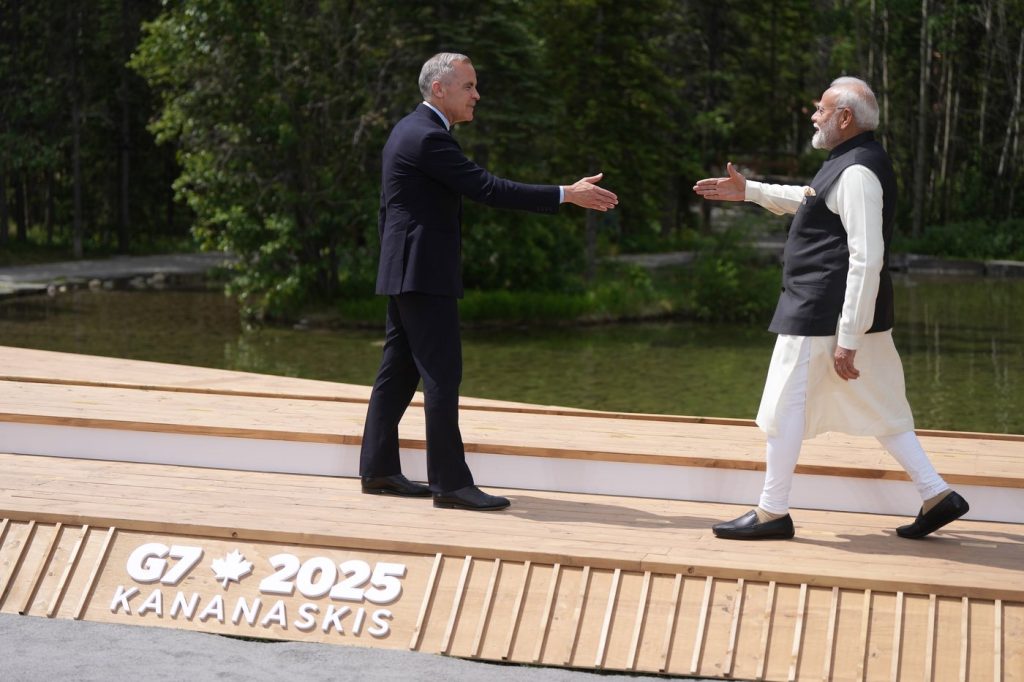
MUMBAI — Prime Minister Mark Carney arrived in India on Friday as part of his government's ongoing efforts to mend a strained diplomatic relationship with Prime Minister Narendra Modi's administration. Both leaders aim to reduce their countries' reliance on trade with the United States under President Donald Trump.
Vina Nadjibulla, vice-president of the Asia Pacific Foundation, remarked, “Both for India and for Canada, the big picture is one of diversification and reducing overreliance on the U.S.” She added that there appears to be a “Trump accelerator” prompting both nations to expedite their partnership and deal-making efforts.
Since his ascension to the prime ministership, Carney has been actively pursuing relations with other nations. His recent address at the World Economic Forum in Switzerland garnered global attention as he advocated for middle powers to unite against coercion from larger countries. Meanwhile, Modi has secured one of the largest trade agreements in history—a pact with the European Union that encompasses approximately two billion individuals.
According to Sushant Singh, a lecturer at Yale University, both Prime Ministers Carney and Modi are motivated by similar logic in their respective initiatives. Carney's two-day visit to Mumbai will be followed by a trip to New Delhi on March 1, where he will meet Modi to discuss plans for rejuvenating their diplomatic ties, which have been fractured in recent years.
Tensions between the two countries have persisted for decades, particularly concerning the activities of Sikh separatists in Canada advocating for an independent Khalistan out of India's Punjab region. India has accused Canada of insufficient action to quell this separatist movement. Canada, in defense, emphasizes the importance of free expression while denouncing violence.
The relationship took a turn for the worse in September 2023, when Trudeau publicly announced that Canadian security agencies were investigating “credible allegations” of Indian government agents' involvement in the murder of Hardeep Singh Nijjar, a Khalistani advocate. This incident led to a diplomatic fallout, culminating in Canada expelling Indian diplomats following India's demand for the withdrawal of Canadian personnel.
As of October 2024, the Royal Canadian Mounted Police (RCMP) accused India of being linked to a network involved in violence that has resulted in domestic homicides and extortion. Following this, Ottawa expelled India's high commissioner along with five diplomats. In retaliation, India expelled Canadian diplomats as well.
However, in June 2025, Carney’s invitation to Modi for the G7 summit in Alberta helped ease these tensions. The two leaders agreed to reappoint high commissioners and subsequently met during the G20 summit in November to initiate formal trade negotiations covering a range of sectors, including agriculture, digital trade, and sustainable development.
Canadian Sikhs are demanding a firmer stance from the government on Indian policies. Activist Moninder Singh has expressed concern over threats to his life, attributing them to potential links with the Indian government. While a government official downplayed the risk of continued Indian governmental interference in Canada, Public Safety Minister Gary Anandasangaree acknowledged ongoing security concerns that continue to be a focal point in discussions with India.
Nadjibulla highlighted ongoing diplomatic efforts, citing meetings held between the foreign ministers of both nations, which have led to the establishment of a cooperative framework aimed at rebuilding their relationship. India’s High Commissioner to Canada, Dinesh Patnaik, emphasized the solid groundwork already laid through various exchanges among politicians and diplomats of both countries.
Although there are expectations for announcements regarding energy cooperation during Carney's visit, Sushant suggested that detailed agreements might be postponed for future discussions. He also raised the possibility that while Trump’s administration has been a unifying factor for Canada and India, this alignment could falter once Trump’s term concludes.
Ultimately, Nadjibulla stressed that Canada needs to catch up, as India has formed strategic economic partnerships with other G7 nations during the diplomatic crisis over recent years. She proposed a vision for a long-term partnership spanning decades, while Sushant warned against a relationship heavily reliant on external factors or individual leaders.








